

Related

Portfolio Strategies
Key considerations for planning a period of part-time work before full retirement.
by Charles Rotblut | June 2025

Charles Rotblut leads a class in AAII's new Essential Investing Video Course. Go to https://www.aaii.com/ves for more information and to subscribe.
Retirement is not always an abrupt process where employment ends on a certain date. Many people opt for a period of semiretirement instead. The amount and type of employment varies, as does the age at which a person or couple enters a period of part-time employment before retirement.
Regardless of when semiretirement begins and what it looks like, having a plan for preserving and growing wealth during this time can help ensure it progresses smoothly and successfully from a financial standpoint. However, there are unique situations and challenges that must be considered.
In this article, I present a one-page PRISM Wealth-Building Plan designed to help a 58-year-old couple, Jack and Janice, transition from full-time employment into semiretirement at age 60 and maintain this lifestyle for several years before fully retiring (Figure 1). I include suggestions for those who wish to enter semiretirement at an earlier age or wish to continue working past age 70 at fewer than 40 hours per week.
An advantage of the PRISM process is its ability to be customized to your own situation and needs.
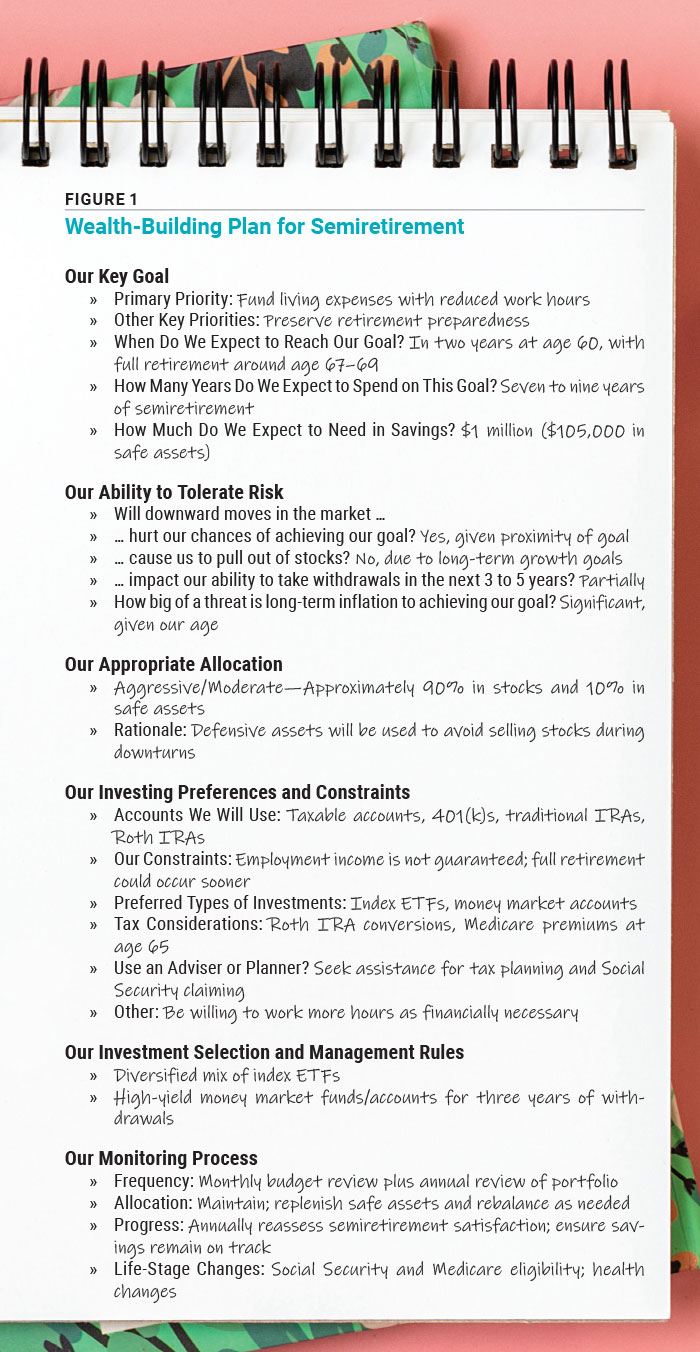
The first step, and the cornerstone, of the PRISM Wealth-Building Process is prioritizing goals. Jack and Janice’s primary goal is transitioning into semiretirement within two years at age 60. (Both are currently 58 years old.) The couple envision working part time for seven to nine years before fully retiring between ages 67 and 69.
To keep things simple, we assume that Jack and Janice will remain in their same careers and continue working for the same employers. This is not the reality for every person. We at AAII encourage those contemplating early retirement to have conversations with their manager in advance. Alternatively, if a change in employer or industry is desired, it is best to arrange for such a change prior to entering semiretirement, if possible. However, an involuntary departure (e.g., due to layoffs) may prevent planning for a smooth transition.
Though Jack and Janice plan on switching to semiretirement in two years, they do not set an exact beginning date for their full retirement. This is because they realize that changes in their health, employment status and even financial situation could alter their timeline. The couple still realize the importance of setting an approximate timeline for becoming fully retired. Doing so helps them better monitor their progress and make key decisions such as when to claim Social Security benefits.
The couple consider two different withdrawal periods for determining how much they will need in savings: semiretirement and retirement. First, they budget the amount they will need to supplement their wages in semiretirement. The couple currently earn $150,000 per year. For the purposes of this example, we assume their income will drop to $75,000 per year in semiretirement. We further assume that the couple will need an additional $35,000 per year from their savings to cover living expenses.
The actual amount needed in semiretirement will vary by person and couple. Outstanding mortgages, lifestyle, locale and medical expenses (including health insurance) are all major factors that will play a role. Those who are abruptly forced into semiretirement may also need to take larger withdrawals from savings.
Jack and Janice recognize that full retirement could last another 20 to 30 years beyond semiretirement. They include this cost when estimating how much they will need in savings. This is an important consideration since they will be taking withdrawals in semiretirement. Even if they weren’t, the reduced level of income from semiretirement could mean that they will not make additional contributions to their retirement savings. Plus, the wages used to calculate Social Security will be reduced. (This is a consideration for those who wish to begin semiretirement prior to having 35 years of indexed monthly earnings for determining benefits.)
After analyzing their anticipated expenses and projected part-time income, Jack and Janice estimate needing approximately $1 million in savings as they begin semiretirement. This includes $895,000 for long-term growth and $105,000 in safe assets (e.g., money market funds). The couple will withdraw from the stock portion of their portfolio during years when the stock market is up and withdraw from the safe assets portion when the market is down, as measured by the S&P 500 index.
Semiretirement introduces a complex risk profile that differs from both preretirement and full retirement. While Jack and Janice will still have income from part-time work, their portfolio will be larger than ever before, and they’ll begin making partial withdrawals. The couple will need to balance their short-term needs against the withdrawal needs of their eventual full retirement.
Sequence risk—the chance of an ill-timed downward drop in the financial markets—is significant whenever withdrawals are scheduled to start. The couple acknowledge this and are willing to push back their planned date to start semiretirement. Jack and Janice also need to be conscious of not selling equity investments from their portfolio when the stock market is down, given their long-term financial needs.
Sequence risk can also trigger a fear response and lead to pulling out of stocks. So far, Jack and Janice have shown a resilience to downward market moves. Semiretirement will provide non-portfolio income that cushions the blow of a market downturn. In addition, any ability to tighten their budget will help them not to panic during a downturn.
A “mega-meltdown” bear market could still impact the couple’s ability to take withdrawals. Such bear markets are characterized as a drop of greater than 40%. These drops are not frequent but do accompany periods of economic strain. This could lead to challenges with staying employed part time or returning to full-time employment depending on the industry the couple works in.
While the prior three risks are shorter-term threats, inflation is a large long-term threat. The potential diminishment in the ability to buy goods and services requires a continued allocation to growth assets. The earlier a person or couple enters semiretirement, the more important it is to take this risk into account. A person who goes into semiretirement at age 50 could well be looking at four or more decades of inflationary pressures. Seeking a return in excess of inflation is a must.
Jack and Janice realize the importance of continuing to seek long-term growth given their current ages of 58. They also realize that they have the flexibility with semiretirement to return to full-time employment or at least seek to boost their working hours, if necessary. Thus, they opt for AAII’s aggressive allocation model. This calls for 90% of the portfolio to be invested in a diversified set of stocks and 10% to be invested in safe assets.
The couple tweak the allocation based on their personal needs—something we encourage. Jack and Janice allocate $895,000 to stock index funds and $105,000 to safe assets (e.g., a money market fund). The money market fund serves as a buffer asset they can withdraw from during years when the stock market is down, as AAII founder James Cloonan suggested in his book “Investing at Level3” (AAII, 2016). The $105,000 amount equates to three annual withdrawals of $35,000.
Unlike a fully retired couple who might need four or more years of expenses in buffer assets, Jack and Janice’s continued employment income means they could maintain a smaller buffer while still being protected against sequence risk.
Those whose spending needs are covered by non-portfolio sources of income—such as a pension, rental properties and Social Security benefits (if starting semiretirement at or after age 62)—could allocate a full 100% of their portfolio to equities. The same would apply if one’s employment income is sufficient to cover living expenses. A full, or nearly full, allocation to equities does require the psychological ability to not react to any market downturns.
A larger cash allocation may be required for someone who is involuntarily forced into semiretirement. The amount would be dictated by their emergency savings and what is needed to cover living expenses.
Like many investors, Jack and Janice have savings in various types of accounts: 401(k)s, traditional individual retirement accounts (IRAs), Roth IRAs and taxable savings accounts. Given changes mandated in the Setting Every Community Up for Retirement Enhancement (SECURE) 2.0 Act, they could also be eligible to contribute to a 401(k) after two years if they switched to a new employer when starting part-time work.
Consolidating some of their accounts—including rolling over their 401(k) plan accounts to an IRA—will simplify the process of tracking future required minimum distributions (RMDs). The couple will need to weigh this against losing some of the benefits provided by the Employee Retirement Income Security Act of 1974 (ERISA) on their 401(k) accounts. Prior to going into semiretirement, both will speak with their respective human resources directors about their options.
By retiring at age 60, Jack and Janice will have a window to complete Roth IRA conversions while their income is lower. The window is short since Medicare premiums are based on income from two years prior. The couple plan to seek professional tax advice about what the optimal strategy for them may be.
Those who opt to enter semiretirement at an earlier age have a longer window to conduct Roth IRA conversions while at lower marginal tax rates. Tax rates in retirement should also be considered since they could be the same or lower once a person is fully retired. The couple plan to meet with a financial planner to discuss strategies to optimally take withdrawals from their taxable, tax-deferred [e.g., 401(k) plan] and Roth accounts. (Withdrawals from retirement accounts can be taken on a penalty-free basis once a person reaches age 59½.)
Jack and Janice also intend to use a financial planner to review their Social Security claiming options. Jack has been the higher earner and is interested in maximizing the survivor benefit for Janice should he die first. This isn’t a necessary step, but an independent opinion can ensure they are making the right decision.
The couple have long preferred investing in mutual funds and exchange-traded funds (ETFs) tracking major indexes. If they had been buying and selling individual stocks, they would continue to do so in semiretirement. Jack and Janice already use a high-yielding money market fund for their cash savings and intend to continue with this.
Health insurance is an issue. When beginning semiretirement at age 60, the couple will be five years away from Medicare eligibility. They will need to factor in the cost of coverage as part of their budget. (Access to health insurance is a consideration for anyone who plans to stop working full time prior to qualifying for Medicare.)
Jack and Janice set a reminder to sign up for Medicare three months before reaching age 65. (The window for enrollment is three months before to three months after turning age 65.) They intend to seek guidance in determining the type of Medicare plan to get.
The couple also note their willingness to work more hours if needed. Keeping skills current is one advantage of being semiretired. It makes the transition back to full-time work easier, if desired or needed.
Nothing needs to change with the couple’s investment rules when semiretirement first starts. Jack and Janice will continue to use a diversified mix of low-cost mutual funds and ETFs that track major, well-known indexes. Some investors may, however, prefer allocating more toward income-producing investments, including dividend stocks. Such decisions are a matter of preference.
The couple will check their ETFs once per year to ensure the objectives have not changed and the fees remain low relative to similar funds. They will also compare the yield on their money market fund against similar funds once per year to ensure it remains competitive. The couple are open to switching to a different money market fund if the difference in yields is large enough to justify it.
Jack and Janice could consider adding a dividend fund to their portfolio for the purpose of generating portfolio income. Such a fund would replace part of their large-cap allocation and potentially part of their mid-cap allocation since most dividend payers are larger companies. It could conceivably go into their traditional IRAs or 401(k) accounts if withdrawals are planned from these accounts to reduce future RMDs.
Investors who previously owned individual stocks should continue doing so, especially if they enter semiretirement while in good cognitive health. Semiretirement also provides more time for those who wish to invest in individual stocks. In both cases, the rules for buying and selling should be included in the PRISM Wealth-Building Plan.
Budgeting takes on added importance early in the semiretirement process, as the couple need to ensure their spending matches expectations. Jack and Janice want to avoid taking too much in withdrawals early on given their age. They will review how their spending compares to their budget on a monthly basis to get more frequent feedback.
Semiretirement has the upside of giving the couple a chance to test their spending plans and withdrawal strategy. If their budget proves to be too conservative, Jack and Janice could consider loosening their budget or, alternatively, moving up their planned retirement dates. If they have difficulties staying within the budget, they can determine where expenses will need to be cut back and/or whether they need to work more hours.
The use of index mutual funds and ETFs allows the couple to limit portfolio reviews to just once per year. (Holding individual stocks would require more frequent monitoring.) Jack and Janice will rebalance their portfolio periodically if the allocations move more than 5% away from their targeted ranges.
Following the guidance given in “Investing at Level3,” the couple will check the level of the S&P 500 at the end of each year to determine the source of portfolio withdrawals. They plan to withdraw from their equity funds only when the S&P 500 is at or within 5% of a record high. Otherwise, they will withdraw from their money market funds.
Jack and Janice will also arrange monthly distributions of their planned withdrawals from their accounts. This will provide them with an ongoing “paycheck.”
For their annual portfolio review, the couple will consider a few things. If the S&P 500 is near its high and no withdrawals have been taken from the safe assets, they will do nothing. If the S&P 500 is more than 5% below its high, they will take withdrawals from the safe assets. Once the stock market has rebounded, they will replenish their safe assets. The couple will review the amount allocated to each type of stock index fund to ensure the allocations within their equity bucket are reasonably close to target. If they aren’t, the couple will rebalance.
Jack and Janice’s tax situation will also be reviewed annually if they are strategically taking withdrawals from pretax retirement accounts to reduce future RMDs. They want to be sure they are not unintentionally putting themselves into a higher tax bracket.
The annual review also serves as an opportunity to assess their satisfaction with semiretirement. Each year, Jack and Janice will discuss their satisfaction with working as well as their increased leisure time. Semiretirement gives people the option to try out new activities before being fully retired. Having a plan for how you will stay active once in retirement is crucial to both happiness and health.
Jack and Janice mark their calendars to sign up for Medicare three months before each turns 65. They intend to delay claiming Social Security benefits for as long as possible unless told to consider a staggered claiming strategy. Though full retirement is not intended until age 70, the couple will reevaluate this goal annually given their lifestyle satisfaction, finances and health.
There are no set rules regarding what semiretirement should look like. It will vary depending on each person or couple’s financial situation, health and interests. The PRISM plan presented here provides an example of what a wealth-building plan for semiretirement might look like. It also raises key considerations for those contemplating semiretirement.
The PRISM Wealth-Building Process is designed to be customizable. The one-page plan can be adjusted to your own personal circumstances and updated as needed.
However you choose to approach semiretirement, have a plan for how you will finance it and eventually transition into retirement. It is better to establish these plans while you are still working whenever possible.
Portfolio Strategies

Portfolio Strategies


BARRY J from TX posted over 1 year ago:
You need to log in as a registered AAII user before commenting.
Log InCreate an account