


Related

Stock Strategies
A few stocks grading highly on the criteria used in each of our eight model stock portfolios present a diversified sample.
by Charles Rotblut | June 2025

Charles Rotblut leads a class in AAII's new Essential Investing Video Course. Go to https://www.aaii.com/ves for more information and to subscribe.
In a market climate shaped by macroeconomic uncertainty and the increasing dominance of passive investing, individual investors are seeking a disciplined edge. The Platinum 30 offers a curated path to build a diversified and resilient factor-driven portfolio by combining the best ideas from AAII’s eight distinctive strategies.
The Platinum 30 is not a model portfolio for tracking performance. Rather, it serves as a dynamic research short list—highlighting stocks that currently meet the most compelling criteria within each of AAII’s distinct strategies.
Each of the eight AAII model portfolios is derived from seminal academic research and approaches followed by some of Wall Street’s most successful investors. Combined, AAII’s Model Shadow Stock, Dividend Investing (DI), Growth Investing, VMQ Stocks and Stock Superstars Report (SSR) model portfolios offer more than 100 stocks selected and vetted using AAII’s long-standing commitment to evidence-based investing.
AAII Platinum also includes AAII’s A+ Investor research and tracking platform and AAII’s Retirement Investing newsletter. A+ Investor features the A+ Stock Grades, a stock-grading research tool that allows you to use a systematic approach to evaluating stocks based on five investment factors: value, growth, momentum, earnings estimate revisions and quality. These grades mirror five of the most compelling factors used to differentiate companies and can help you build portfolios that match your investing style. The Retirement Investing newsletter, launched in 2023, provides strategic guidance on getting to and thriving in retirement.
The Platinum 30 is a collection of stocks selected from each model portfolio, and further filtered by AAII’s A+ Stock Grades, that encapsulate the respective portfolio strategies. The characteristics of each stock differ based on the criteria of each portfolio, thereby providing diversification benefits.
Created by AAII founder James Cloonan and launched in 1993, the Model Shadow Stock Portfolio is one of the longest-running factor-based stock portfolios. It is based on the groundbreaking finding by Nobel laureate Eugene Fama and Dartmouth College professor Kenneth French that the smallest and cheapest stocks offer the highest risk-adjusted return potential.
Rather than just targeting stocks with small market capitalizations or low price-to-book-value (P/B) ratios—two strategies that have independently worked well—the strategy seeks stocks possessing both traits.
This is a model portfolio developed for individual investors. Its philosophy holds that:
Cloonan’s challenge in creating the portfolio was constructing a set of practical rules that AAII members could easily follow to take advantage of the approach. The Model Shadow Stock Portfolio approach has been refined over the years to adjust to new research while seeking to minimize the transaction costs of investing in micro-cap stocks that are out of reach from most institutional investors and therefore in the shadows of Wall Street.
All members can follow the Model Shadow Stock Portfolio online and in the AAII Journal. We have also incorporated the research into the AAII Platinum service. The Platinum 30 pulls in three stocks from the portfolio, first identifying those holdings that currently meet the small size, attractive valuation and profitability criteria. Then, only the holdings that exhibit the best combination of value and quality, based on the A+ Stock Grades, are selected.
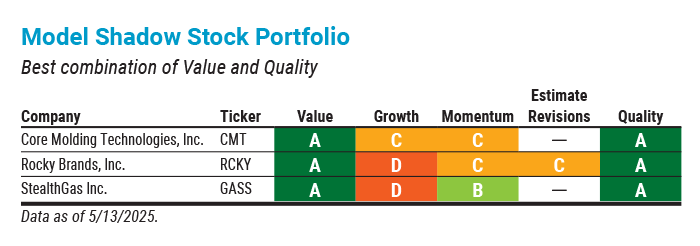
StealthGas Inc.  (GASS) is held in the Model Shadow Stock Portfolio and is currently a part of the Platinum 30. As of May 12, 2025, shares of the liquefied petroleum gas shipping company met the Shadow Stock approach’s qualification rules. It has a market cap of $201.9 million and a price-to-book ratio of 0.31, and it is profitable.
AAII Dividend Investing seeks attractively valued stocks with both a history of raising their dividends and the financial capacity to continue doing so. Put another way, the strategy seeks to buy, collect and grow.
Stocks of companies that either grow or initiate dividends have outperformed over the last 30 years. This is because the dividends not only add to a stock’s total return but also provide a stream of cash that can be reinvested for further growth—a win-win situation.
Stock prices are unpredictable, of course, so there is no guarantee that the total return will be positive for any specific stock held in the portfolio. But the presence of a dividend provides another component of return in an investor’s favor.
Stocks are chosen for the portfolio based on three pillars: dividend valuation, dividend growth and dividend strength. The valuation pillar favors stocks whose current dividend yield is above their five-year average. Such stocks are trading at a discount to what investors have historically been willing to accept for a yield. The growth pillar seeks out stocks with a history of raising their dividend and increasing cash flow. The strength pillar requires a company to have a reasonable payout ratio, manageable debt levels and no dividend cuts.
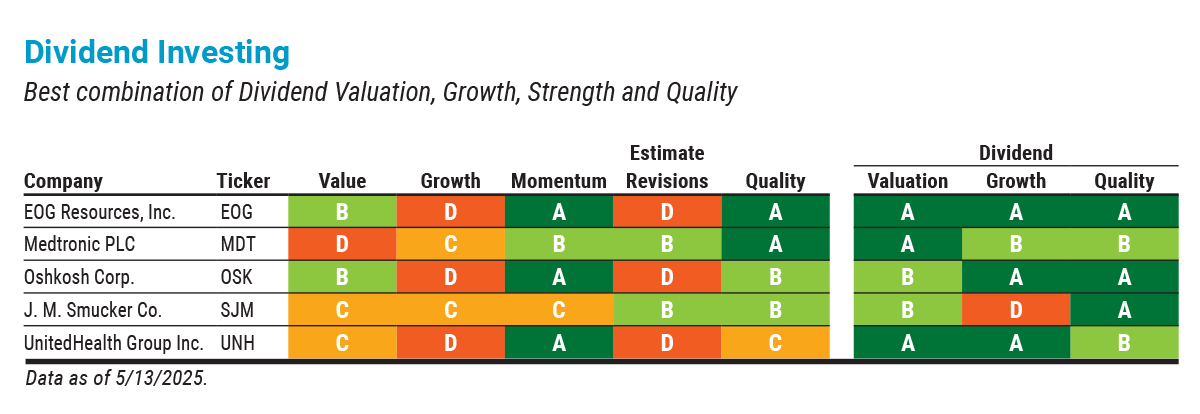
Oshkosh Corp. (OSK) meets these requirements. The stock’s current dividend yield of 2.0% is not only above its five-year average yield of 1.6%, it is also near its five-year average high. (Yields and valuations are inversely related, so a higher yield equates to a cheaper valuation.) The commercial and defense vehicle manufacturer announced a 10.9% increase in its dividend this past January, its 11th consecutive dividend increase. Plus, not only is the company’s debt level reasonable, its 12-month trailing earnings are eight times greater than its interest expense—a very strong level of interest coverage.
Oshkosh was added to the DI model portfolio in March 2025 and continues to meet its rules for addition. It is also one of five stocks representing the DI approach in the Platinum 30 portfolio.
AAII Growth Investing identifies high-quality stocks with sustainable growth potential. It seeks stocks with “sweet spot” growth—growth rates that are neither too high nor too low. The strategy is also unique in that it focuses on secular growth. Secular growth stocks possess attributes that make them likely to continue growing regardless of the economic cycle.
Growth Investing identifies companies with a history of consistent and sustainable sales growth and cash generation as well as fundamental characteristics. Such characteristics have been associated with future growth. Stocks are selected for the Growth Investing portfolio based on their A+ Growth Grade and G-Score.
The A+ Growth Grade evaluates companies based on their year-over-year sales growth, five-year annualized sales growth rate and annual cash from operations. The G-Score, which is based on research from University of Toronto accounting professor Partha Mohanram, uses an eight-point scale to analyze companies. Companies are scored based on their profitability, sales and earnings variability, and accounting conservatism.
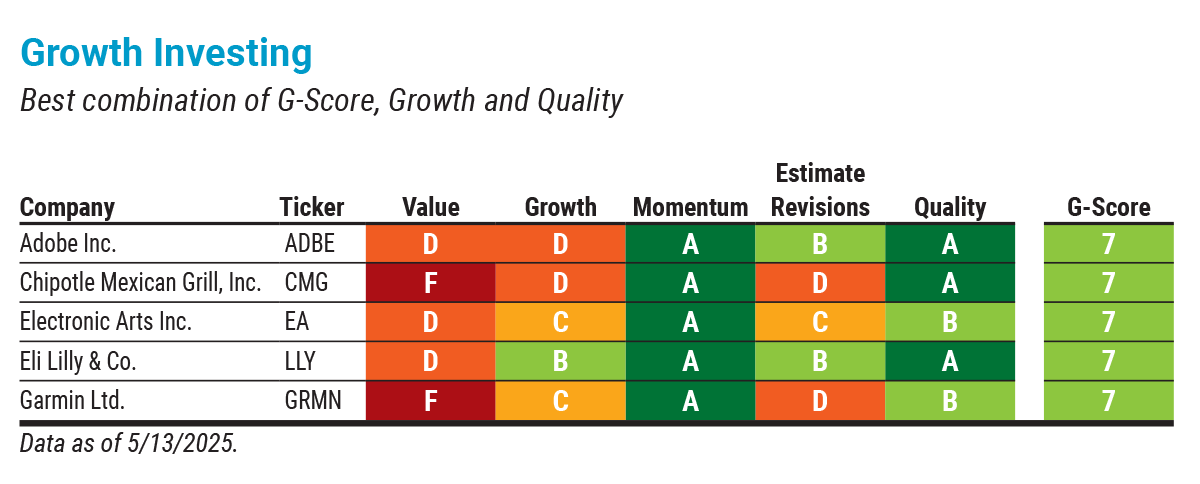
Eli Lilly & Co. (LLY) is currently held in the Growth Investing model portfolio and meets the strategy’s criteria for inclusion. The drug maker has a Growth Grade of B and a G-Score of 7. (The Growth Investing approach uses the A+ Investor Growth Grade, while the G-Score is specific to the strategy.) Eli Lilly has realized annualized five-year sales growth of 15.1%, remains cash flow positive and meets seven of the G-Score’s eight criteria—a threshold most companies do not meet.
Eli Lilly is one of five Growth Investing stocks in the Platinum 30 portfolio.
The Stock Superstars Report (SSR) strategy combines the approaches of four “superstar” investors. Those investors are currently William O’Neil (growth and momentum); David Dreman (large-cap value), James O’Shaughnessy (value- and quality-factor-based stock selection) and John Neff (growth at a reasonable price).
Each of these four gurus have beaten the market over very long time periods. These stellar records have occurred despite shorter-term periods of underperformance. Since each superstar investor hasn’t outperformed or underperformed by the same magnitude at the same time, combining them creates diversification across investing strategies.

Water treatment and specialty ingredients provider Hawkins Inc. (HWKN) is held in the SSR Group 1 O’Neil CAN SLIM model portfolio. The company has increased its earnings for six consecutive years, with strong quarterly growth of 18.7% during the first quarter of 2025. Shares of Hawkins also exhibit very strong relative strength, as evidenced by its 52-week relative strength rank of 88. This rank shows that Hawkins has outperformed most other stocks over the trailing 52 weeks as of mid-May 2025.
Life insurance and financial savings products company Primerica Inc. (PRI) exemplifies SSR Group 2, which follows Dreman’s larger-cap value strategy. The stock trades at a low price-earnings (P/E) ratio of 12.4. Primerica also pays a dividend—as is required by the strategy—and yields 1.5%.
Both stocks are part of the Platinum 30. The A+ Grades reflect the differences in the types of stocks that Group 1 and Group 2 seek. Hawkins has very strong Growth and Momentum Grades, representative of O’Neil’s approach. Primerica has a Value Grade of B, indicative of the value approach favored by Dreman.
Group 2 and Group 3 only had two stocks that qualified to be included in the Platinum 30 based on the grade requirements as of mid-May 2025, bringing the current number of stocks on the list down to 28.
The VMQ strategy is based on two of the strongest indicators of long-term outperformance in investing: value and momentum. Value investing involves buying stocks trading at low valuations. Momentum investing involves buying stocks with above-average price returns. The two characteristics have both been linked to high long-term returns.
The strategy seeks stocks whose valuations rank in the bottom 40% of all exchange-listed stocks (a Value Grade of A or B) and whose weighted four-quarter price returns rank in the top 40% of all stocks (a Momentum Grade of A or B). A separate quality component is included to weed out the riskiest stocks and identify those stocks with additional characteristics associated with upside potential (Quality Grades of A or B).
VMQ uses the same value, momentum and quality grades as A+ Investor does.
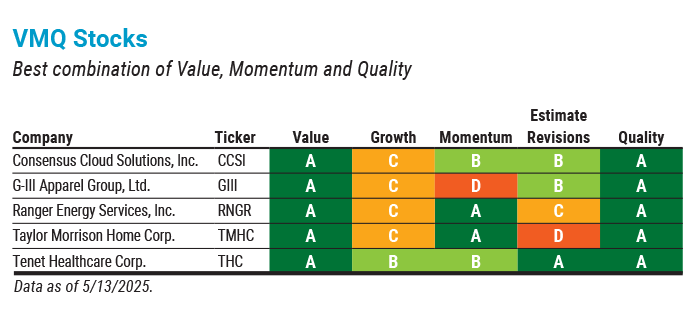
Hospital operator Tenet Healthcare Corp. (THC) is in the VMQ model portfolio and currently meets the strategy’s qualifications for inclusion. The stock’s price-earnings ratio of 10.2 helps give it a Value Grade of A, which is deep value. Its stock has outperformed more than three-quarters of all other stocks on a four-quarter weighted basis, earning it a strong Momentum Grade of B. Tenet Healthcare’s high profitability relative to both assets and invested capital helps it to earn a very strong Quality Grade of A.
Tenet Healthcare is also one of five VMQ holdings included in the Platinum 30 portfolio. All five stocks have Value and Quality Grades of A.
The Platinum 30 is presented to give you a sample of the stocks held in each model portfolio that currently have attractive A+ Investor Grades related to each portfolio’s approach. These are stocks that could be candidates for your own portfolio. The Platinum 30 isn’t a finish line—it’s a launchpad. Use the A+ Investor Grades to explore each stock’s strengths and limitations. Test strategy combinations, track grade movements or simulate your own custom model. With AAII Platinum, these stocks offer a starting point for your next investment breakthrough.
The stocks included in the Platinum 30 can and will change over time as changes in grades occur among the respective portfolio holdings. For more on AAII Platinum, please visit the AAII Platinum website.
Stock Strategies

Portfolio Strategies


JOHN L from NJ posted over 1 year ago:
KISHORE K from WA posted over 1 year ago:
CHARLES R from IL posted over 1 year ago:
BARRY J from TX posted over 1 year ago:
You need to log in as a registered AAII user before commenting.
Log InCreate an account