


-
 Longer life-spans, inflation and personal responsibility are reshaping retirement planning challenges and financial strategies
 - Investors need to understand how evolving strategies and tools influence retirement savings, risks and income security
- AAII’s Retirement Investing is an essential guide on the journey to and through retirement
The modern retirement experience is shaped by different opportunities and risks than prior generations encountered. Retirement today is changing faster than most people realize, reshaped by economic, social and technological shifts.
This month marks the two-year anniversary of the launch of AAII’s Retirement Investing service. From the start, our goal has been to provide subscribers with up-to-date information and ideas to help navigate the evolving retirement landscape. Saving for retirement has become more complex, as have transitioning to and living in retirement. Retirement Investing is designed to address retirement realities like the following.
The Longevity and Portfolio Marathon
Longer life-spans mean many retirees must now plan for 30 years or more of life after work, a challenge their grandparents rarely faced. In the mid-20th century, the average life expectancy was much shorter. According to historical life expectancy data from the Centers for Disease Control and Prevention (CDC), life expectancy at birth in the U.S. around 1950 was about 68 years, leaving only a few years for retirement. Today, medical advances, better living conditions and healthier lifestyles mean it’s increasingly common for people to spend one-third of their lives in retirement. While this is a positive development, it also creates new health concerns. As people live longer, the likelihood of experiencing dementia or age-related cognitive decline increases significantly.
Women face differentiated challenges in retirement. Men, on average, have shorter life-spans, leaving a widow with less household income. Women are also more likely to live longer on their own, which increases the risk of outliving savings and needing long-term care.
In all cases of longer life-spans, savings must stretch further and portfolios must balance both growth and income over an extended period. Retirees are now confronted with the dual challenge of preserving their nest egg for decades while also ensuring it supports not just basic needs, but the quality of life they envision.
Marriage, Divorce and Remarriage
Marriage ushers in shared financial goals and the opportunity to coordinate retirement savings and investing strategies. First marriage ages are trending higher. According to the U.S. Census Bureau, the median age for a first marriage in 2024 was 30.2 for men and 28.6 for women. This means that each partner comes to the table with an asset base and their own ideas on how to invest.
To say the least, divorce upsets apple carts. Retirement accounts such as 401(k)s, individual retirement accounts (IRAs) and pensions are often split during a divorce settlement. This reduces the total retirement savings and income available to each spouse and can modify long-term investing strategies. Divorce can also change eligibility for Social Security benefits. For example, a former spouse may be entitled to benefits based on the ex-spouse’s work record if the marriage lasted at least 10 years, although remarriage will affect this eligibility. Wills, beneficiary designations and trusts may need to be updated to reflect the divorce and ensure retirement assets are distributed according to current intentions.
Remarriage brings new financial obligations, including supporting children from previous marriages or combining households with different spending habits. Retirement planning must account for these blended responsibilities to ensure both partners’ needs are met. Prenuptial and postnuptial agreements can be used to ease this transition and protect the interests of both partners.
Inflation Is a Constant Retirement Reality
The all-items consumer price index (CPI) increased 2.9% over the 12 months ended in August 2025, up slightly from the 2.7% gain recorded through July. Excluding food and energy, the CPI rose 3.1% over the past year.
Inflation is a consistent economic reality, and with retirement time frames increasing, all of us will likely have to encounter elevated inflationary periods at some point during retirement.
Retirement Savers, It’s Up to You
For most Americans, individual savings now play the largest role in filling the gaps left by Social Security and the decline of traditional pensions. While Social Security provides a base level of income, it typically replaces only a portion of a worker’s preretirement earnings and is often not enough to fully cover living expenses.
At the same time, defined-benefit pensions, once a cornerstone of retirement security, have become increasingly rare in the private sector. Companies offering pensions often require long tenures, something workers may have little control over. Traditional defined-benefit plans typically follow a vesting schedule, where an employee gains ownership of employer-provided benefits only after a set number of years. This means that employees who change jobs, are laid off or shift careers may never qualify for the benefit.
With today’s workforce experiencing more frequent job changes and corporate pension offerings shrinking, far fewer workers can count on a guaranteed income stream from an employer in retirement. This shift has placed greater responsibility on individuals to save and invest through vehicles such as 401(k)s, IRAs and other personal accounts to ensure a financially secure retirement.
More Tools, Increased Access and More Risk
Recent legislation such as the Setting Every Community Up for Retirement Enhancement (SECURE) Act of 2019 and the SECURE 2.0 Act of 2022 have given savers more tools and flexibility. Today’s investors have access to an ever-expanding menu of products to save for retirement, many intended to simplify decision-making and others that introduce complexities.
Products like target-date funds are designed to help investors manage risk. Exchange-traded funds (ETFs) are increasingly used not only to provide broad market exposure but also to fill specific investment needs or niches. Technology and the rise of index products have also made investing cheaper and more accessible.
On August 7, 2025, President Donald Trump issued an executive order titled “Democratizing Access to Alternative Assets for 401(k) Investors” that instructs the U.S. Department of Labor (DOL) and the U.S. Securities and Exchange Commission (SEC) to reduce regulatory and litigation barriers that have historically limited access to alternative assets in workplace retirement plans. Offering these types of assets in employer-sponsored plans could have the unintended consequence of employees investing in expensive, opaque and risky asset classes.
Hot stock markets can lead to overconfidence and complacency, tempting investors to take on excessive risk with their retirement nest eggs. Periods of strong market gains often create a false sense of security, encouraging people to increase equity exposure beyond their comfort zone or neglect diversification. While this can feel rewarding in the short term, it leaves portfolios vulnerable to sharp corrections and can jeopardize long-term financial goals. Recently retired individuals or those nearing retirement who have less time to recover from losses are especially vulnerable.
Retirement Your Way
Layered on top of these changes are shifting expectations that retirement is no longer just about financial security but also about lifestyle, purpose and flexibility.
Today’s retirees increasingly view this stage of life as an opportunity for reinvention—pursuing travel, part-time work, volunteering or new hobbies. Many are also prioritizing wellness, maintaining social connections and finding meaningful ways to stay engaged.
Flexibility has become key, as retirees seek to balance financial needs with the freedom to design a life that reflects their personal values and aspirations.
Retirement Is a Lifelong Journey
AAII’s Retirement Investing understands that retirement is not just a state of being. It is the culmination of years of planning, effort, dedication and discipline. Everyone should stay attentive to their retirement planning, though the focus shifts as you move through the various stages of life.
Retirement planning isn’t defined by any single action or decision; it’s a series of choices, each shaped by your life stage and your individual circumstances. We know that each phase comes with its own unique challenges, joys and pain points. To enable you to easily connect with content that is focused on your most pressing needs, AAII Retirement Investing identifies three retirement life phases.
- Accumulation: Saving for retirement
- Transitioning: Preparing for retirement
- Retired: Living in retirement
Retirement is almost unimaginable at the beginning of the accumulation phase when you start saving and establish disciplined habits. Accumulation encompasses years of working through situations that compete with and test your retirement savings commitment.
A person can be in two phases at one time. This is particularly true with the accumulation and transitioning phases. The final years of the accumulation phase are for doubling down by maxing out your contributions while simultaneously starting to think about Social Security claiming strategies, enrolling in Medicare and minimizing taxes. Those in the transitioning phase or who are in both the accumulation and transitioning phases have weighty topics on their mind such as legacy planning, long-term care, and where and how to spend their retirement years.
Living in retirement has the most complexities that require attention. At this phase, you likely need to take required minimum distributions (RMDs) from tax-deferred accounts and are ensuring that your “retirement paycheck” is sustainable and sufficient. You are enjoying the fruits from sacrifices made in your early years, which necessitate tax planning. You may also be working through hesitation to spend your nest egg.
Your Modern Retirement Toolkit
There is a lot happening in each life phase, and we think of our content and commentary for each phase as a modern retirement toolkit. AAII Retirement Investing is a specialized online service offering weekly insights and a monthly feature. Both come right to your inbox. Each month, our feature article dives into the most pressing retirement and investing topics, providing in-depth analysis and practical insights. When needed, we bring in outside experts to ensure you receive not only well-rounded perspectives but also the most actionable information to apply directly to your financial life.
Our weekly insights keep you informed on the latest trends and developments that affect your retirement. From breaking legislative changes that can alter tax or savings strategies to practical tips on maintaining cognitive health, our goal is to help you stay prepared and confident throughout the year.
Finding Topical Content for Your Life Phases
Retirement Investing subscribers can go directly to the Retirement Investing website and log in with their AAII member credentials. (Retirement Investing is a premium service.)
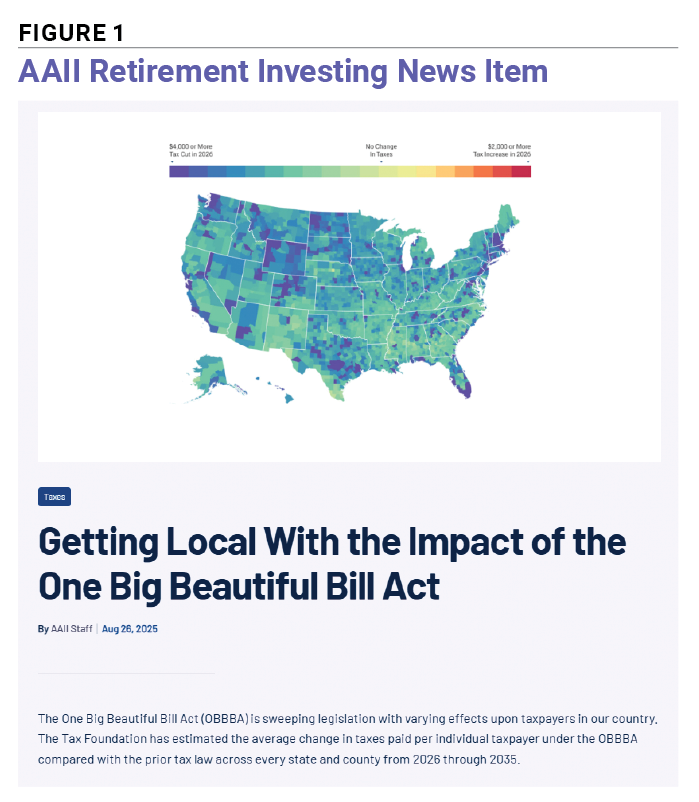
Articles on the Retirement Investing website are organized under the Weekly Insights and Monthly Newsletter tabs. Articles can be accessed by clicking on the tab from the main site navigation bar. Updates to regulations that affect retirees and retirement savers are included in the Weekly Insights email and posted at the News tab (Figure 1). The News section is also used to communicate new Retirement Investing features to subscribers.
The home page highlights recent articles. You can dig into the article archives by clicking on one of the links under Popular Topics or Life Phases on the right side (Figure 2). Popular topics rotate frequently.
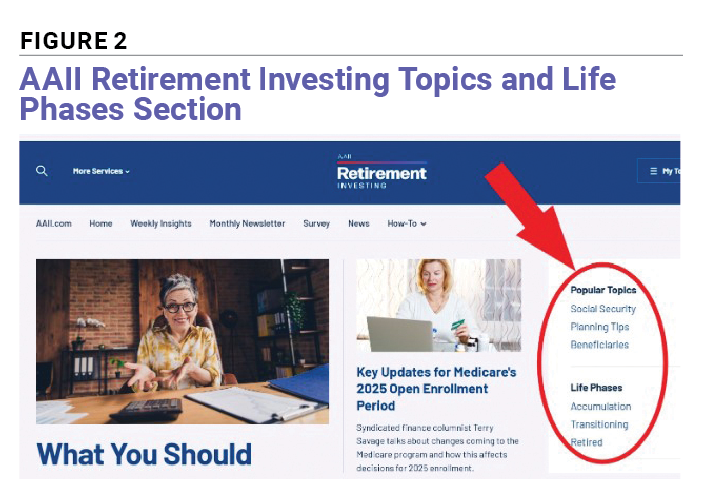
Category labels can also be used to explore topics. We have more than 20 categories ranging from 401(k)s to estate planning. Each article is assigned at least two categories: one that categorizes the content by topic and one that identifies it by the most applicable life phase.
Clicking on a topic category will provide an archive of all content focused on that topic. Similarly, clicking on a life phase will open the archive page showing all content specifically targeted to that life phase. Now that our archives contain two years’ worth of articles, we will be adding filtering capability to the site, where users can select categories from a list to more easily find articles.
What’s Next for Retirement?
Financial advice and information are more accessible than ever thanks to artificial intelligence (AI). Models and recommendations that once demanded significant human hours can now be produced by prompting a sophisticated large language model (LLM) such as OpenAI’s ChatGPT, Google’s Gemini or Anthropic’s Claude. Trained on gigantic datasets, these models process vast amounts of information to generate answers that are supposed to be both coherent and helpful. However, their usefulness comes down to the skill of the user and the detail included in prompts provided to the models.
AI chatbots such as these can be a starting point for generating a retirement plan or an investment policy statement. However, they lack perspective on an individual investor’s situation and are by no means set up to be a fiduciary with a mandate to act in your best interest. Human judgment will always be required when viewing AI output.
Modern retirements are very different from those of our grandparents or even our parents. Today, retirees face both greater flexibility in how they spend their later years and greater uncertainty in how to fund them. AAII Retirement Investing is here to guide you through these evolving challenges and opportunities, helping you prepare for what’s next. Go to AAII Retirement Investing to check it out.

Related

PRISM Wealth-Building Process
A One-Page Wealth-Building Plan for Semiretirement
Related

Portfolio Strategies
Want More Retirement Income? Lower Your Portfolio Fees
Discussion
FREE REPORT

Get your free copy of our special
report analyzing the tech stocks
most likely to outperform the
market.
JOHN L from NJ posted about 1 year ago:
Cynthia M from IL posted about 1 year ago:
JOHN C from MA posted about 1 year ago:
JAMES F from FL posted about 1 year ago:
ROBERT A from NC posted about 1 year ago:
DANIEL B from MN posted about 1 year ago:
JOHN F from FL posted about 1 year ago:
PAUL K from ID posted about 1 year ago:
BARRY J from TX posted about 1 year ago:
JOHN L from NJ posted about 1 year ago:
MIKE C from SC posted about 1 year ago:
You need to log in as a registered AAII user before commenting.
Log InCreate an account