


Paul Merriman leads a class in AAII's new Essential Investing Video Course. Go to https://www.aaii.com/ves for more information and to subscribe.
- Investing success depends on emotional resilience—the ability to stay invested through volatile markets
- Traditional risk metrics miss real risk; portfolios should be evaluated by behavioral challenges
- Choosing a sustainable portfolio mix helps investors endure downturns and achieve long-term financial success
For most investors, the challenge of investing sounds deceptively simple: find the best returns and build a portfolio that delivers them. But after more than 60 years in this business, I’ve learned that returns are not the real challenge. The real challenge is surviving the journey required to earn them.
Investors don’t fail because they chose the wrong asset class or missed the top-performing fund. Investors fail because, at the worst possible moment, they abandon a strategy they can no longer endure.
That moment rarely shows up in average returns. It doesn’t appear on long-term charts, and it’s almost never captured in traditional measures of risk. Yet, it is the moment that determines financial success or failure.
The Problem With How We Measure Risk
For decades, the investing industry has relied on statistics like standard deviation to define risk. While useful, these numbers often miss what matters most to real investors.
Risk isn’t a number. Risk is the moment an investor says, “I can’t take it anymore.” It’s the sleepless nights, the second-guessing and the overwhelming urge to sell. Even well-informed investors make decisions during these moments that permanently damage their long-term results.
Here’s the irony: Portfolios with similar long-term returns can feel completely different to live with. Some demand a level of emotional resilience that few investors actually possess. Others offer a smoother path—one that investors are far more likely to stay on. Understanding that difference is where wisdom begins.
The Pains and Gains of Investing
In my April 2022 AAII Journal article, “The Pains and Gains of Investing,” I introduced a simple but powerful idea: Evaluate portfolios not just by their returns, but by the “pain” required to earn them.
I examined measures such as:
- Number of profitable years
- Average gain during profitable years
- Best single-year gain
- Number of losing years
- Average loss during losing years
- Worst single-year loss
These measures revealed an essential truth: The path to returns matters as much as the returns themselves. Two portfolios may arrive at similar long-term destinations, but the journey they take can be dramatically different—and that journey may determine whether investors actually stay on board.
A Simple Test: Which Portfolio Would You Choose?
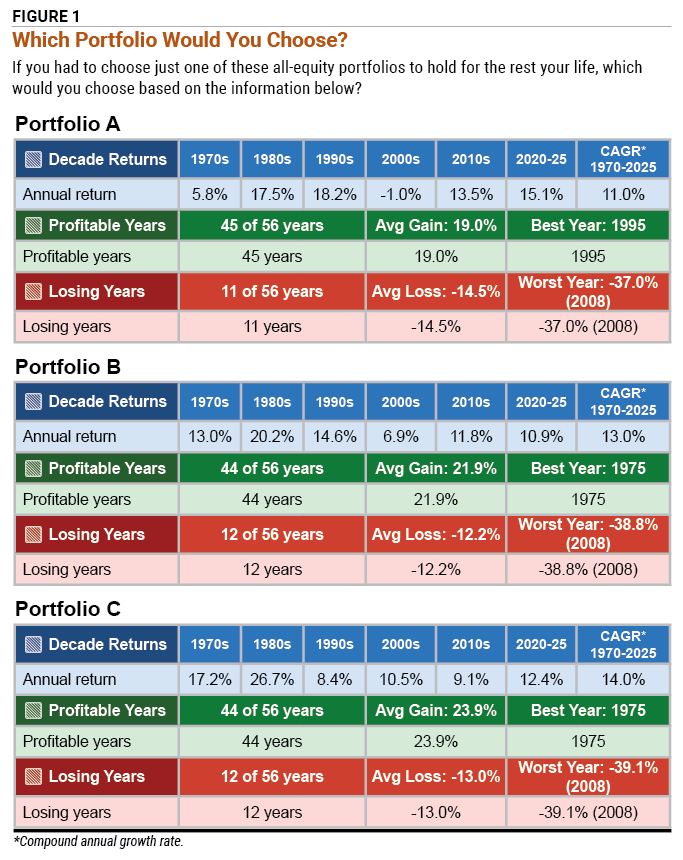
Before we go further, try this exercise. Look at Figure 1, which shows three portfolios. I won’t tell you what they are yet. All you’ll see is their history of returns, profitability and losses. Now, answer this simple question: Which one would you choose for the equity portion of your portfolio—for the rest of your life?
Review Figure 1 and select a portfolio before continuing to read more.
What Most Investors Do
When investors study this kind of information, they tend to fall into one of the following three groups.
- The Return Chasers: They choose the portfolio with the strongest decade returns.
- The Comfort Seekers: They choose the portfolio with the most consistent gains and the fewest losing years.
- The Balancers: They split their money—half in what feels safest, half in what looks most rewarding.
The Reveal
Here’s what the portfolios in Figure 1 actually are.
- Portfolio A: The S&P 500 index
- Portfolio B: A Worldwide All Value portfolio
- Portfolio C: A Worldwide Small-Cap Value portfolio
The Lesson That Changes Everything
Now comes the most important lesson to take away: The best-looking portfolio is not always the best-lived portfolio.
The Worldwide All Value portfolio may deliver higher long-term returns than the S&P 500, but it also demands greater emotional resilience. Value stocks can underperform for years, even a decade, at a time. The S&P 500 may feel safer, but it may not deliver the same long-term outcome. And for many investors, the best answer isn’t choosing between them—it’s combining them in a way they can actually live with.
Why This Exercise Matters
This simple exercise does something most investing advice fails to do: It forces you to face the reality of investing before you commit. It prompts you to ask not just “What return can I earn?” but “What must I endure to earn it?”
Understanding the Building Blocks
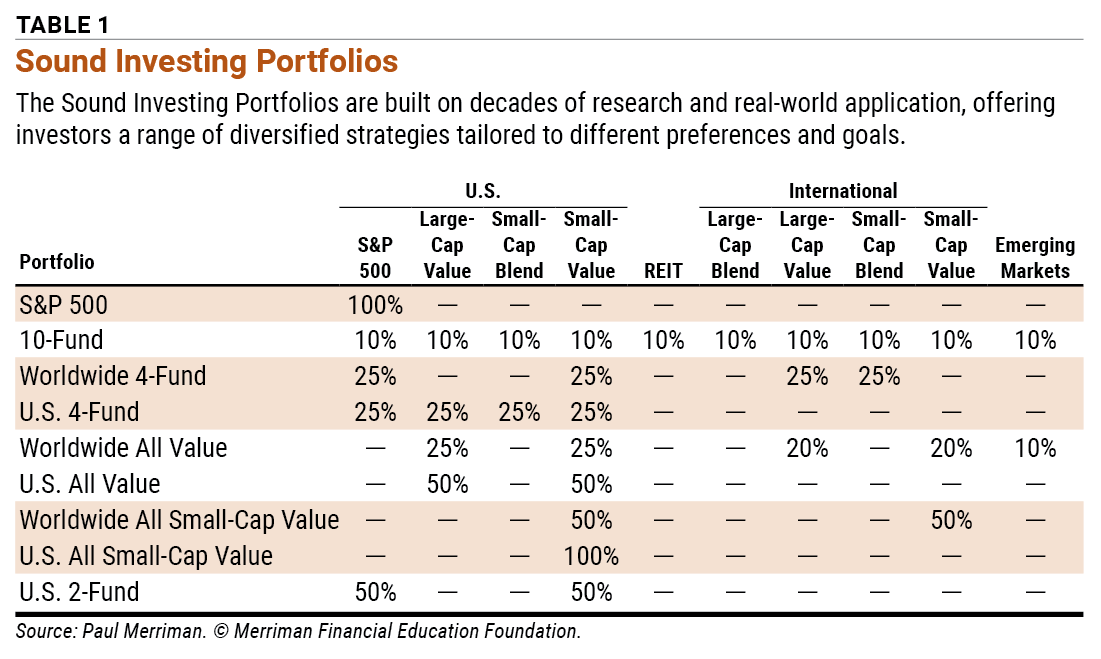
Behind every portfolio are specific equity asset classes, each with its own return profile and risk characteristics. Every portfolio outcome in Figure 1 is the product of the following 10 building blocks.
- U.S. large-cap blend (the S&P 500)
- U.S. large-cap value
- U.S. small-cap blend
- U.S. small-cap value
- U.S. real estate investment trusts (REITs)
- International large-cap blend
- International large-cap value
- International small-cap blend
- International small-cap value
- Emerging markets
Table 1 shows the allocations for the Merriman Financial Education Foundation’s Sound Investing Portfolios.
From Theory to Real Life
Investors don’t experience averages. They experience life—one year at a time.
For investors still in the accumulation phase, the tables we publish at the Merriman Financial Education Foundation website show the impact of contributing regularly through both good and bad markets. Investors can see how dollar-cost averaging works across each of our recommended portfolios and why staying invested, even through downturns, can be the most powerful financial decision they make.
For investors in retirement, the tables show the impact of different withdrawal rates—both fixed withdrawals adjusted for inflation and flexible withdrawals without adjustments. In every scenario, the tables reveal how long money lasts, how early losses affect outcomes and what may be left for children and charities.
The Three Rs of Investing
Three “Rs” determine your success as an investor.
- Returns: The reward for having the discipline to save.
- Risk: The cost of exposing your money to market volatility.
- Resilience: The ability to stay the course.
Most investors understand returns. Some understand risk. Very few prepare for resilience. And yet, resilience is what ultimately determines success.
Investors don’t fail because they lack information. They fail because they weren’t prepared for the experience. They didn’t know how bad it could feel, how long it could last or how difficult it would be to stay invested.
A Better Way Forward
The goal isn’t to find the perfect portfolio. The goal is to find a portfolio you can live with for a lifetime.
Once investors understand the trade-offs, the next step is implementation.
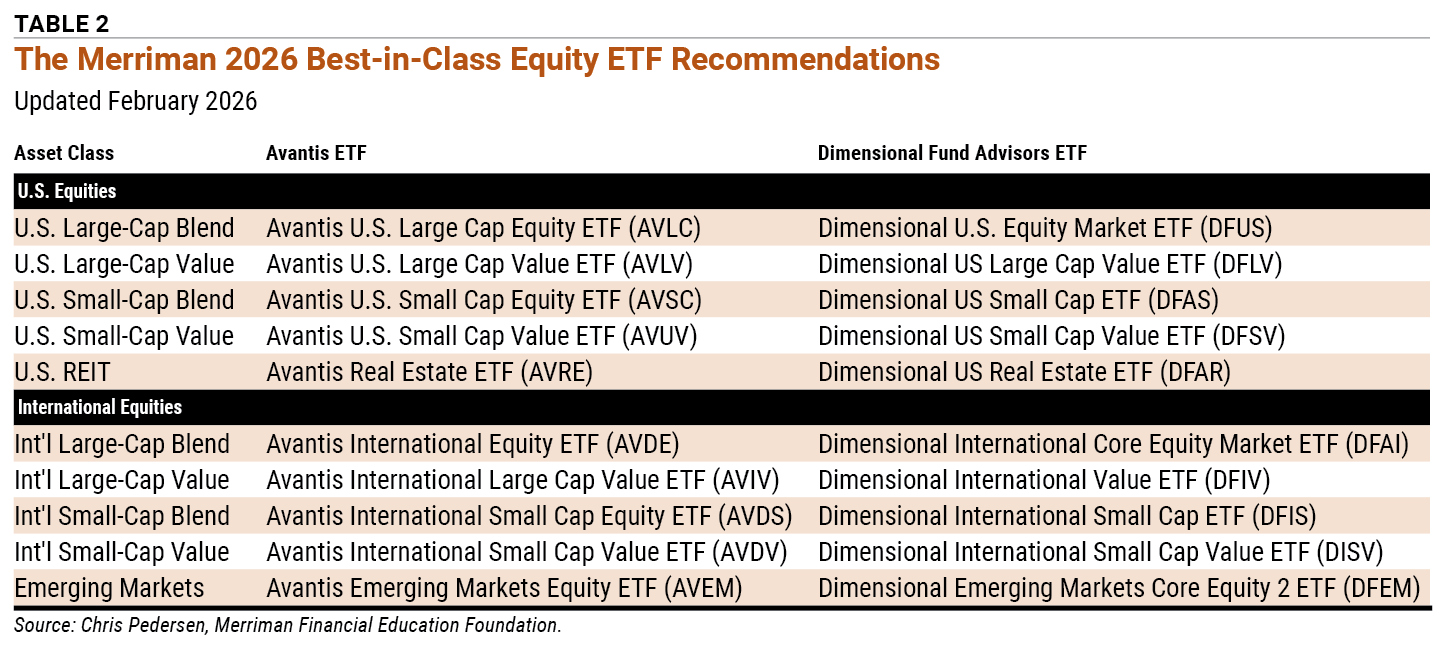
We at the Merriman Financial Education Foundation recommend evidence-based equity portfolios using funds from Dimensional Fund Advisors (DFA) and Avantis Investors. These firms are built on broad diversification, factor-based investing, low costs and decades of academic research. Our best-in-class recommendations are listed in Table 2.
The Myth of “There Is No Alternative”
Investors are often told that they have no choice: React to the coming bear market, go to cash and chase what’s been working.
But there is a clear alternative. It’s called discipline.
Building the Conditions for Success
Success in investing doesn’t come from prediction. It comes from preparation—from understanding history, accepting uncertainty and making wise decisions in advance.
Our mission is to help investors make better decisions that lead to more money in their pockets and less in someone else’s. We’re committed to presenting the evidence clearly, including the good periods and the bad, and helping investors build the emotional resilience to stay the course.
The hopeful outcome? Better returns at similar or lower risk—and the commitment to see it through.
Final Thought
When markets fall and fear rises, you’ll hear it again: “There is no alternative.”
But there is. There’s a better plan, better information and the discipline to follow it.
This isn’t just about investing. It’s about behavior. And for those who prepare—not just intellectually, but emotionally—it has the power to change your financial future.

Related
AAII How-To
Aligning Portfolios With the Risk Index
Related

PRISM Wealth-Building Process
How Much Risk Can You Handle and Still Meet Your Goals?
Discussion
FREE REPORT

BARRY J from TX posted 5 months ago:
ROBERT A from NC posted 5 months ago:
ROBERT A from NC posted 5 months ago:
JOHN L from NJ posted 5 months ago:
Paul M from FL posted 5 months ago:
ROBERT A from NC posted 5 months ago:
Paul M from FL posted 4 months ago:
DAVID S from TN posted 4 months ago:
Paul M from FL posted 4 months ago:
You need to log in as a registered AAII user before commenting.
Log InCreate an account