


- A midyear financial checkup reviews your net worth, cash reserves, goals and household changes
- Review tax-planning strategies, RMD rules, withholding adjustments and taking losses to offset gains
- Check your asset allocation, sector exposure and individual holdings for disciplined rebalancing and stock evaluation decisions
It’s a good idea for you to update your household’s financial plan once per year and do an informal checkup in the middle of the year. A checkup doesn’t need to be as time-consuming and detailed as a formal review. Simply ask yourself the questions presented in this article, decide whether changes are warranted enough to act and make changes as needed. Easy peasy.
Here’s a convenient checklist to tick off to keep your finances on course.
Assess Your Current Finances
How has your financial position evolved over the past six months? Have there been any big changes to your income or financial net worth? If so, you might want to formally update your plan.
Once you have an idea of your net worth and cash flow, make sure you have enough resources to take care of an urgent expense or to capitalize on a sudden opportunity. Financial planners often recommend having a rainy-day fund of cash or cash equivalents equal to six months’ worth or one year’s worth of household expenses. If you don’t have enough cash on hand—and we understand that many do not—are your investments stable enough to cover surprise expenses? If not, make a note of this for your annual review or make changes now.
Consider Any Major Changes in Your Household or Your Financial Goals
Have there been any recent changes in your family’s situation or dynamic? That could lead you to change beneficiary designations, your will and any trust documents. Is a breadwinner in your household getting close to retirement? If so, it’s a good idea to evaluate how much risk is in your portfolio. Though it’s probably wise to wait until an annual review to change your overall asset allocation, you might begin to buy higher-quality stocks, funds or bonds.
How have your family’s financial goals changed in the past six months? Maybe you’re enjoying your job enough to postpone retirement for a few more years. Perhaps your long-held daydream of a vacation home has lost some of its luster. These questions can either lead to formally updating your plan or making a note to investigate these issues in your annual review.
Is one of your children or grandchildren thinking about pursuing a graduate degree? If so, would you like to help financially support them? If you donate to charity, do you still want to support the charities you’re currently giving to? Every household has its own list of priorities. What else might have changed that could affect your financial plan?
If you’ve neglected to write an overall financial plan that sets down your goals and risks, our PRISM Wealth-Building Process can get you started. See the lastest PRISM article in this issue.
Minimize Your Tax Exposure
This is a good time to reassess your tax liabilities and deductions. Do you have paper losses that, if taken, can offset capital gains? Many investors are hesitant to take losses, but locking in a surefire tax offset and replacing it with a similar security with the same risk/reward exposure is often a good idea. Capital losses can offset taxable income (to a degree) and be carried forward to be applied against future years’ gains.
If you are required to take mandatory withdrawals from a retirement account or an inherited individual retirement account (IRA), make sure that you have withdrawn or have a plan to withdraw the appropriate amount; the Internal Revenue Service’s (IRS) penalties for failing to take required minimum distributions (RMDs) can be severe, up to 25%. If you are participating in a work-sponsored retirement plan and aren’t a 5% or more owner of the sponsoring business, you may defer withdrawing from the account until you separate from that employer.
Has your income gone up? If so, is your employer withholding enough from your salary to satisfy your expected tax liability? If not, ask your employer to adjust your withholding amount. The same applies to estimated tax payments, if you are making those. Overpaying might be a conservative approach, but that’s money that could be earning interest or capital gains over the year.
Once you have refreshed your household’s financial picture and goals, it’s time for your midyear portfolio update. It’s best to do this from the top down: Start with asset classes, move down to sector allocations and, from there, assess individual securities.
Check Asset Allocation Against Your Target
The market has been volatile over the past six months. But, then again, the markets have always been volatile to one degree or another. You should already have what planners call an investment policy target allocation that reflects your expectations for assets’ returns over the long term as well as your ability and tolerance for market volatility.
Market moves or any transactions you’ve made may have caused your current allocation to drift away from your target allocation, leaving your portfolio with either more risk than you intended or less potential upside than needed.
Rebalancing your portfolio not only addresses that but also naturally avoids overexposure to a price bubble. For example, if your policy allocation is 60% stocks, 35% bonds and 5% alternative assets but appreciation from a few good picks led your portfolio to be composed of 70% stocks, 20% bonds and 10% alternatives, rebalancing will reduce the impact of the outperforming asset class reversing itself.
A+ Investor and AAII Platinum subscribers can use the Diversification Analyzer at My Portfolio to determine if their portfolio allocations have strayed too far off track.
Compare Your Sector Exposure to Benchmarks
Once you’ve checked your allocation between asset classes, compare your sector exposure to those in your preferred benchmark(s). If the information technology sector makes up 35% of the value of the S&P 500 index and your portfolio has a 75% exposure to technology, it’s unrealistic to expect market-like returns from your portfolio. You might be comfortable with that, or you might not. But it is important to know how aligned your portfolio is with your personal investment policies.
A+ Investor and AAII Platinum subscribers can also use My Portfolio’s Diversification Analyzer to see their sector breakdowns.
Take a Good, Hard Look at Your Individual Holdings
By now, you have identified any gaps between your target allocation and your current portfolio. Now, it’s time to look for sell candidates that can raise money to fill those gaps.
AAII strategies generally prefer to give a loose leash to outperforming stocks, unless they grow to dominate the portfolio’s performance. A common rule used by AAII model portfolios (such as Growth Investing and VMQ Stocks) is to consider trimming positions that are more than 2.5 times the average position size. For a 20-stock portfolio, the maximum size of the position should be 12.5% or less. AAII’s My Portfolio tool makes checking this easy for all members by showing the percentage weight of each investment in your portfolio (Figure 1).
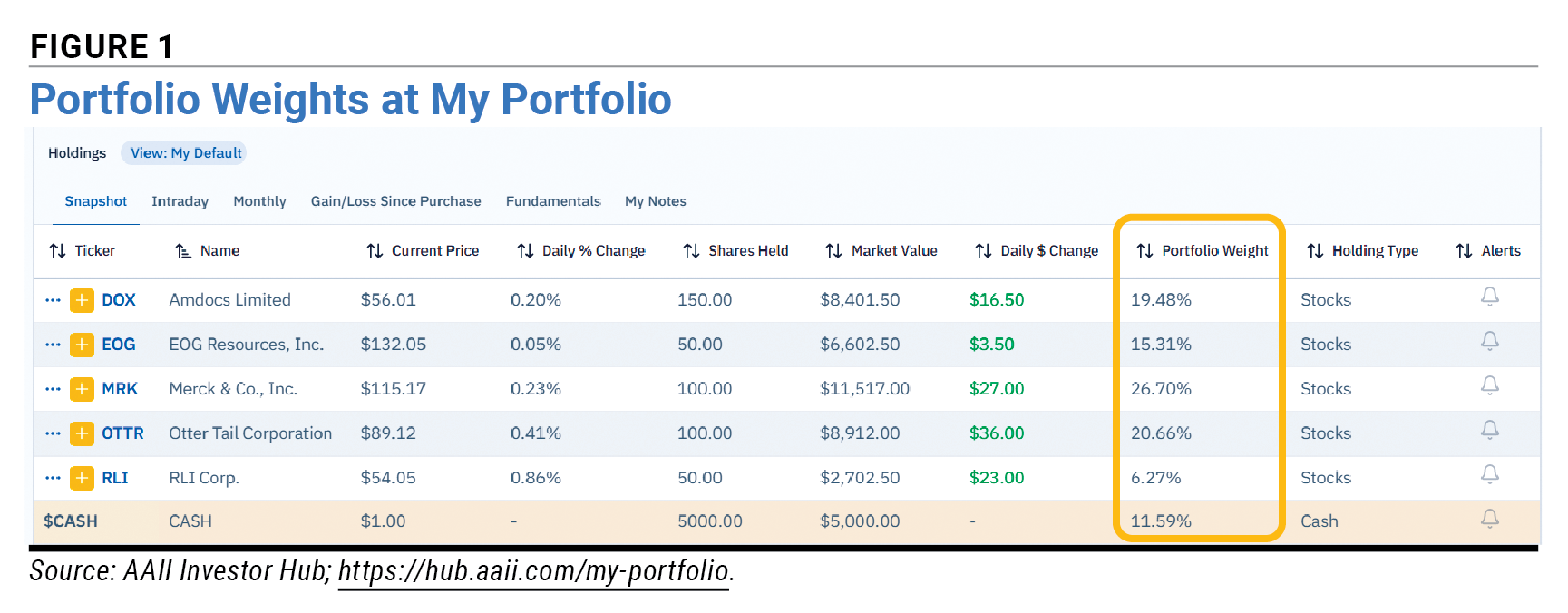
You can also keep tabs on the gain/loss since purchase for your holdings using My Portfolio. Underperformers should get a closer look. If your taxes benefit enough from booking a capital loss and there’s no compelling reason to hold onto the underperformer, sell it. Stocks that are flat or underperforming your target return or a benchmark should be checked against the reasons you bought them. If a stock no longer fits the parameters that led you to hit the buy button and it’s been a disappointment, it’s likely a strong sell candidate.
We humans are naturally inclined to avoid change, so you may find yourself justifying holding onto a stock even if the company has little in common today with the company you originally bought. Adopting and following a rules-based approach helps avoid inertia.
Some stocks will underperform even if they meet all the guidelines. Though individual stocks’ performance is expected to diverge from the overall market’s, waiting years for a stock to catch up to expectations isn’t necessary when a world of fresh opportunities awaits.
Replace Sold Holdings and Enjoy Your Summer
Use that newly freed-up cash from selling to rebalance your portfolio toward your target allocation. If you’re looking for ideas, AAII has an abundance of tools at your disposal, including 55 stock screens, top exchange-traded fund (ETF) and mutual fund lists, and model portfolios. Visit the Investor Hub and the fund guides to dive in.

Related

Portfolio Strategies
Which Protects Your Retirement Better: Rebalancing or Buffer Strategies?
Related

Discussion
FREE REPORT

Get your free copy of our special
report analyzing the tech stocks
most likely to outperform the
market.
JOHN L from NJ posted 3 months ago:
BARRY J from TX posted 3 months ago:
BARRY J from TX posted 3 months ago:
SAM L from USA posted 3 months ago:
JOHN L from NJ posted 3 months ago:
SAM L from USA posted 3 months ago:
ROBERT A from NC posted 3 months ago:
JOHN L from NJ posted 3 months ago:
CRAIG B from WI posted 3 months ago:
BARRY J from TX posted 3 months ago:
BARRY J from TX posted 3 months ago:
SAM L from USA posted 3 months ago:
JOHN L from NJ posted 2 months ago:
SAM L from USA posted 2 months ago:
BARRY J from TX posted 2 months ago:
SAM L from USA posted 2 months ago:
ROBERT A from NC posted 2 months ago:
SAM L from USA posted 2 months ago:
ROBERT A from NC posted 2 months ago:
SAM L from USA posted 2 months ago:
You need to log in as a registered AAII user before commenting.
Log InCreate an account