


Related

AAII + BetterInvesting
How to find a portfolio approach that works best for you and that you can stick with through the ups and downs of the market.

AAII and BetterInvesting held a joint webinar on September 22, 2026, in which BetterInvesting’s Doug Gerlach and AAII’s Sam Levine and John Bajkowski discussed best practices for constructing a well-balanced portfolio. The following is an edited excerpt of their discussion. The full recording is linked at the end of this article.
John Bajkowski (JB): Nowadays, we’ve come to think of portfolio construction in terms of top 10 lists and tips on the “best” ways to invest. Is there really a right or wrong way?
Sam Levine (SL): One challenge that beginning investors often face is that strategies will do well for a certain time before declining. Even an approach that is almost certain to fail over the long term will occasionally look like the right way. At AAII, we focus on general principles and use the best tools available to us. It’s also worth stressing that it takes time to develop a personal strategy. I’d like people to be patient with themselves as they learn how to do it.
Doug Gerlach (DG): There are many portfolio approaches. BetterInvesting’s approach is designed to be implemented by nonprofessional individual investors without spending lots of money or time. That said, it is not a cookie-cutter approach. I love the concept that as you gain more and more investing experience, you can break the rules. After all, it is your money. Experience gives you the license to figure out what works for you and take advantage of opportunities.
DG: Let’s talk about some of the beginning elements of portfolio construction. First and foremost, you need a plan. Buying investments willy-nilly or only acting on tips you hear on the radio or TV is not an investing plan. Discipline and consistency are key to investing. As part of your investing journey, you need to find the approach that works best for you and stick with it through the ups and downs of the market. One way you can do that is by developing an investment policy statement—that is, a written set of guidelines for managing your portfolio and assets.
SL: When you construct your portfolio, start off by picking an approach. This approach will evolve as you read and learn more, but until you have an overwhelming amount of evidence that it is incorrect or requires adjusting, stick with it. Additionally, don’t expect that your chosen approach will work 100% of the time. The goal is simply to have an acceptable return with an acceptable level of risk.
I agree wholeheartedly that you should create an investment policy statement. This statement might include rules about when to buy, when to sell and how much you can hold of a particular security. Once per year, revisit your investment policy statement to make sure it’s still appropriate.
Finally, it’s important to experiment. Allocate a certain percentage of your assets to learning how to invest through trial and error. Once you have an asset allocation in mind, you need to monitor it. AAII’s My Portfolio tool can help you do so.
DG: One of BetterInvesting’s principles is that it’s possible to be a successful investor by remaining fully invested in stocks at all points of the market cycle. This is really a risk-management strategy. Brokers and advisers often move assets around in an attempt to time the market. This approach pretends to be active and tactical, but it is often much riskier because if you mistime those movements in and out of the market, the damage can be much greater than if you simply waited out the market downturns.
We know that bear markets always end; the market does recover, and so trying to guess the market’s direction is most often futile. It’s not riskier to be in the market when the market is underperforming because at the end of the day, your portfolio will recover with the market, and it’ll go on to make new highs.
SL: Even though I’m interested in market motions, I agree that it’s very difficult to time the market well. To add bit of a twist, I’d argue that cash is a useful tool for moderating market movements. Some investors don’t want to take the risk of being down 16% or 20% fairly often over their investing career. By allocating a certain portion of their investing assets to cash and keeping it at that stable amount, they can have a less volatile portfolio.
DG: Diversification is a primary risk-management tool. For an all-equity portfolio, BetterInvesting suggests that investors should diversify their portfolios in two ways: by including stocks of many industries and sectors, and by including stocks of all sizes. Those methods of diversification can help offset the impact of recessions on sensitive sectors. They can also reduce downside risk during bear markets and protect you from downturns in any sector you might be overloaded in.
JB: To clarify, when we refer to being fully diversified, we mean making sure the equity part of your portfolio is diversified across sectors and size ranges. The same is true of bond portfolios. Cash, or other kinds of short-term instruments, acts as a buffer so that should you need to withdraw any money from your portfolio, you’re not forced to sell your assets at inopportune times.
SL: AAII doesn’t have a specific guideline for how much to invest in a particular sector. The AAII model portfolio approaches are guided more by stock characteristics that are likely to perform well, but diversifying among different sectors and different factors that drive stock performance is very important.
JB: One of the benefits of diversification is that it forces you to sell some of your assets when they become an overvalued or a disproportionately large part of your portfolio. Then, you can reinvest some of those proceeds into potentially underweighted or undervalued components.
DG: BetterInvesting does have some basic diversification guidelines. Sector and industry diversification helps in two ways. First, it helps you balance out problems. If the information technology sector goes into a slump and you’re overweighted in technology stocks, your portfolio will be overly impacted by that downturn. Second, it allows you to capture economic returns that come from diverse activities across the span of the U.S. and global economy. One suggestion is to invest in at least seven different sectors, with no sector being less than 10% of your overall portfolio. Another concept I find useful is Morningstar’s notion of Super Sectors, which groups the 11 sectors into defensive, sensitive and cyclical groups. The idea is that if you’re broadly diversified across all three Super Sectors, you can make your way through a recession.
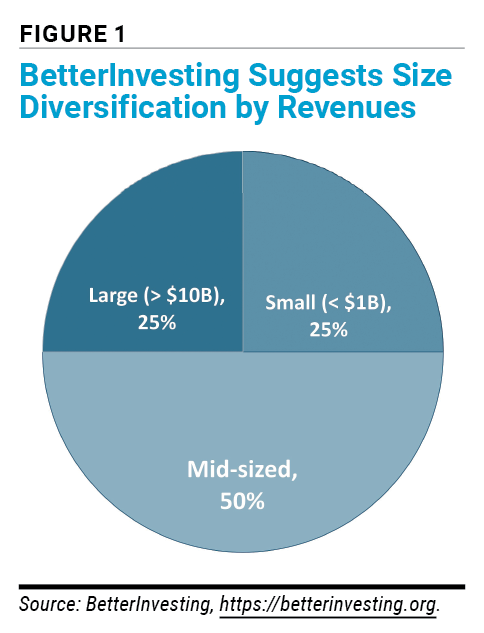
The second area of diversification in BetterInvesting’s principles is company size. We suggest that members don’t overload on large- and mega-cap stocks. Small- and mid-cap stocks perform well over time. And historically, they tend to compensate investors for the additional volatility they bring. By investing in companies with a mix of sizes, you can create a unique portfolio that perhaps better serves your goals. (Figure 1 shows BetterInvesting’s recommended breakdown for diversifying by revenue size.)
DG: It’s also important to consider concentration. Many investors don’t really manage their portfolios; rather, they collect stocks as they would coins or books without any thought to how they all fit together. Concentrating on a smaller portfolio may provide greater benefits.
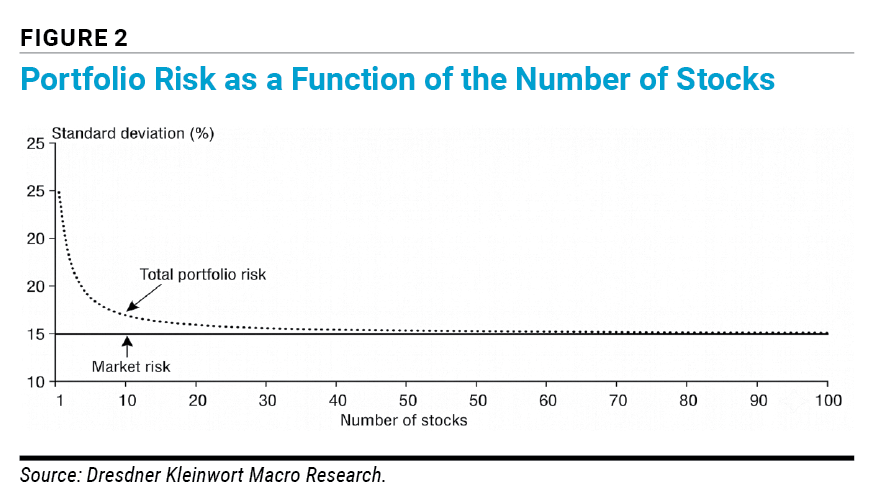
If you hold 75 stocks in your portfolio, for instance, some of your small holdings likely won’t provide any benefits to your return. If you concentrate your holdings, a good target is to limit your portfolio to somewhere between 20 and 30 stocks. Around that range, every stock you add tends to reduce the risk level. But after that, the market risk is not diversified away and your portfolio starts to perform like an index fund (Figure 2). At that point, you might be better served by simply holding one exchange-traded fund (ETF), which would likely deliver the same returns at a comparable level of risk.
JB: I think, to some degree, if you are doing closer in-depth company analysis, you can hold a smaller number of stocks. But if you want to try to capture the essence of a style or factor, you may need to hold a larger number of stocks. For example, the AAII Model Shadow Stock Portfolio has about 30 holdings, and it involves very little individual stock analysis. Rather, it tries to capture the overall factors (small size and attractive valuation). In that case, holding more stocks provides a bit of additional company-specific diversification beyond sector and style.
SL: I’d also note that buying a number of stocks in the same sector is not the same as diversifying. Be sure to buy stocks with different influences on their performance. You don’t need to be a very large investor to have a 20-stock portfolio. You can buy fractional shares at many brokers, often without a cost.
DG: There is an investing concept called pruning your losers and letting your winners ride. If you’re selling all your winners, what’s left in your portfolio is all your underperformers. Some of them may turn out to be big winners in the future, but there’s something to be said for a buy-and-hold approach. The buy-and-hold approach that BetterInvesting espouses does not encourage investors to buy and never sell. Rather, it guides investors to replace underperformers.
Look at the companies that aren’t working out, and find better opportunities in every market. Challenge your underperformers, and find other opportunities if you’re dissatisfied with a holding’s performance or fundamentals. At BetterInvesting, we believe that your overall portfolio return will be greater if you can consistently find companies that inspire more confidence and that have higher quality, better balance sheets, higher growth profiles and greater return potential. There is a balance. We’re not saying that you need to buy and sell every week, month or even quarter, but be sure to keep tabs on your holdings.
JB: We often consider the pain of a loss much stronger than the joy of a victory, so we tend to take our profits too quickly and hold onto our losses to try to prove ourselves right. It’s very important to have disciplined rules in place to overcome those behavioral biases. It is okay to sell, but you shouldn’t sell simply because the stock is up. It is okay to take profits or accept losses when the stock is no longer attractive.
DG: I call this recharging your portfolio. Everyone should have a watchlist of companies that they’ve done preliminary research on, so you can take advantage of opportunities when they present themselves. Market corrections can be especially great opportunities. BetterInvesting offers a number of tools in our online tool suite to help investors identify opportunities, including our newsletters, MyStockProspector screener and RightStock tool.
If you want to take action, look at your losers first and try to cope with them. Then you can look to the offensive side to determine how you’re going to manage exiting or trimming positions in your big winners.
SL: It’s so tempting to sell a winner just to feel good, and it’s so difficult to admit that you’re wrong and take the loss, even though it’s a sensible idea from the tax and portfolio management perspectives. AAII model portfolios tend to use a disciplined approach with rules that are governed by the style of investing being pursued. Stock grades are used to evaluate investment factors, and model portfolios are managed according to whether the holdings are within the predetermined guidelines, which are backed up by substantial backtesting and research.
The market is also used as a check. If a stock has been underperforming for years, I think it’s safe to say that something has gone wrong with the investment thesis. But if a stock is going up and staying within the portfolio rules, it stays in the portfolio. The particular strategy used by each model portfolio determines when a holding is sold, and at that time, a replacement is sought.
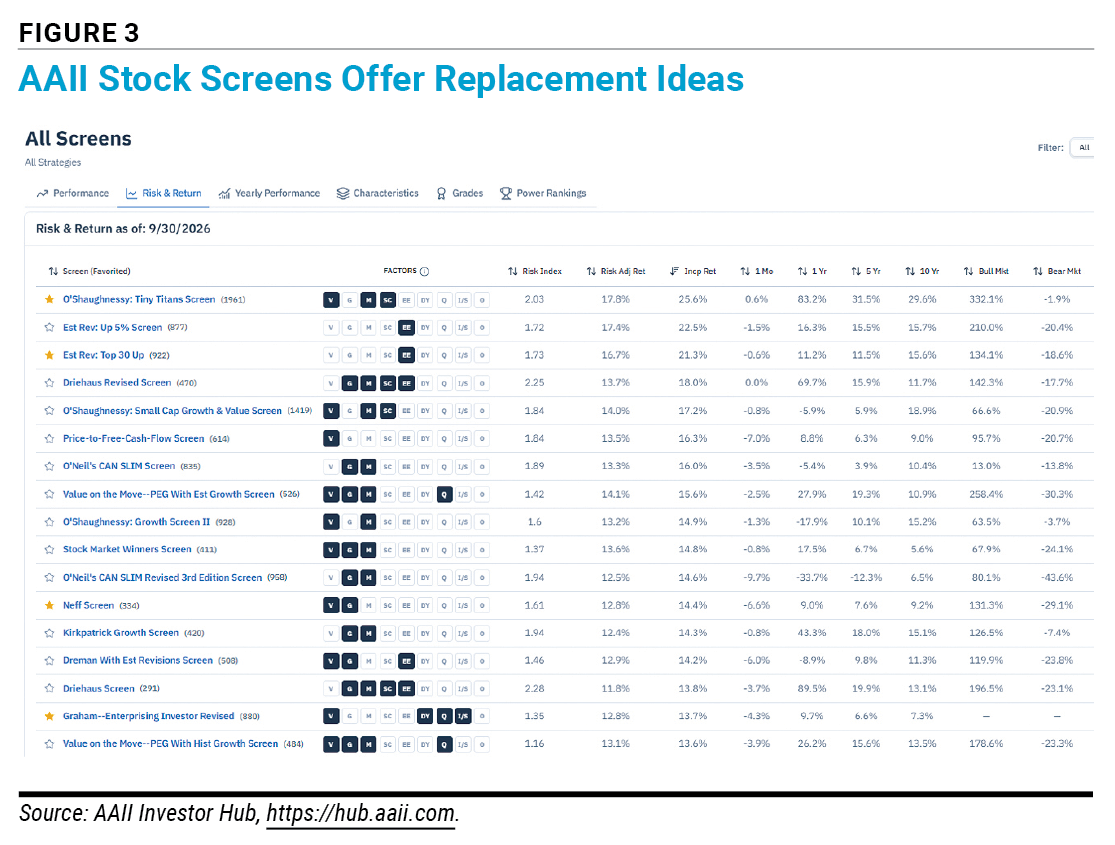
AAII members have access to premade stock screens with ideas lists that follow defined stock strategies. Some screens follow the philosophies of famed investors, such as Warren Buffett, David Dreman and William O’Neil. Others use factors, such as cash-rich stocks and dividend-focused investors (Figure 3).
DG: If you have a stock portfolio, it’s possible to fill in holes—such as those in market segment, size, sector or industry—by investing in an ETF in addition to your individual stock holdings. But one of the gotchas you have to watch out for in a mixed individual equity and ETF/mutual fund portfolio is overweighting.
For instance, if 15% to 20% of your portfolio is in Apple Inc.  (AAPL) and half of your portfolio is indexed to the S&P 500 index, your exposure to Apple is much higher than your individual stock position because Apple is one of the largest individual stocks, if not the largest stock, in the index. Your exposure gets to be doubled up pretty quickly, especially when it comes to the mega caps. While the S&P 500 is a broad market index, it is overweighted in mega- and large-cap stocks, so your mega- and large-cap exposure could be significantly higher than it appears.
JB: Along that line, investors may wonder if they should simply invest in a total market fund. Those are often market-capitalization weighted, so the fund is almost entirely made up of S&P 500 stocks, with perhaps a 5% tail that pushes it toward small-cap stocks. So, if you want diversification by size and style, you’re better off holding a couple different funds in different areas. I think the same is true of international diversification. When it comes to individual stocks, it’s very difficult and expensive to achieve that directly.
DG: With respect to international exposure, the S&P 500 is not strictly a U.S.-economy–focused index. So, before you take on the currency, political and other risks that come from investing outside the U.S., consider that you may already have a lot of international exposure. If you own mega-cap stocks or broad-based market ETFs, the companies manage the currency conversion and the rest of the risks for you.
We think you’d like this related webinar! AAII + BetterInvesting: Portfolio Construction in a Top-Heavy Market
AAII + BetterInvesting

Investor Professor

Stock Strategies

No comments have been added yet. Add your thoughts to the discussion!
You need to log in as a registered AAII user before commenting.
Log InCreate an account