


Charles Rotblut leads a class in AAII's new Essential Investing Video Course. Go to https://www.aaii.com/ves for more information and to subscribe.
Heading into summer 2023, the S&P 500 index entered a new bull market, yields on the benchmark 10-year Treasury note roughly stabilized and inflation continued to show signs of cooling. Overall, it’s been a welcomed change from 2022’s high inflation and difficult financial market conditions.
What the headline numbers reflect and how your portfolio is performing can be two very different things. This is why a midyear review is useful for ensuring you remain on track to achieve your financial goals.
These midyear checks need not be as comprehensive as an annual review (which is part of Step 5 of AAII’s PRISM Wealth-Building Process) but should still be thorough enough to identify any areas where tweaks or corrections are needed. In this month’s AAII How-To column, we share five steps for conducting a midyear portfolio review.
1. Ensure Your Allocation Is Reasonably Close to Target
Since both stocks and bonds have rebounded this year, your portfolio allocation may not have shifted significantly relative to the start of 2023. Still, it’s good practice to check—especially since the rally in the S&P 500 has been driven by a smaller number of stocks.
Ask yourself whether your current allocation is reasonably close to your target or if it has strayed off course. Vanguard suggests semiannual or annual rebalancing when your allocation is more than five or 10 percentage points off target.
Look at your individual holdings as well. Has a particular investment jumped in value relative to your other holdings and now represents an outsized position in your portfolio? If so, consider whether it makes sense to take some security-specific risk off the table by capturing some of the profits. Both AAII’s Stock Superstars Report (SSR) and VMQ Stocks consider trimming positions that have grown to 2.5 times more than the average position size for the entire portfolio. (Average position size is calculated by dividing the portfolio’s dollar value by the number of positions held. Your threshold can be larger or smaller than 2.5.)
AAII’s My Portfolio tool can assist you with this process. For all members, it shows the percentage weight of each investment in your portfolio, as shown in Figure 1. A+ Investor subscribers can further use the Diversification Analyzer to determine if their portfolio allocations have strayed too far off track.
My Portfolio Tool" src="https://www.aaii.com/images/journal/68037-figure-1.jpg" style="width: 700px; height: 438px;" />
2. Ensure No Investments Meet Sell Rules
As you review your portfolio, compare each investment against your sell rules.
For stocks, your sell rules might include a minimum amount of earnings growth, an upper limit on valuation, a certain level of relative strength or meeting certain standards for fundamental strength. (The A+ Investor Grades can help you track all of these.)
Mutual funds and exchange-traded funds (ETFs) should be compared against their peers. Lackluster performance over the past six months is not generally a reason to sell a fund that was bought as a long-term
investment. If the most recent six months reflects a continuation of underperformance relative to category peers that has been occurring for the past few years, then it may be time to consider making a change. AAII members can view current grades on a fund’s Evaluator page. (Simply type a fund’s name or ticker symbol into the search at the top left of web pages on AAII.com.) Grades for mutual funds and ETFs tell you how the fund ranks compared to other funds in the same category.
3. Do a Status Check of Your Retirement Savings
Those in the accumulation phase should look at how much they have saved so far this year. Determine not only if you are making contributions to your retirement accounts as planned but also if your overall savings rate (amount saved divided by income) is on track to be higher than last year. Then determine if you can boost it a bit more. Even small increases in the amount saved add up over time.
If your planned retirement date is getting closer, review how much you have allocated to a bucket of safe investments (e.g., money market funds, short-term bonds, etc.). AAII founder James Cloonan suggested allocating between two and four years of planned withdrawals to a bucket of safe investments to avoid having to sell stocks during a market downturn.
If you are retired and subject to the required minimum distribution (RMD) rules, ensure that you are on track to take those RMDs from all appropriate accounts. Taking advantage of automated monthly distributions from your broker or mutual fund firm ensures that you will meet the requirements (at least for those specific accounts). If you opt instead for taking the full RMD amount at the end of the year, schedule to take the distribution before year-end. Even if you prefer to take the withdrawal manually, having an automatic distribution scheduled provides a backstop against unintentionally incurring the steep penalty for missing a withdrawal.
If you adjusted your withdrawal amount for inflation, run a quick calculation to ensure that it doesn’t put your portfolio under too much strain. The PRISM Wealth-Building Process “Monitoring Your Progress” worksheet can help you run these numbers. It can be found at the Wealth-Building Process Toolbox.
Keep in mind that the SECURE 2.0 Act made several changes to retirement savings and withdrawal rules. See “Changes Made to Retirement Savings by SECURE 2.0 Act” in this issue for more information.
4. Assess Your Tax Situation
Assessing your 2023 tax situation now gives you several months to make adjustments to better position yourself for year-end.
A good place to start is with your brokerage statements. Have you claimed any losses so far? What about capital gains? Excess losses can provide the opportunity to offset any capital gains realized later in the year. If you have excess capital gains, see if there are any losses you are carrying forward from past years. Those losses carried forward can be applied against capital gains realized this year up to a maximum of $3,000. In managing your realized capital gains tax exposure, be conscious not to let the tax tail wag the portfolio dog. Transactions should be based on your buy and sell rules first and tax considerations second.
Then look at your income, deductions and, if applicable, estimated tax payments. Has there been a change in income that would move you above or below a certain tax, Medicare premium or Social Security threshold? Have your deductible expenses been higher or lower than expected? Have your estimated tax payments been too low or too high? If so, consider whether there are opportunities to take action between now and year-end.
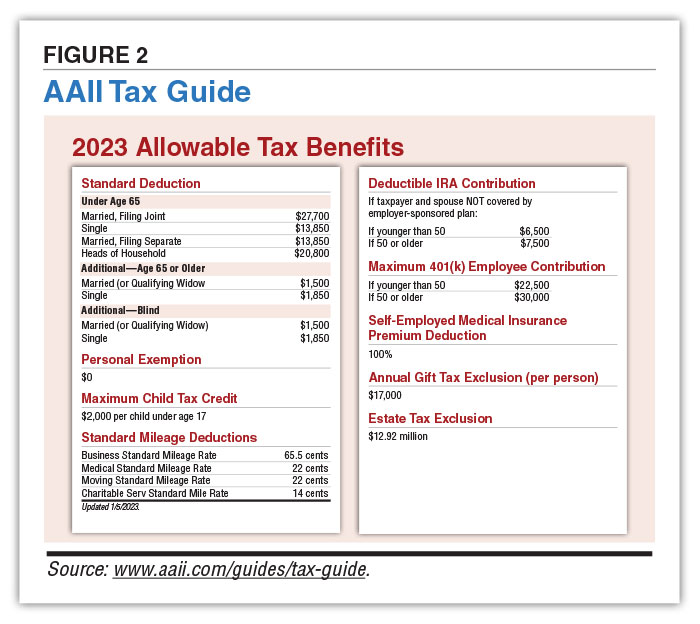
AAII’s Tax Guide can help you with your tax planning. It provides useful information regarding 2023 tax rates, credits, deductions and limits (Figure 2).
5. Adjust for Any Life Stage Changes
Finally, take a moment to consider what has happened in your life over the last six months. Is there anything that affects your financial situation, your goals or your beneficiary information? If so, make the appropriate adjustments.
Then, add a calendar reminder for around year-end to conduct a more thorough annual review.

Related

PRISM Wealth-Building Process
Portfolio Monitoring for Progress of Goals and Life Stage Changes
Related

Portfolio Strategies
The Portfolio Review: Why It Is Important and How to Do It
Discussion
FREE REPORT

Get your free copy of our special
report analyzing the tech stocks
most likely to outperform the
market.
JOHN L from NJ posted over 3 years ago:
Stephen C from NJ posted over 3 years ago:
ROBERT A from NC posted over 3 years ago:
PRESTON H from NJ posted over 3 years ago:
Dr. Charles L P from MD posted over 3 years ago:
You need to log in as a registered AAII user before commenting.
Log InCreate an account