


William “Bill” Bernstein is a neurologist, co-founder of the investment firm Efficient Frontier Advisors and the author of several books including the recently released “The Four Pillars of Investing, Second Edition: Lessons for Building a Winning Portfolio” (McGraw Hill, 2023). We spoke about strategies investors can use to protect their portfolios during periods of severe downside risk.
—Charles Rotblut, CFA
You write in your latest book that long-term success is dependent on what an investor does during the worst of times. Could you explain why that’s so important?
That’s one of the reasons why I wrote a second edition of the book. It’s been 20 years since the first edition. One of the most important things I’ve learned since the publication of the first edition is that you really need to design your portfolio with the worst 2% of the time in mind.
Albert Einstein is supposed to have said that compound interest is the eighth wonder of the world, but I always add Charlie Munger’s dictum that the first directive of compounding is to never interrupt it.
We’re all overconfident. We’re overconfident about our ability to select securities, and we are overconfident about our ability to time the market. But there’s an overconfidence that is even more destructive than that. It is overconfidence about our risk tolerance. We all think we’re long-term investors and we all think we’re very disciplined, but when the ground starts to shift below our financial feet, we tend to become more risk intolerant.
You might think you’re going to buy at the bottom, but walking the walk is a lot different than simply talking the talk in a spreadsheet. During those 2% worst of times, you’re going to hear very scary narratives about the collapse of banks, the implosion of the economy from a pandemic or the disappearance of corporate earnings. That 2% of the time is also when you’re most likely to see your job go kaput or your rental income from your properties decrease, and cash suddenly becomes very precious.
The most important thing is that during those periods, the definition of money changes. You might think that your short-term bond fund or even your long-term Treasury bond fund is money, but only money is money. The thing that is closest to money is Treasury bills, which are short-term Treasury securities. There is a reason why Warren Buffett holds 20% of Berkshire Hathaway Inc.’s assets in Treasury bills and cash equivalents. The name of the game is to design your portfolio with those worst 2% of times in mind so that you don’t violate Munger’s dictum.
That plays into your idea that it is better for an investor to use a suboptimal allocation they can stick with rather than trying to maximize return when they are not able to handle the associated downside volatility.
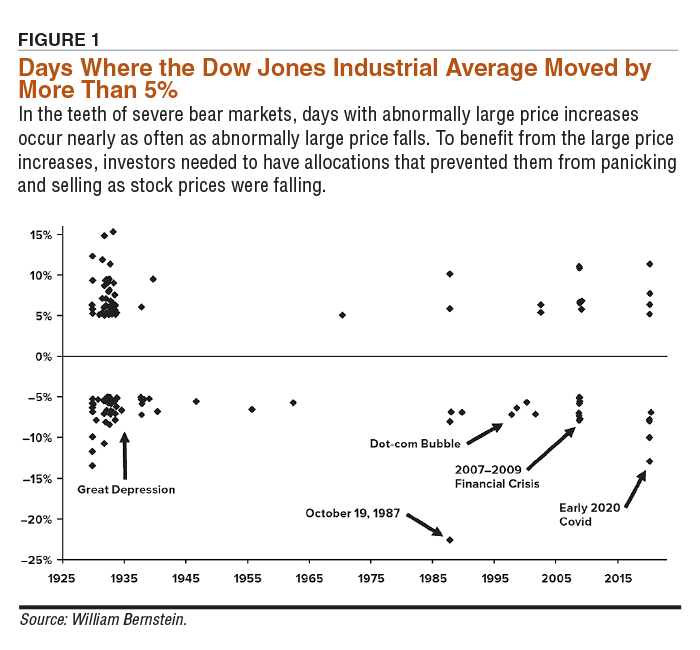
Yes. Finance theory tells us that every penny you don’t have in stocks is going to hurt you. It also tells us that a portfolio that is light on stocks and heavy on safe assets is suboptimal. The latter is suboptimal in a mathematical sense, but a portfolio that is too risky for you also makes you most likely to violate Munger’s dictum. So, what I like to say is a “suboptimal portfolio” that you can tolerate is better than an “optimal” one that you can’t stick with (Figure 1).
Since we’re talking about risk, you describe risk as either being shallow or deep.
Shallow risk is the 2008–2009 global financial crisis. It’s the 1973–1974 bear market. It’s the March 2020 flash bear. It’s a brief, sharp break in the market that freaks everybody out but eventually recovers. Throughout history, the U.S. stock market has always recovered—at least so far.
That’s not true abroad. This is where we get to deep risk. Deep risk is St. Petersburg, Russia, in 1914. It’s owning Argentine stocks or Chinese stocks during a revolution or during a government confiscation. We’ve also seen some episodes of deep risk in what we like to think of as stable developed markets. The most spectacular recent example was what happened to Japanese stocks. During the past 30 years, they’ve experienced a loss of real value. So deep risk is a loss of real value that affects your consumption that can last for decades at a time.
Until last year, the worst episode of deep risk in the U.S. was what happened to bonds between 1940 and 1980. One dollar invested in U.S. long-term Treasury bonds, which are supposedly the world’s safest asset, lost almost two-thirds of its value in real [inflation-adjusted] terms. If you invested in long-term Treasurys in 1960 and were dependent upon them for your retirement, you were in a world of hurt 20 or so years later.
In terms of bonds, you favor focusing on the short end of the yield curve—fewer than five years, correct?
I really prefer Treasury bond ladders or short-term Treasury bond funds that have durations of less than two or three years. This is basically a five-year ladder.
What about substituting the bonds with ladders of certificates of deposit (CDs)? You don’t get capital appreciation, but CD rates are looking pretty attractive relative to bonds right now.
CDs are also attractive; anything with a U.S. government guarantee is fine. A CD you purchase directly from a bank, and not at a brokerage, gives you a put option on the interest rate [a locked-in rate]. The CD might cost you a percentage point of interest, but that’s not as bad as the hit that you’re going to take in Treasurys or a brokered CD if rates rise significantly—as they did in 2022. So, if you have the time and the energy to go around to different banks and buy CDs, they’re certainly a good solution as long as you stay under the Federal Deposit Insurance Corp.’s (FDIC) limits.
Let’s pivot back to risk. You list four types of risk in your book: inflation, confiscation, devastation and deflation.
Deep risk does come in four different flavors. Of the four, the one you have to worry least about is deflation, because governments have printing presses. There is not a lot you can do about destruction [devastation]: If we wind up in a global conflict that goes nuclear, your portfolio is going to be the least of your problems. Regarding confiscation, you can move your assets abroad. If you’re an American, that comes at an enormous cost and you’re basically painting a target on your back for the Internal Revenue Service (IRS). You’re also taking a hit when it comes to your own personal life and moving away from your family and social support. Inflation is the one that’s most common of those four flavors of deep risk when you look at financial history. Fortunately, it is the one that you can do the most about.
Inflation is certainly on everybody’s minds after the past few years. In terms of investments that would help protect against inflation, you discuss keeping bond durations short. What about Treasury inflation-protected securities (TIPS) and Series I bonds? Additionally, if someone is looking at a Treasury bond ladder, should they have a preference between, say, TIPS and traditional bonds?
I bonds and TIPS each have their advantages and disadvantages. The big advantage of I bonds is that they’re basically an inflation-adjusted money market account. If there’s a rise in interest rates, you’re not really hurt. The disadvantage of I bonds is that you’re very limited by the amounts you can invest. You also have to deal with TreasuryDirect.gov, which is not very user friendly.
The advantage of a TIPS ladder is that you can use it to precisely match your living expenses in retirement. If you’re 70 years old, a TIPS ladder can last to age 100. You simply have maturities every single year that match your real [inflation-adjusted] living expenses. You can sleep like a baby, knowing that real expenses have been covered for the rest of your natural life. It’s especially valuable to someone who is risk averse and who has a large amount of tax-sheltered assets because you want to hold TIPS in a rollover IRA.
If they’re buying TIPS in that type of scenario, they could go further out in terms of maturity.
The reason why you want to keep the maturities of your nominal bonds short is because of the risk of inflation. But with TIPS, you’re taking that risk out of the picture.
You also describe stocks as a good hedge against inflation in your book.
Stocks are a long-term hedge against inflation, but not a short-term hedge. As we found out in 2022, if there’s an uptick in inflation, stocks are going to take a temporary hit from that unexpected inflation.
When I worry about inflation, I don’t worry about 2022 or the inflationary period of 1972 to 1980. What I worry about is very severe hyperinflation—Weimar Republic–type inflation. This has so far never occurred in the U.S., but it still could.
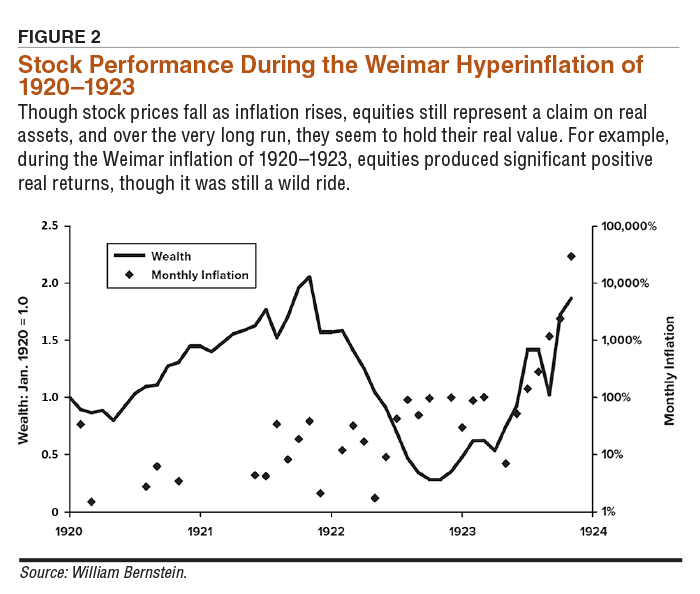
When you look at history, stocks do quite well with hyperinflation. There was the hyperinflation in Germany that everyone knows about, from 1920 to 1923. Bondholders were pretty much wiped out. German stocks, it turns out, did very well. They had a positive real return, although it was quite a wild ride (Figure 2). In the long term, stocks do pretty well with inflation because they are a claim on real assets and they are a claim on real earnings.
What kinds of stocks do particularly well with inflation? Well, commodities producers, obviously. The other kinds of stocks that do well are value stocks. Historically, value stocks do well with inflation because their future earnings are not discounted as much as they are for growth stocks. Value stock companies also tend to be highly leveraged in nominal terms, so they pay for loans taken out previously with future dollars that have been inflated. That erosion of nominal debt goes directly to their bottom line. So, if you look at the history in the U.S., as well as abroad, value stocks do much better with inflation than the overall market does.
I found it interesting that you are opposed to holding corporate bonds because of their inability to provide a hedge against the market’s volatility.
If you look at returns over several decades, corporate bonds look like a mixture of about 90% Treasurys and 10% stocks. But in really bad states of the world—such as 2008, 1973–1974 and 1929–1932—the stock contribution to corporate bond returns goes up dramatically. During really bad states of the world, the behavior of corporate bonds looks like a 25%/75% portfolio of stocks and Treasurys.
That’s sort of a long preamble to what happened in 2008. In late 2008, corporate bonds took a very bad hit. Now, remember what I said about designing your portfolio with the worst 2% of times in mind. In the worst 2% of times, you want your money to be money. Corporate bonds suddenly stopped being money during those states. You wanted to hold Treasurys because they were still money.
In contrast, even the short-term debentures of Intel or Procter & Gamble weren’t money in 2008. You took about a 10% haircut if you needed to consume those bonds for your living expenses or if you wanted to buy stocks at the fire sale. If you had to sell your corporate bonds to do that, you were taking quite a haircut. The long-term premium of about one-half to three-quarters of a percent over Treasurys is not worth it.
You’re not a fan of directly investing in gold to hedge against inflation, right?
Physical gold is probably not a great hedge against inflation. It looks like a good hedge against inflation because it did well in the U.S. during the late 1970s. But if you were a Brazilian who was trying to hedge against hyperinflation in the 1990s with gold, you were very sorely disappointed. In fact, the more you look at gold, the more you see that it’s really not a great hedge against inflation. In fact, it’s a hedge against deflation because deflation is associated with financial panics. Gold shines when people lose faith in the banking system and in money. Those tend to be deflationary periods.
Could you discuss what else you would not put into a bucket of safe assets?
Anything that has any credit risk or duration risk [sensitivity to changes in interest rates]. Anything that doesn’t have a government guarantee has a credit risk. This includes corporate bonds and municipal bonds. Anything that has duration risk also can be very risky—so that’s long-term Treasurys. Three out of four times when stocks crater, long-term Treasurys do well. But one time out of four, like 2022, they don’t. That really should tell you that you don’t want to be taking too much duration risk, even with Treasurys, except for TIPS.
In terms of how much to allocate toward safe assets for retirees, our founder James Cloonan suggested two to four years of living expenses in safe assets. Others have suggested three years. In your book, you suggest at least five years and possibly up to 20 years.
I think 10 years is a bare minimum. All you have to do to convince yourself of that is ask what would have happened to you if you had retired in 1929. Four years of Treasurys wouldn’t have been enough. If you had retired in Japan in 1990, even 10 years of bonds wouldn’t have been enough.
I consider five to 10 years of living expenses to be a bare minimum to allocate to safe assets in retirement, and 20 years if you’re a young retiree. That’s what the TIPS ladder is there for. When I say 10 or 20 years of expenses, I’m not talking about full living expenses. I’m talking about enough income to keep you from living under a bridge and starving.
The amount to allocate to safe assets also gets adjusted for any Social Security or pension benefits.
Right. When talking about living expenses, the example I use over and over again as a simple mathematical exercise is to assume your annual living expenses are $70,000 per year. You’ve got annual Social Security and pension benefits of $30,000. The remaining $40,000 is what I like to call your residual living expenses. That’s what you have to pay for. Maybe in a bad state of the world, that goes down to $20,000. Well, 20 years of $20,000 is $400,000 of safe assets.
For those nearing retirement, when should they start filling their bucket of safe assets for retirement?
That’s the trickiest part of the investing life cycle: the transition to retirement. So, I think you should start upping your level of safe assets 10 years before retirement. When you ask that question, you really have to think about four things.
Number one is what is your burn rate going to be in retirement? If your burn rate is going to be 5% or 6% of assets, then you’d better start accumulating some safe assets. If your burn rate is going to be only 2% or 3%, you really don’t have to do that because probably any allocation is going to be fine.
Next is how old are you? The Financial Independence, Retire Early (FIRE) person who wants to retire at age 40 better have a pretty low burn rate and a decent balance between stocks and bonds. On the other hand, the person who retires at age 75 doesn’t need that much in the way of safe assets simply because their life expectancy isn’t that long.
The third factor is risk tolerance. Theoretically, someone who has a 1% or 2% burn rate should easily be able to tolerate a portfolio of 100% stocks. They can pretty much live just on the stock dividends, which generally increase at an inflation-adjusted rate. But if you have a low risk tolerance, maybe you shouldn’t do that.
The final and probably the least important factor is what is the balance between your bequest and safety preferences? If you are a person who can tolerate some risk and wants to endow a hospital wing, well, you can invest aggressively. On the other hand, if you’re a person for whom sleeping at night is extremely important, then you want to be less aggressive.
And before I finish up, I wanted to ask you about value averaging. A lot of people are familiar with dollar-cost averaging, but this is a little different. Could you explain?
It’s simply a more aggressive way of dollar-cost averaging. With dollar-cost averaging, you put $1,000 into savings every single month. It’s a good psychological approach. If you have a lump sum of money, seven times out of 10 you’re better off making a lump-sum investment. But it also feels very risky to a lot of people. So, I view dollar-cost averaging as a suboptimal strategy that is easier to execute than the optimal one of putting a lump sum in.
Now, what is value averaging? Well, it’s a variant of dollar-cost averaging where you up your target amount of equities by $1,000 every month, for example. During your first month, you buy $1,000 of stocks and for your second month, you seek to increase the balance to $2,000. If stocks have increased in value and they’re now worth $1,200, then you’re only going to add $800. If stocks decrease by 20%, then they’re only worth $800. So to get to $2,000, you’re going to have to buy $1,200 of stocks. Value averaging forces you to add more money at lower prices.
There are some people, and I’m one of them, who think this is advantageous. But it’s not a risk-free way of investing. It’s slightly riskier than dollar-cost averaging, but it’s what I use to deploy lump sums of money for someone who can’t tolerate lump-sum investing.
Let’s say you want to put $1,000 into the stock market. The reason why lump-sum investing is theoretically optimal is because you’ve got $1,000 in the market for the entire year. Seven times out of 10 that works to your advantage. If you want to put $1,000 into the stock market over a year by value averaging over the same year instead, you’ve only got $500 on average in the market because you’re going from $0 to $1,000.
What value averaging does is avoid the regret of investing at a market top and then having your head handed to you over the next year, next five years or even next 10 years. The person who invested a lump sum in the year 2000 wasn’t a happy camper. The person who started value averaging or dollar-cost averaging in 2000 was a very happy camper at the end of those 10 years.

Related

Retired Investor
Optimizing Retirement Withdrawals Using the Level3 Strategy
Related

AAII InvestoGraphic
The Power of Compounding
Discussion
FREE REPORT

Get your free copy of our special
report analyzing the tech stocks
most likely to outperform the
market.
CRAIG B from WI posted over 3 years ago:
JOHN L from NJ posted over 3 years ago:
ROBERT A from NC posted over 3 years ago:
ROBERT A from NC posted over 3 years ago:
ROBERT A from NC posted over 3 years ago:
JAMES F from WI posted over 3 years ago:
Don P from USA posted over 3 years ago:
THOMAS D from VA posted over 3 years ago:
David L from AK posted over 3 years ago:
Chris P from OK posted over 3 years ago:
DAVE G from TX posted over 3 years ago:
MIKE M from OR posted over 3 years ago:
PAUL H from MD posted over 3 years ago:
GLEN S from SC posted over 2 years ago:
CRAIG B from WI posted over 2 years ago:
You need to log in as a registered AAII user before commenting.
Log InCreate an account