


Happy 2016!
I hope your start to the New Year was better than the market’s.
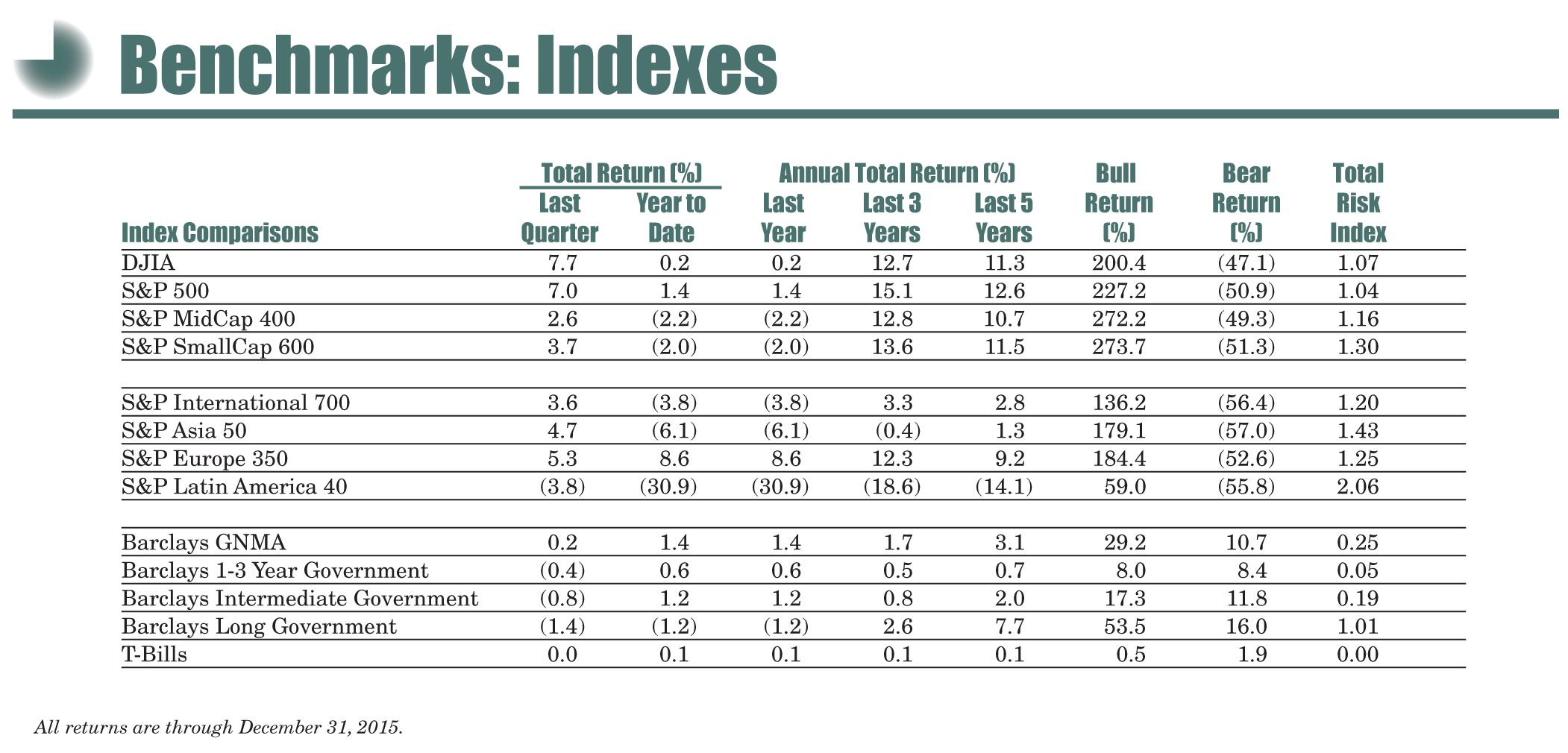
However, despite the absence of a so-called Santa Claus rally in December, equity markets posted generally positive returns for the fourth quarter of 2015. The S&P 500 index gained 7.0% in the fourth quarter, while the S&P MidCap 400 gained 2.6% and the S&P SmallCap 600 gained 3.7%. Large-cap stock funds gained 5.8% on average in the fourth quarter, followed by mid-cap and small-cap stock funds gaining 3.0% and 2.6% on average, respectively. The quarter’s gains can be largely attributed to October performance, which was boosted by investors’ optimism surrounding accommodative monetary policy moves from both the Peoples Bank of China (PBOC) and the European Central Bank (ECB).
Below is a table featured in AAII’s upcoming Quarterly Mutual Fund Update regarding benchmark index performance during the fourth quarter and 2015.
Why am I talking about mutual funds? Because it’s that time of the year at AAII. February’s Guide to the Top Mutual Funds in the AAII Journal and the Quarterly Mutual Fund Update, both reporting year-end data, are just around the corner. Also, to tie into the January mutual fund madness, our Feature article this month talks about Fund Manager software and the basics of how to use it.
What are mutual funds? Although it seems like a basic question, it’s always good to brush up on your basics. Fidelity.com states, “Mutual funds are investment strategies that allow you to pool your money together with other investors to purchase a collection of stocks, bonds, or other securities that might be difficult to recreate on your own. This is often referred to as a portfolio. The price of the mutual fund, also known as its net asset value (NAV), is determined by the total value of the securities in the portfolio, divided by the number of the fund’s outstanding shares. This price fluctuates based on the value of the securities held by the portfolio at the end of each business day. Note that mutual fund investors do not actually own the securities in which the fund invests; they only own shares in the fund itself.”
Many individuals invest in mutual funds through their retirement accounts, while others invest through a regular brokerage account. An important part of mutual fund investing is not only tracking your holdings, but tracking their performance over time and comparing performance to a benchmark.
Not every fund can outperform its benchmark all the time; however, if your mutual fund holdings are consistently underperforming their benchmarks, it may be time to make a change.
Thankfully, there are many tools online to assist you in your mutual fund tracking. CI’s Best of the Web column covers several different types of websites for mutual fund and exchange-traded fund (ETF) research, including sites that provide the best in-depth data, sites best for viewing analyst ratings and recommendations and sites with the best screeners for finding funds and ETFs that interest you.
As always, if you have particular comments regarding any of the software, websites or tools mentioned in Computerized Investing, please let us know via email at CI@aaii.com. Additionally, if you have any experience with a particular website, tool or service and think that you would be able to write an article about how you use it, let us know.
In addition to the Fund Manager review, this month you will also learn about the Podcasts application built into your iOS device. Also, Sharon Mallory, CEO of SDM Investments, talks about three reasons to embrace robo-technology
Discussion
FREE REPORT

No comments have been added yet. Add your thoughts to the discussion!
You need to log in as a registered AAII user before commenting.
Log InCreate an account