When deciding whether to invest in funds or individual stocks, stock investors are at an advantage regarding taxes. Especially with mutual funds, understanding a fund’s tax efficiency is crucial as it may have a significant effect on your long-term returns. A+ Investor gives subscribers tools with which they can gauge the tax-friendliness of a fund.
Stock investors pay taxes on an investment only when they receive income such as dividends and when they sell stocks for a profit. As is the case with stocks, mutual fund investors owe tax on income that they receive from stock dividends or bond interest generated by securities in the portfolio. Therefore, mutual fund investors can face a tax bill even if they haven’t sold any of their fund shares.
Unlike stocks, mutual funds make distributions, which are generally disbursements of assets from a fund to an investor consisting of dividends and interest payments but also any net capital gains made from the profitable sale of portfolio assets. Fund managers ultimately decide if and when they will pare down some of the portfolio’s holdings for a gain, and taxes on those gains are passed on to the fund’s investors. For this reason, mutual funds tend to be tax-inefficient from the standpoint that investors do not have control over when a fund manager sells portfolio assets.
The Fund Evaluator available to all A+ Investor subscribers provides portfolio turnover and a metric called the tax-cost ratio for any mutual fund or exchange-traded fund (ETF). Subscribers can also use the Funds+ Screener and ETF+ Screener to find funds with turnover less than their category average.
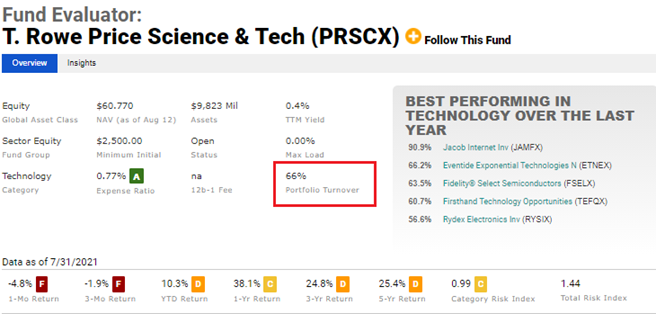
The investment strategy that a fund follows will have an impact on its tax-efficiency due to how often there is portfolio turnover—i.e., how often portfolio assets are bought and sold. Funds that employ passive strategies—usually ETFs and some mutual funds that follow indexes—are far more tax-efficient than actively managed mutual funds because they have lower turnover.
A mutual fund manager must constantly rebalance the fund by selling securities to ensure enough cash is on hand to accommodate shareholder redemptions or reallocate assets. Managers of course do everything in their power to mitigate taxes through strategies such as tax-loss harvesting and carrying over capital losses from the previous year.
Portfolio turnover is calculated by dividing the lesser of purchases or sales for the year by the monthly average value of the securities owned by the fund during the year. Securities with maturities of less than one year are excluded from the calculation. The result is expressed as a percentage, with 100% implying a complete turnover of the portfolio within one year.
The tax-cost ratio measures how much a fund’s annualized return is reduced by the taxes paid on distributions, assuming the maximum marginal tax rate. A tax-cost ratio of 0.0% indicates that the fund did not distribute any taxable income or make capital gains distributions. If a fund had a 3.0% tax-cost ratio, it means that on average each year, investors lost 3.0% of their assets to taxes. The lower the ratio, the more tax-efficient the fund.
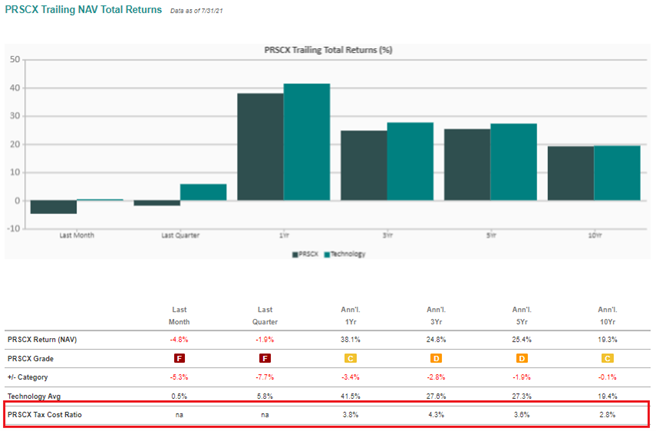
Like an expense ratio, the tax-cost ratio is a measure of how one factor can negatively impact performance. It is usually concentrated in the range of 0% to 5%. Zero percent indicates that the fund had no taxable distributions, and 5% indicates that it was less tax-efficient.
This is not to say that you should automatically buy a fund because its tax-cost ratio is low or zero or it has a lower turnover. Many good funds make distributions, so you shouldn’t necessarily avoid a fund just because it has a tax-cost ratio greater than 0%. However, you may wish to hold funds with high tax-cost ratios in nontaxable accounts, such as 401(k)s and IRAs.

