Different types of risk need to be taken into account when building your investment portfolio. Business and industry risk, market risk, inflation risk and liquidity risk are the main ones to become familiar with, and each applies differently depending on the asset category you are looking at. However, the most efficient investment portfolios are based on an overall approach that examines the risks and return potential of your total portfolio, not just the individual parts.
Diversifying among the asset categories reduces the individual category risks and allows you to build a portfolio that matches your investment profile. Despite allocation differences between the model profiles of aggressive, moderate and conservative investor, their portfolios are built with the same three major asset categories: stocks, bonds and cash.
But building your portfolio’s asset allocation isn’t simply a matter of how much you will hold in those three major categories. Especially with stocks and bonds, your allocations may not be as diversified as you assume. For fund investors, it depends on what kind of stock funds and bond funds you are invested in.
You don’t want to just hold the best-performing stock funds or bond funds. To have a truly diversified portfolio, you want to slice up the stock and bond allocations into more nuanced categories of large cap, mid cap and small cap, as well as international for stock holdings and different term lengths for bond holdings.
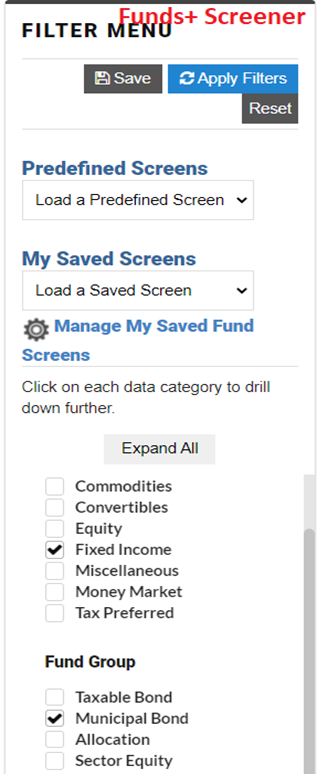
A+ Investor subscribers can use the Funds+ Screener and the ETF+ Screener to easily screen for mutual funds and exchange-traded funds (ETFs) that will fully diversify your portfolio. In the screener’s Filter Menu, select Fund Type or ETF Type—depending on which screener you are using—for the first drop-down menu. This menu groups funds by their global asset class, such as equity and fixed income. Hit Apply Filters once you’ve determined your settings.
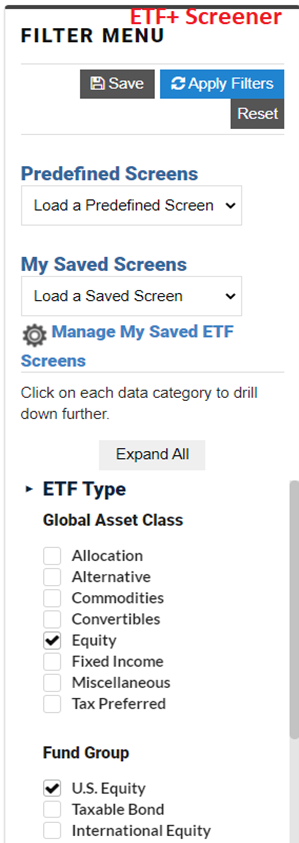
The next menu drills down to fund group. For stock funds, this is where you can select U.S. Equity. If you are looking for a specific category, such as small-cap value funds, mid-cap growth funds or large-cap blend funds, options to filter on these will appear once you’ve selected the U.S. Equity group. Switching the fund group from U.S. Equity to International Equity will bring up options for funds that diversify your portfolio outside the U.S. economy, giving you exposure to international economies. You can screen for funds covering specific market sectors, too, by selecting Equity Sector from the fund group menu.
For bond funds, select Fixed Income as the global asset class setting. The main fund groups are taxable and municipal bonds, but the Funds+ Screener can also screen for bond funds with specialized allocation and alternative strategies.