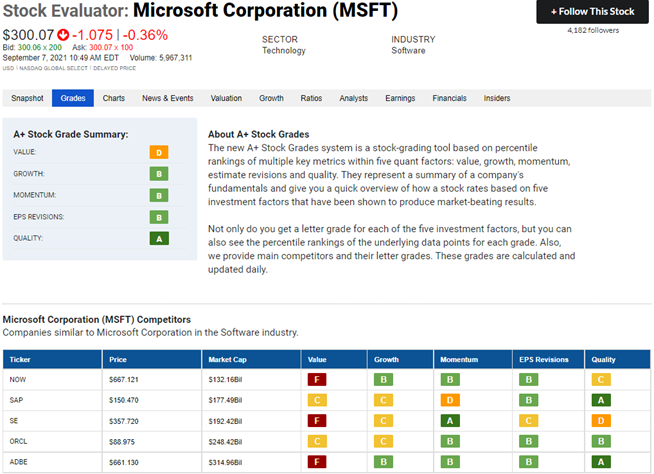
One of the most important concepts of investing is that the valuation of an investment is relative to its peers. This tenet holds when comparing different types of investments, such as comparing stocks to funds, bonds and even real estate, as much as it does when comparing investments within their categories. For stocks, the most useful analysis compares a company to its competitors. The A+ Stock Grading system provides a simple quantitative approach to comparing stocks and directly provides a table of an individual stock’s competitors and their grades.
Type a stock’s name or ticker into the search box at the top of AAII.com and select the company name from the drop-down list to access its Stock Evaluator page.
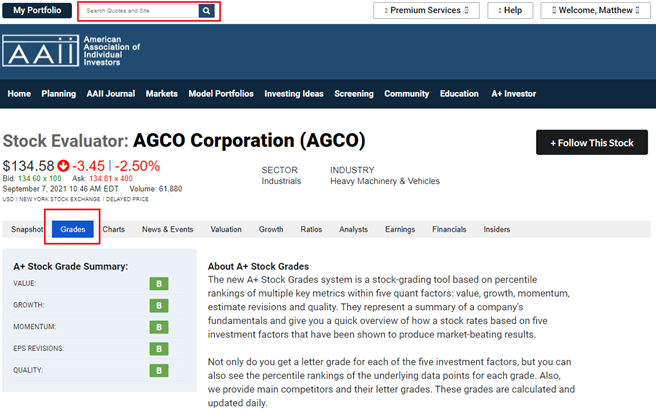
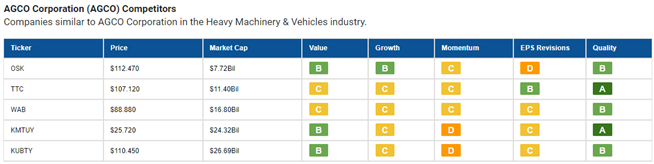
The competitors table is found just below the first section at the Grades tab of the Stock Evaluator.
Publicly traded companies are required by law to produce financial statements so investors can have equal access to clear and consistent information regarding the health of a company and the viability of its stock. The basis of stock analysis comes from evaluating the three financial statements: the balance sheet, the income statement and the cash flow statement. Key metrics such as the price-to-book-value ratio, inventory turnover, shareholder yield and dividend yield are derived from these statements.
The consistency of financial statements is meant to allow investors to compare one stock to another. Despite the intention of regulated financial statements, the ratios derived from public documents used to evaluate stocks do not inherently denote their natural relativity.
In general, shareholders want a company to have a lot of cash and equity on their balance sheets. In reality, the amount of cash, inventory, fixed assets, intangible assets and debt will vary based on the industry in which the company operates.
AGCO Corp.  (AGCO) makes various types of machines. It needs metal and factories, neither of which are cheap, making it a capital-intensive business. Microsoft Corp. (MSFT), by contrast, is not capital intensive as a provider of software and digital services via cloud technology. The capital required to provide one additional software license is nominal because it doesn’t require additional factory space or raw materials.
Whether you emphasize a technical or fundamental approach to analyzing stocks, all analysis originates in a company’s financial statements and the ratios derived from them. The A+ Stock Grading system does the work of quantifying fundamental analysis so you can easily compare a stock to its industry peers.