A family of funds is managed by an investment management company registered with the U.S. Securities and Exchange Commission (SEC). The family includes all the separate funds its management company oversees. Investing in mutual funds or exchange-traded funds (ETFs) in a particular family may provide advantages. With the fund and ETF screeners, A+ Investor subscribers can target a specific family of funds.
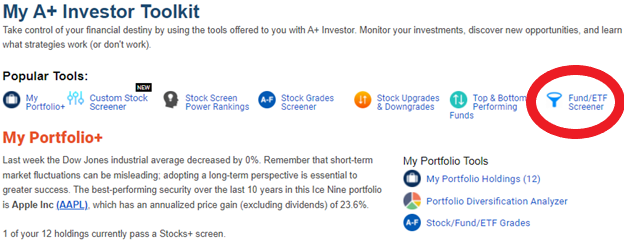
Access the Funds/ETF Screener from the A+ Investor dashboard. You can toggle between the two screeners.
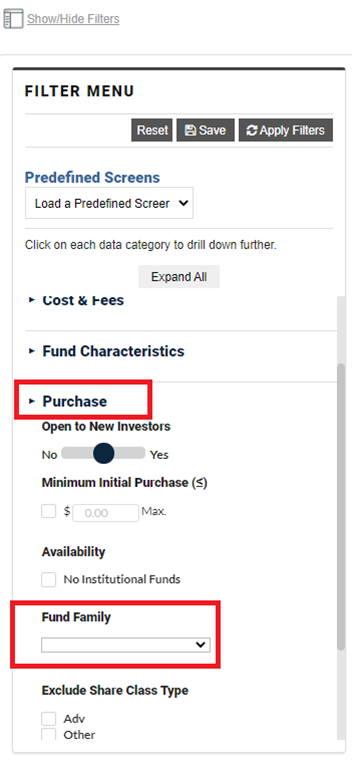
The fund family filter is included on the screener’s Filter Menu, in the Purchase section. Click on Purchase to expand the list of filters for this section (see below). The Fund Family drop-down menu has hundreds of families to select from. Select a name from an alphabetized list of fund families and hit the Apply Filters button at the top of the menu.
Management companies may offer a broad range of funds for investors to choose from, including both ETFs and different asset classes of mutual funds. As of mid-2021, BlackRock Inc.  (BLK) controlled the largest assets under management (AUM) with about $9.5 trillion. The Vanguard Group is second at $7.2 trillion and Fidelity Investments has $4.2 trillion AUM.
Investing in funds broadly across a particular family may provide advantages if the funds are managed by a blue-chip fund family such as Vanguard. Otherwise, you may want to diversify your investments across several fund families to mitigate any localized family risk. Due to Vanguard’s size, an investor could build a broad portfolio of only Vanguard funds and buy ETFs through its brokerage services.
One advantage of investing within a family of funds is the consolidation of fund investment reports into one monthly statement. Another is exchange privileges, which typically allow investors to shift allocations in changing markets with minimal to no fee. Sometimes minimum investment levels are also lowered for funds within a family.