Environmental, social and governance (ESG) investing attempts to match investors’ investments with their beliefs. As its name suggests, ESG investing considers the potential environmental and/or social impact of a particular investment—a concept known as sustainable, responsible and impact investing, or SRI investing.
Historically, ESG investing was known mainly for “negative” screening or excluding certain companies or sectors from a fund or portfolio. (Tobacco and oil stocks are two common examples.) ESG investing now commonly includes “positive” screens as well—in other words, actively seeking companies or sectors considered to have “best-in-class” ESG performance metrics relative to their industry peers.
There’s been a longstanding perception that screening one’s portfolio can have a negative effect on investment performance, as it may result in less diversification. However, an increasing amount of research has countered this notion—particularly for funds that use both positive and negative screens, as opposed to negative screens alone. This was affirmed in a recent meta-analysis. Jon Hale of Morningstar reviewed the findings of numerous academic studies and concluded that ESG investors “can receive competitive performance while also addressing their sustainability concerns.”
Without a doubt, ESG investing is rapidly evolving from a niche corner of the investment landscape into the mainstream. Additionally, the field has become quite broad in scope, encompassing not just screened funds but shareholder advocacy, community investment (deposits at banks, credit unions and other financial institutions whose mission is to serve low- and middle-income communities), as well as targeted “impact” investments in the private markets.
Until recently, much of the growth in ESG investing has been concentrated among large institutional investors. However, interest has been growing among individual investors—particularly women and millennials. The increased interest in ESG investing has dovetailed with another industry growth trend: index investing. Fortunately for ESG investors with a bias toward passive investment approaches, a growing number of options [particularly ESG-oriented exchange-traded funds (ETFs)] are becoming available.
Of course, ESG screens, which often rely on an added layer of internal or third-party research services, can still result in higher embedded fund expenses compared to their non-screened alternatives. But it is getting easier for index-oriented investors to build well-diversified ESG portfolios at a reasonable cost. Portfolio managers following such strategies seek out securities with both favorable ESG ratings and other attractive investment characteristics.
A+ Investor subscribers have access to predefined ETF (ESG Stock ETFs) and mutual fund (ESG Equity Stock Funds) screens that seek out funds classified as following a socially responsible approach to investing. Specifically, they seek socially responsible stock funds with below-average expense ratios and no loads. Passing mutual funds are also both open and available to individual investors. A total of 23 ETFs and 29 mutual funds passed the screen as of June 30, 2020. Most are actively managed. The screens are available to A+ Investor subscribers at the respective Funds+ and ETF+ screeners.
In terms of relative performance, several of these funds realized higher returns than many of their peers over the last one- and three-year periods. This suggests that it has been possible to do good while doing well. Careful selection is still required, as evidenced by poor one- and three-year returns for certain funds. There is also a greater mix of funds than many investors might anticipate. More than half of the funds invest overseas. There were also some small- and mid-cap funds passing these ESG fund screens.
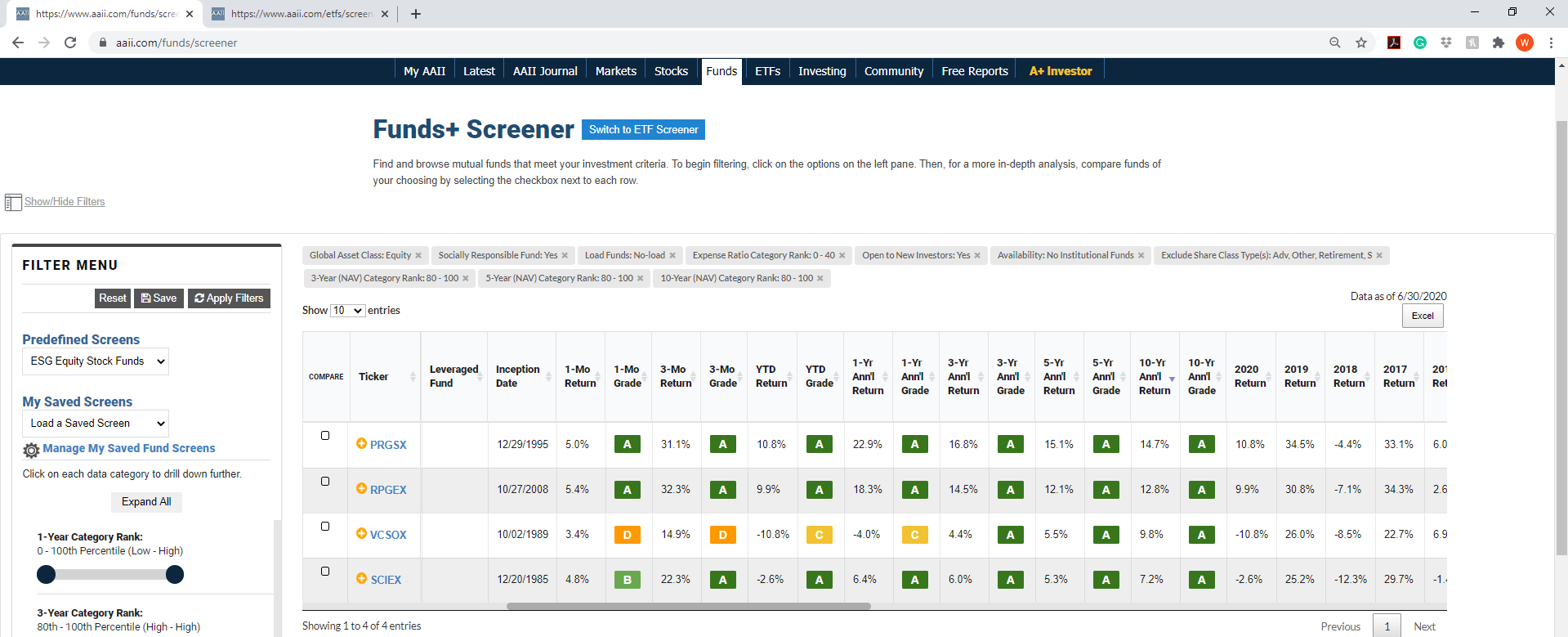
From the 29 ESG mutual funds that passed the predefined Funds+ screen as of June 30, four rate in the top 20% of their category in terms of net asset value (NAV) performance over the last three, five and 10 years. Here is the list ranked in descending order by 10-year return:
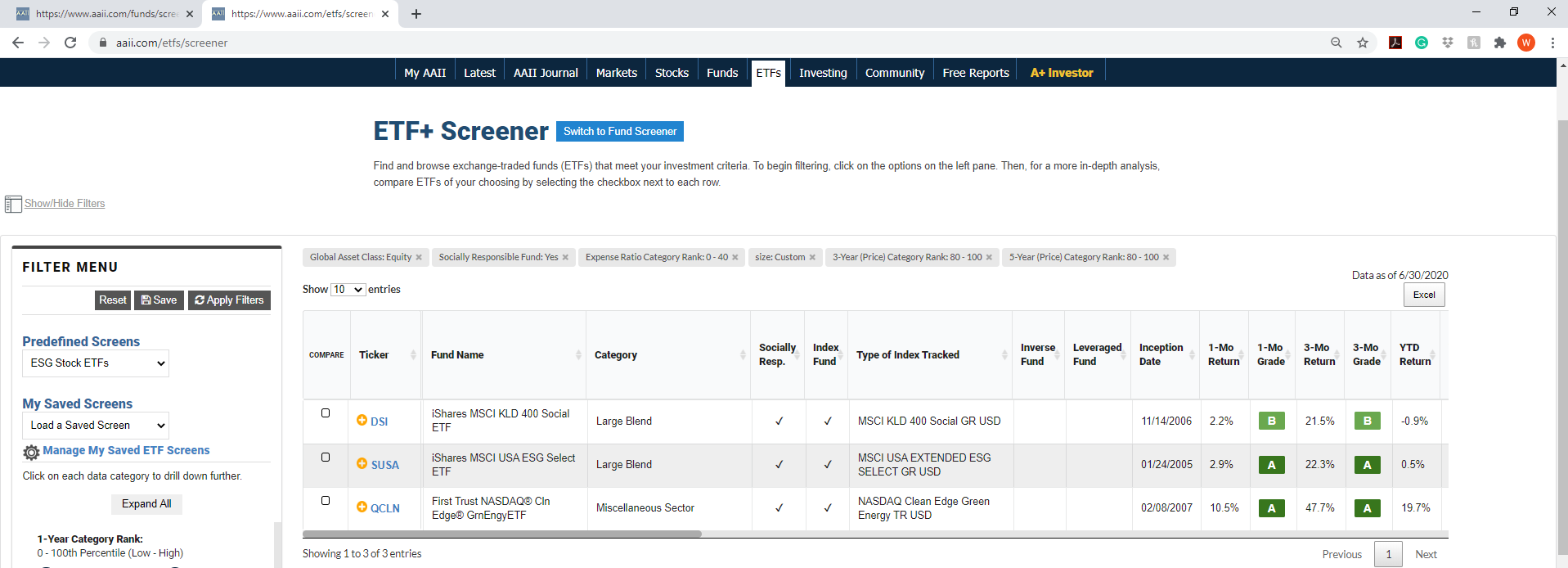
Of the 23 ETFs passing the ESG Stock ETFs screen as of the end of June, three ranked in the top 20% in their category in terms of price return over the last three and five years. These three ETFs are presented in the table below and are sorted from highest to lowest based on total 10-year performance: