 TRMCX
TRMCX
Have you ever spent the time researching a mutual fund that meets your objective(s), time horizon and risk tolerance, only to find that it is closed to new investors?
If this has happened to you, it may beg the question of why a fund closes and why a closed fund would reopen. This installment of Making the Grade With A+ Investor will cover the process, why it happens and how it affects investors.
What happens when a mutual fund closes?
When a mutual fund closes, investors cannot buy more of it. Current investors can remain invested in the fund, but they can also sell their fund shares if they wish.
Generally speaking, a mutual fund has two options for closing. First, it might close only to new investors. This means if you already own shares in the fund, such as in an individual investment account or 401(k) plan, you can still buy more shares.
Alternatively, the fund can close to all investors, meaning no one can purchase more shares.
Furthermore, a fund can initially close to new investors but then later close to all investors, or it may close to both at the same time.
Once a fund announces it is closing, it may do so that day or give investors time to buy more shares.
Why do funds close?
Closing to new investors or to all investment is one way for a fund to slow or stop the inflow of money that the fund manager(s) must invest. This stops one way that a fund increases its assets or gets bigger. But why would a mutual fund want to do this?
Altruistically, this is a way for managers to protect investors in the fund. Depending on the fund’s objective or investment style, having too big an asset base may force managers to move away from their desired process.
This is a common case for mutual funds that focus on smaller-cap funds, especially when small stocks have been on a roll. As small-cap funds’ assets grow, it becomes harder for fund managers to build meaningful positions in small firms because the increasing amount of money they have to invest can have an impact on the underlying stocks’ prices. This is also true for funds that invest in segments of the market that are less liquid, such as emerging markets.
In these cases, the fund managers can choose to become less concentrated or invest in securities that are more liquid. However, doing so may change the objective or style of the fund, which could make it less attractive to shareholders.
Another consideration that is important for portfolio managers, specifically in diversified funds, is the fund’s positioning in single stocks. Management investment companies registered under the Investment Company Act of 1940 can manage either diversified or non-diversified funds. Diversified funds have assets that fall within the 75-5-10 rule. This rule says that funds can have no more than 5% of assets in any one company and no more than 10% ownership of any company’s outstanding voting stock. Diversified funds must follow 75-5-10 compliance closely, and this rule can be a leading factor causing funds to limit their investments.
It is worth noting that these concerns apply less to passive or index funds and more so to actively managed mutual funds.
When does a fund close?
There are no hard and fast rules for when a mutual fund closes. Undoubtedly, the fund managers and the fund family will consider many factors when deciding the ideal asset size for a fund. The size and capacity of the research team and the liquidity and size of the target security universe are definite considerations.
There is nothing that says a mutual fund must close. Some funds may be driven more by profits and stay open, making shareholder considerations a secondary concern.
Funds may or may not provide details of the closing specifics when they decide to close to certain investors. It is also becoming more difficult to find out when a fund closes. If you are a shareholder of a fund closing to all investments, you will inevitably receive some notification from the fund family. However, looking for news releases when a fund closes, even for funds offered by large fund families, has proven difficult.
What happens when a fund reopens?
Reopenings take place, oftentimes, after a spate of poor performance or large investment outflows from investors selling their shares, thereby reducing the asset size of the mutual fund. If a fund closed because managers were finding it more difficult to invest in their target securities, a reduction in asset size may make this easier. In this case, they might allow newcomers.
When a mutual fund is once again open to investment, fund companies don’t seem to be in a hurry to make that information known either. Once again, if you own shares in a mutual fund that has been closed to investment, you will probably receive a notice that you can once again buy shares.
Even if a fund “reopens” there may be restrictions. The T. Rowe Price Mid-Cap Value fund (TRMCX) reopened to investment earlier this year. But if you go to the T. Rowe Price website, you see that the fund’s shares are restricted. According to T. Rowe Price, restricted shares may be restricted for purchases.
How can I check to see if a fund is open?
As an A+ Investor subscriber, you have access to Fund Evaluator pages for a universe of over 25,000 mutual funds. Using the search box at the top of any AAII.com page, type in a ticker symbol of a fund and when the autofill displays the name of the fund you are looking at, click on it.
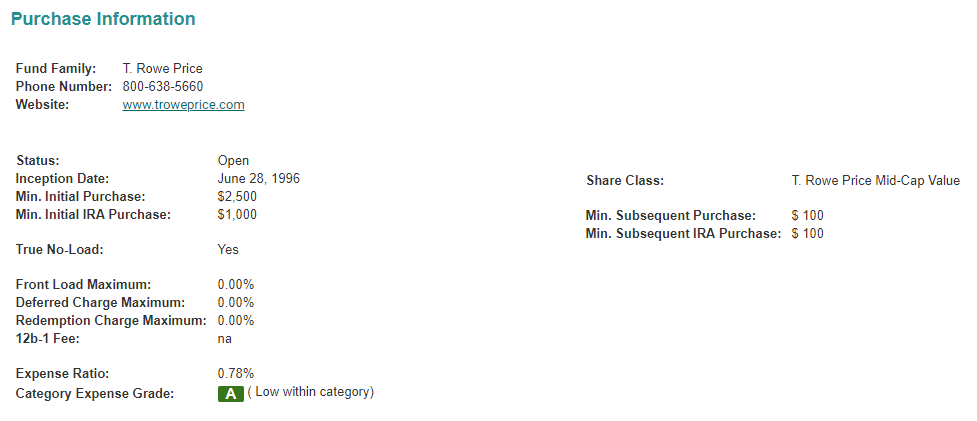
On the Overview tab of the Fund Evaluator, scroll to the bottom to the Purchase Information section. There you will the fund’s status, indicated by Open or Closed.
Here is an example for the T. Rowe Price Mid-Cap Value fund, which shows its open status:
In addition, the Investing Ideas menu at AAII.com has a Fund Openings and Closings listing where you can see funds in the universe that have opened or closed in the past month:
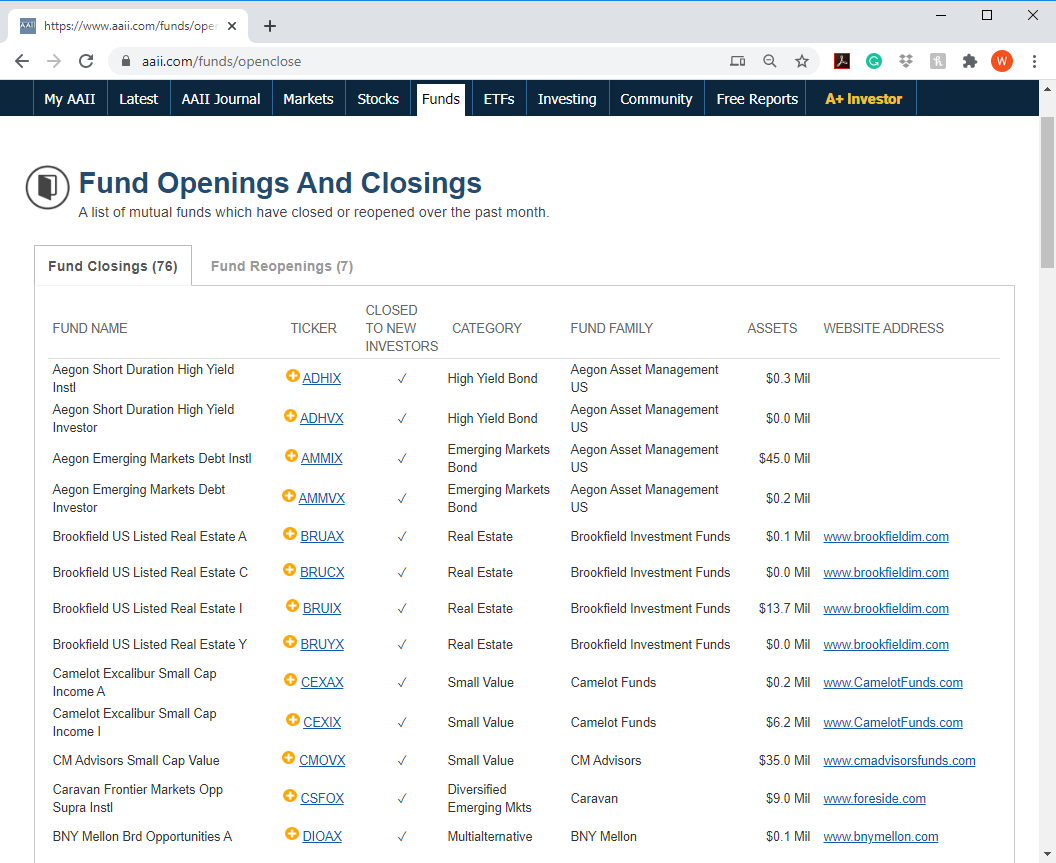
As of August 2, 2020, 76 funds have closed within the past month, while seven have reopened.
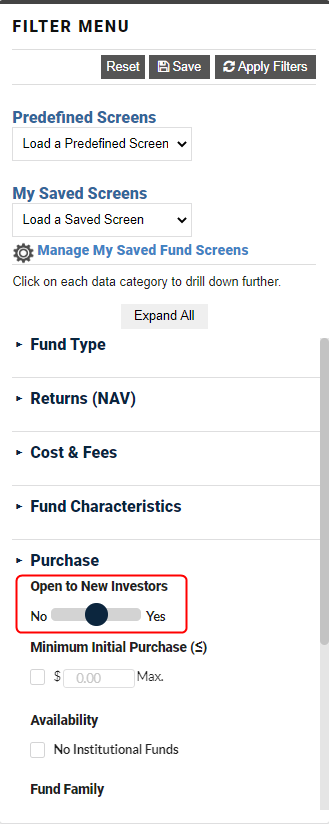
To avoid the frustration of finding a promising fund that is not open to new investors, you can also screen for only those funds that are open using the Funds+ Screener.
From the Filter Menu at the left side of the screener page, under the Purchase data category, move the slider to Yes under Open to New Investors:
What should I do if my fund is closing?
Fund closings usually occur to protect existing shareholders, so if you hold shares in a fund that announces it is closing to new investors, this may actually be a good thing. The situation is different, however, if the fund closes to all investment. In this case, you will not be able to keep buying additional shares until the fund reopens.
Typically closing to new investors is not a performance-related issue. If you own shares in a mutual fund that is closing to new investors, you shouldn’t panic. If a fund does not provide full disclosure on the closing, you can request additional information from the fund family.
Often, closing to new investors is done to help the fund’s operational efficiency and, thus, improve its performance. Current investors should keep in mind that liquidating their entire investment in the fund can keep them from making new investments in the future.

