Selecting good investments is key to achieving your financial goals. But this is only one piece of the puzzle. You need to pay attention to the diversification of your overall portfolio and your asset allocation. These two elements have a significant impact on the overall risk of your portfolio.
The diversification benefits of holding a diverse collection of assets is tied to how the investments are correlated with each other. According to modern portfolio theory (MPT), investors can maximize their return potential and reduce the risk of losses by combining investments in asset classes that are not perfectly correlated with one another. A combination of investments such as this is likely to do reasonably well in a variety of economic and market environments, because as one asset is falling, another is likely rising.
Using the My Portfolio tool of A+ Investor, you can assess the asset allocation of a portfolio. When you first use the asset allocation analyzer, you are asked to describe what kind of investor you are (you can modify this at any time as well). The analyzer then compares your asset allocation to AAII’s asset allocation models to see whether your current allocation is “conservative,” “moderate” or “aggressive.”
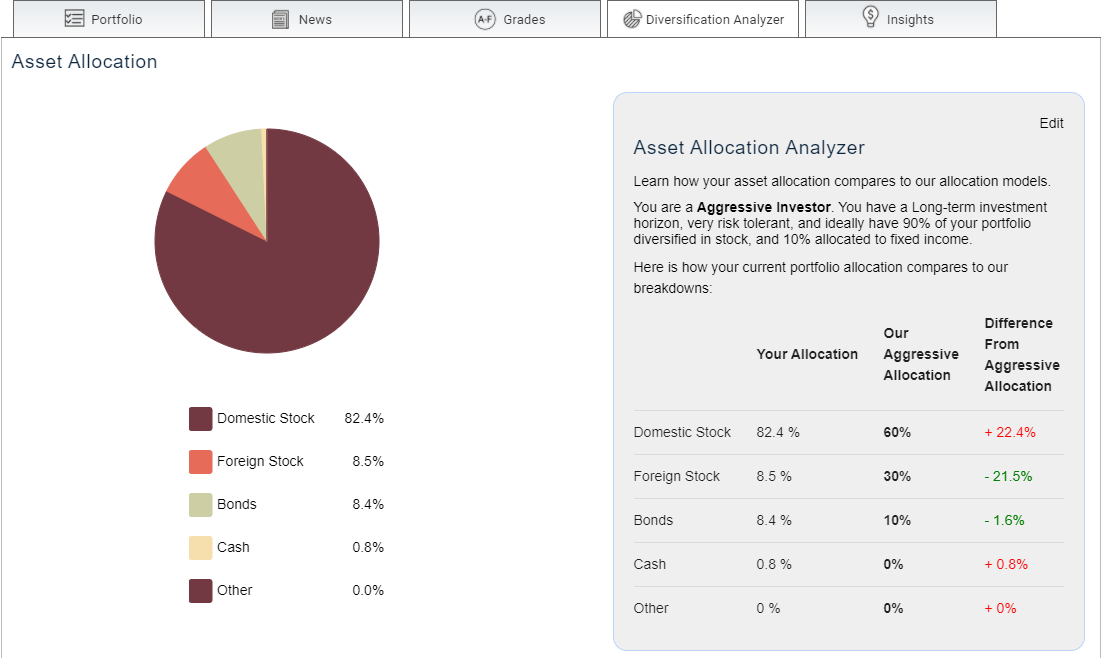
Once you’ve established an optimal asset allocation that meets your investment personality, it is advisable to rebalance back to your target allocations every so often, perhaps quarterly, twice a year or annually. And as you near retirement, or the time when you need the money for a key expenditure such as a child’s education or buying a new house, the assets needed to fund that expenditure should be moved away from risky assets such as individual stocks and stock funds. The objective in these cases is preserving wealth, not amassing it.
For many investors, though, this task may seem daunting. Others, however, can handle the task and do it quite well. Some investors prefer to outsource the tasks of portfolio assembly, rebalancing and adjusting to a more conservative asset allocation over time. This is where target-date funds come into play: They do all of this for you.
A target-date fund is a “fund of funds”—a fund made up of other funds. The underlying funds held in a target-date fund offer a diversified exposure to a mix of asset classes such as stock (small-, mid- and large-caps), foreign stocks, bonds, foreign bonds and perhaps a portion of cash-like securities such as money market funds. Target-date funds are designed to be held throughout a person’s lifetime, and the asset allocation mix shifts dynamically, becoming less risky over a person’s working career and into retirement. These funds achieve this by rebalancing their portfolios over time to become less focused on asset growth (lowering their allocation to stocks) and more focused on wealth preservation (increasing their allocation to bonds) as the fund approaches and passes the target date. (The years in the fund’s name corresponds, approximately, to the investor’s retirement date.)
According to data from Morningstar, there was $2.3 trillion invested in target-date funds at the end of 2019. A primary reason for their popularity is due to their relative ease of ownership—they offer a hands-off approach to portfolio diversification, with asset allocation and rebalancing that is being made by professional managers.
You may have a limited number of choices, but there are still some key factors to consider when selecting a target-date fund. Here are some things to look for.
Low fees
More definitely isn’t better when it comes to how much you pay to own a mutual fund, and the same holds true for target-date funds. For that reason, it is important to pay attention to the overall cost of owning a target-date fund. Often, you not only pay the blended costs of the underlying funds held by the target-date fund but also the additional management fees the adviser charges to implement their asset allocation “glide path” (I discuss the target-date’s glide path shortly). It’s worth noting that target-date funds that are closer to their target retirement date tend to be less expensive because their asset mix is starting to move away from the higher-priced equity portion and toward lower-cost fixed-income options.
All else equal, look for target-date funds with low fees.
As someone who’s in his mid-40s, I put my target retirement date around 2040 (unless I am holding the winning Powerball ticket to the upcoming $50 million Mega Millions drawing).
Using the Funds+ mutual fund screener available to A+ Investor subscribers, there are 163 target-date funds with 2040 as the target date that are non-institutional funds and are open to new investors.
Adding the additional requirement that the target-date fund must rank in the bottom 20% of its category in terms of expense ratio lowers the number of funds to 24.
Since I am a fan of Vanguard funds, that led me to the Vanguard Target Retirement 2040 fund (VFORX).
According to data on the fund provided by the Fund Evaluator, it is a true no-load fund, charging no front load, deferred charge or redemption fee. The fund also does not charge a 12b-1 fee. Overall, the fund charges an annual expense ratio of 0.14%.
According to the Vanguard website, the fund offers a diversified portfolio with a single fund that adjusts its underlying asset mix over time. The fund provides broad diversification while incrementally decreasing exposure to stocks and increasing exposure to bonds as its target retirement date approaches. The fund continues to adjust the mix for approximately seven years after the target retirement date. The fund is for those planning to retire between 2038 and 2042.
An asset mix that suits your risk tolerance
Depending on the fund family, target-date funds with the same target retirement date may invest more aggressively than others, specifically with a higher allocation to stocks, including foreign stocks.
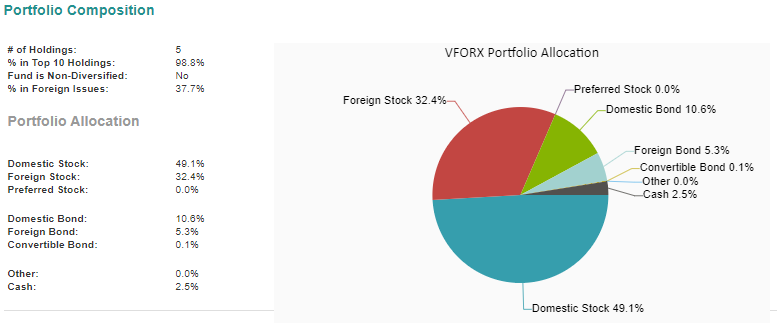
The Vanguard Target Retirement 2040 fund is invested 81.5% in stocks, with a breakdown of 49.1% in domestic stocks and 32.4% in foreign stocks.
Among the 24 target-date 2040 funds that meet my filters, the allocation to stocks ranges from 72.1% for the Goldman Sachs Target Date 2040 fund (GTMMX) to 87.8% for the Fidelity Freedom Index 2040 fund (FBIFX). Looking at the allocation to foreign stocks, the allocation among these 24 target-date 2040 funds ranges from a low of 14.4% for the Mutual of America 2040 Retirement (MURLX) to 41.1% for the Fidelity Flex Freedom Blend 2040 fund (FCLSX).
This data reinforces the need to examine the underlying exposure to stocks and foreign stocks as well as fixed income, especially the allocation to high-yield bonds, to see if this allocation suits your risk tolerance.
The Fund Evaluator pages generated by A+ Investor provide statistics about a fund’s portfolio. For example, here is the snapshot of the big-picture asset allocation of the Vanguard Target Retirement 2040 fund. Here you see that the stock allocation of the fund is 81.5%, with 49.1% in domestic stocks and 32.4% in foreign stocks.
A “glide path” that makes sense
I’ve mentioned the term glide path a few times without offering a definition of what it means. A target-date fund’s glide path refers to a formula that defines the asset allocation mix of the fund, based on the number of years to the target retirement date. The glide path creates an asset allocation that typically becomes more conservative—lowers the allocation to stocks and increases the allocation to fixed-income assets—as the fund gets closer to the target retirement date. Generally speaking, the glide path is the rate at which a target-date fund adjusts its allocations to stocks and fixed-income investments over time.
Some target-date funds invest more heavily in stocks throughout the life of the fund in the belief that a higher allocation to equity—and the higher returns it typically generates—is necessary to ensure that investors don’t outlive their savings. Target-date funds that invest more heavily in fixed-income assets throughout the life of the fund operate with the belief that being more conservatively invested will preserve wealth and lower the risk of a large market downturn, reducing the likelihood of not having enough money for retirement.
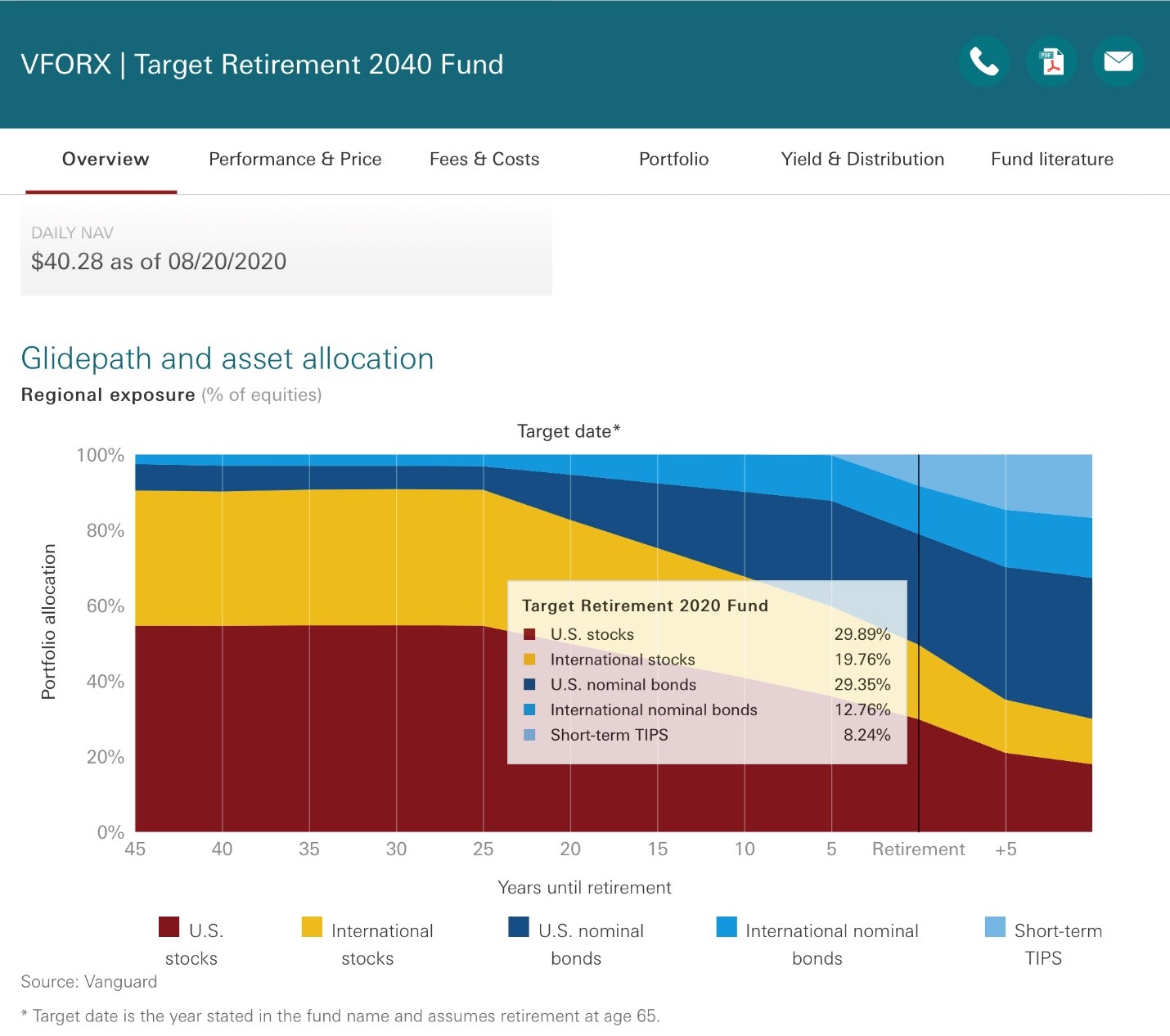
You can learn more about a target-date fund’s glide path from the fund family. At the Vanguard website, I found data for the target allocation of the Vanguard Target Retirement 2040 fund at the retirement date and the final allocation that it reaches approximately seven years after the retirement date.
To get an idea of what the target allocation will be in 2040, we can look at the current allocation for the Vanguard Target Retirement 2040 fund:
A relevant question to ask when investing in a target-date fund is: What happens once the fund reaches its retirement date?
Different target-date funds take different approaches when they reach their retirement date. Some funds convert their assets to a retirement-income fund at the target date, while others do so years after reaching the target date. Still, others maintain the assets in the original fund and keep the same name, even though the target date has passed.
For example, the Vanguard Target Retirement 2015 fund (VTXVX) is still in operation even though it hit its target date five years ago.
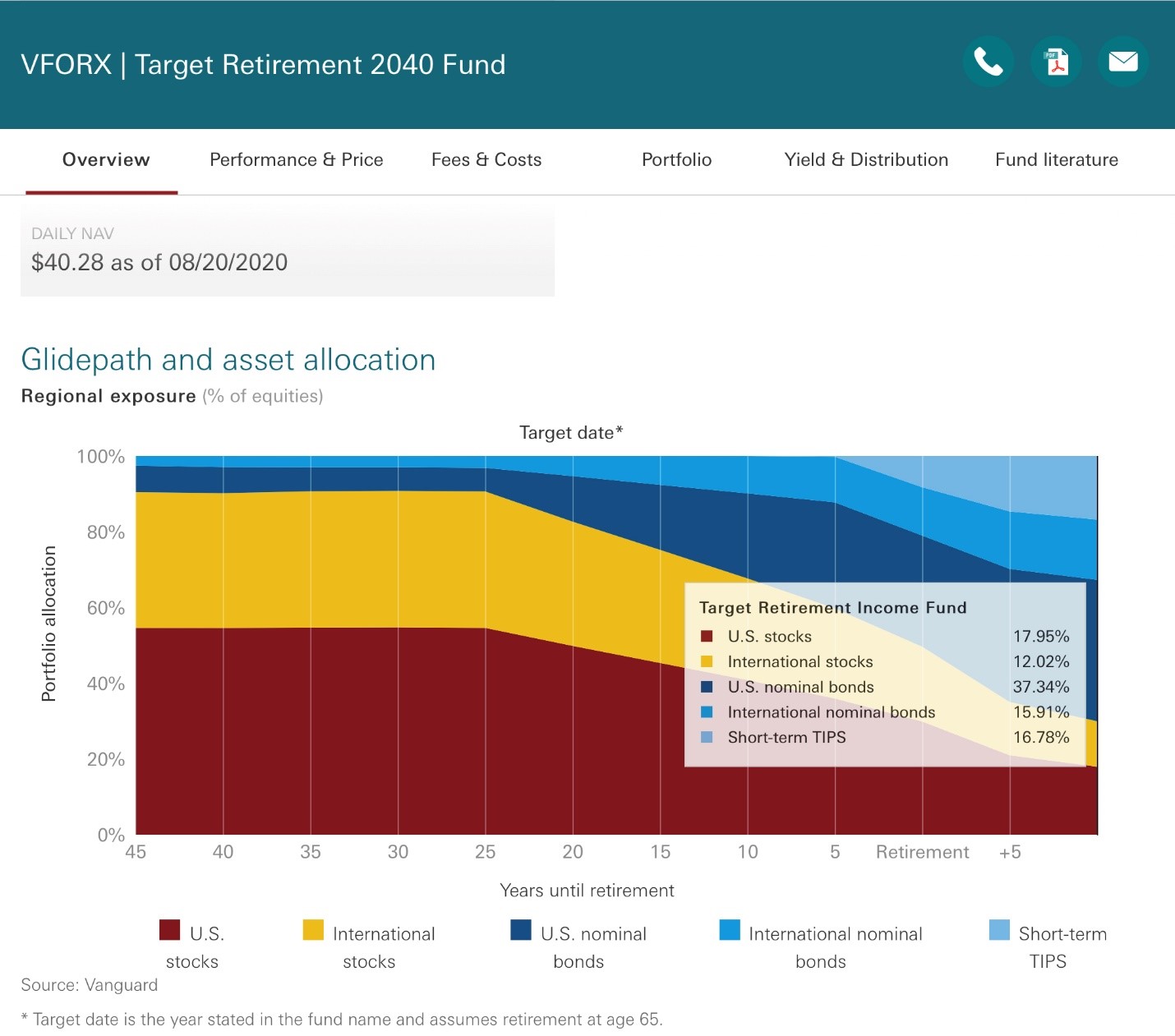
Currently, Vanguard Target Retirement funds with target retirement dates that are more than seven years past their target retirement date have this allocation, as shown in inset box:
The glide path that target-date funds follow to their final allocation rests in two seemingly innocuous, but important, words: “to” versus “through.”
A “to” glide path means that the fund manager stops adjusting the fund’s allocation at the retirement date while a “through” glide path means that the manager continues to adjust the allocation beyond the target retirement date.
According to Morningstar, one of the key differences between a target-date fund with a “to” glide path versus one with a “through” glide path is that, even if they have the same retirement date and both start out with similar allocations to equities, the average “to” path decreases the equity allocation more rapidly than the average “through” glide path. The average “through” fund hits the target date with a higher allocation to equities and can lower this exposure over the next 20 or 30 years before landing at its final allocation. This longer glide path offers greater protection against longevity risk since equities tend to outperform other asset classes over long periods of time. In contrast, the quicker drop in exposure to equities for “to” glide paths tends to lower the risk of exposure to a sharp downturn in stocks when the investor is close to retirement.
The Vanguard Target Retirement funds we’ve discussed are considered “through” funds, since they continue to adjust their allocation up to seven years after the retirement date, but they do so more quickly than other “through” funds.
For many investors, target-date funds are a no-brain solution. But there are some caveats worth mentioning that mean they don’t work for everyone.
First, investors have no control once they select the target-date fund. They cannot adjust the investment or allocation decisions of the fund. In addition, by choosing a target-date fund, you are usually limited to a given fund family’s funds. Most target-date funds use their own underlying funds to build the target-date fund’s portfolio. One drawback with this is that few fund families offer best-in-class funds across all asset classes.
Returning to the Vanguard Target Retirement 2040 fund example, the Vanguard site also provides the funds used to arrive at the target allocations throughout the fund’s glide path:
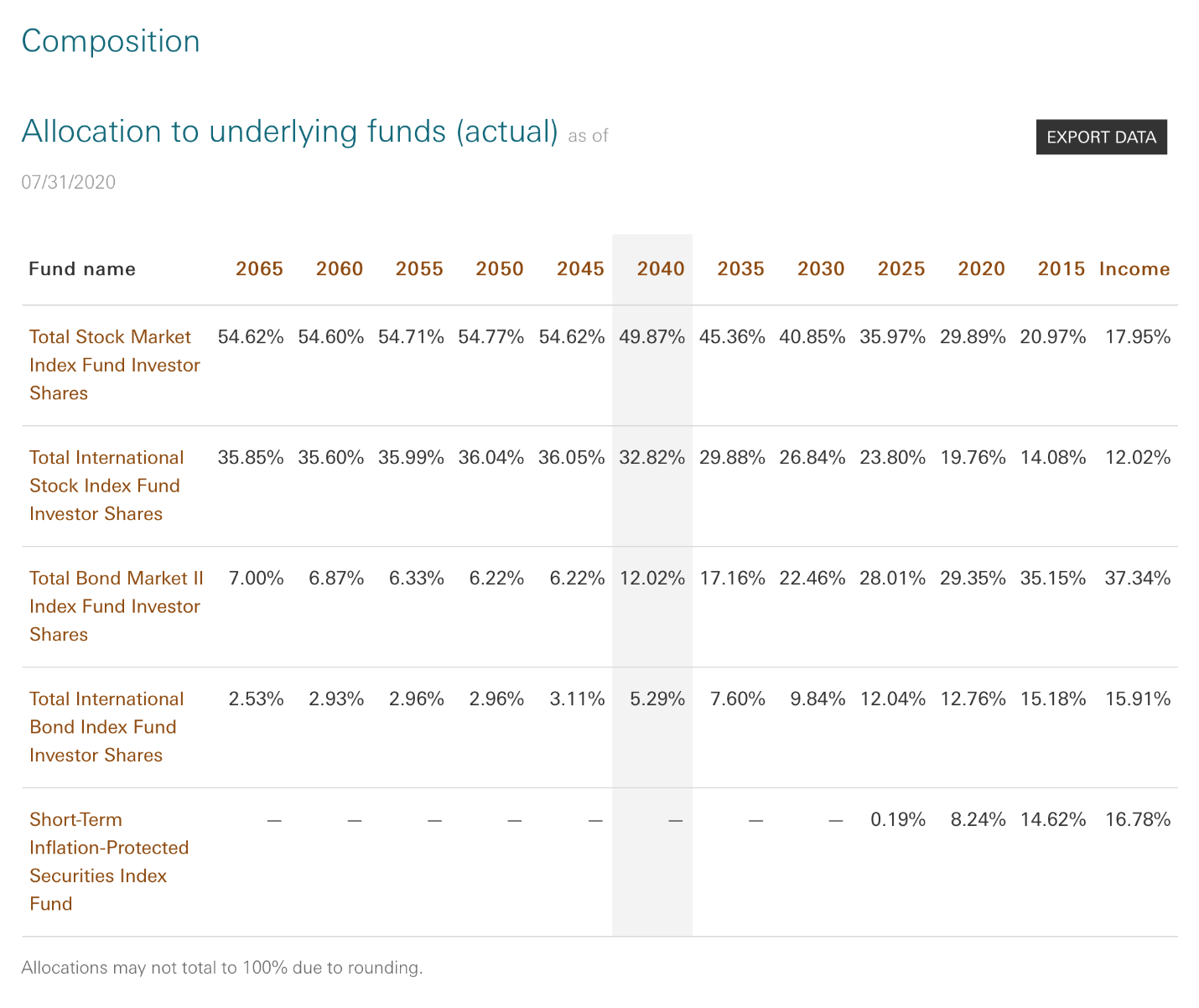
Here we see that the target-date fund currently uses four Vanguard funds to achieve the current asset allocation: Total Stock Market Index Fund, Total International Stock Index Fund, Total Bond Market II Index Fund and Total International Bond Index Fund.
Over time, the exposure to stocks declines while the allocation to bonds increases as the target date approaches. Eventually, the fund will also add the Vanguard Short-Term Inflation-Protected Securities Index Fund as it nears the target retirement date.
Also, target-date funds are intended to be used as a total-portfolio solution. If you own additional holdings, you must consider them as well to make sure you achieve your overall asset allocation. This also means it is up to you to perform periodic rebalancing to ensure that your entire portfolio is in line with your target allocation.
The bottom line, however, is that target-date funds are a comprehensive and easy-to-use solution for retirement savers. They are literally a one-step solution for setting up a diversified portfolio and maintaining a reasonable asset allocation for years, and even decades, to come.


