Stock splits have been in the news more than usual lately, namely because of high-profile stocks like Tesla Inc. (TSLA) and Apple Inc. (AAPL).
This week’s Making the Grade takes a closer look at stock splits and how you can adjust for them in the My Portfolio tool.
All publicly traded companies have a set number of shares that are outstanding. A stock split is a decision by a company’s board of directors to increase the number of shares that are outstanding by issuing more shares to current shareholders.
For example, in a 2-for-1 stock split, an additional share is given for each share held by a shareholder. So, if a company had 10 million shares outstanding before the split, it will have 20 million shares outstanding after a 2-for-1 split.
A stock’s price is also affected by a stock split. After a split, the stock price will be reduced (since the number of shares outstanding has increased). In the example of a 2-for-1 split, the share price will be halved. Thus, although the number of outstanding shares increases and the price of each share changes, the company’s market capitalization remains unchanged.
When a company’s share price increases to levels that it believes are too high, it may decide to do a stock split. The reason for this is that a stock split can make shares seem more affordable to small investors (even though the underlying value of the company has not changed). This also has the practical effect of increasing liquidity in the stock.
When a stock splits, it can also result in a share price increase—even though there may be a decrease immediately after the stock split. Small investors may perceive the stock as being more affordable and buy the stock. This effectively boosts demand for the stock and drives up prices.
Another possible reason for a price increase is that a stock split provides a signal to the market that the company’s share price has been increasing; people may assume this growth will continue in the future, thereby further boosting demand and prices.
When a company announces a stock split, it gives out two dates that are important to shareholders, a record date and an ex-date. You must hold the stock at the close of business on the record date to be eligible for the split, while the actual split itself and the adjustment to the number of shares in your account takes place on the ex-date.
On August 31, Apple split its stock 4-for-1. In a press release on July 30, Apple said the board of directors approved the 4-for-1 stock split “to make the stock more accessible to a broader base of investors.”
If you held shares of Apple before the market open on August 31, you now own four shares for every share you held, and the stock price was reduced to one-quarter of its value at the start of trading on August 31. Apple shares closed on August 28 at $499.24 (pre-split), which translates into a split-adjusted price of $124.81. On August 31, Apple shares closed at $129.04.
If you sold Apple shares after the record date (August 24) but before the open on August 31, you sold them at the pre-split price. You were not entitled to the split shares. If you bought Apple shares after the record date but before August 31, you purchased shares at the pre-split price. Following the split, you received the additional shares resulting from the stock split.
Also on August 31, Tesla split its stock 5-for-1. Mirroring Apple, the company’s press release on August 11 stated that the stock split was “to make stock ownership more accessible to employees and investors.”
If you held shares of Tesla before the market open on August 31, you now own five shares for every share you held, and the stock price was reduced to one-fifth of its value at the start of trading on August 31. Tesla shares closed on August 28 at $1,996.96 (pre-split), which translates into a split-adjusted price of $442.68. On August 31, Tesla shares closed at $498.32.
If you sold Tesla shares after the record date (August 21) but before August 31, you sold them at the pre-split price. You were not entitled to the split shares. If you bought Tesla shares after the record date but before August 31, you purchased shares at the pre-split price. Following the split, you received the additional shares resulting from the stock split.
Another version of a stock split is called a reverse split. Companies with low share prices typically use this procedure to increase their prices. A company may do this if they are afraid that their shares are going to be delisted or as a way of gaining more respectability in the market. Many stock exchanges will delist stocks if they fall below a specific price per share.
For example, in a reverse 1-for-5 split, 10 million outstanding shares at $0.50 each would now become 2 million shares outstanding at $2.50 per share. In both cases, the company’s market capitalization (share price multiplied by the number of shares outstanding) is still $5 million.
In May 2011, Citigroup Inc. (C) reverse split its shares 1-for-10 to reduce its share volatility and discourage speculator trading. The reverse split increased its share price from $4.52 to $45.12 post-split. Every 10 shares held by an investor were replaced with one share. While the split reduced the number of its shares outstanding from 29 billion to 2.9 billion shares, the market cap of the company stayed the same (at approximately $131 billion).
When it comes to stock splits, this is perhaps the most straightforward question to answer, because most of the time investors should do nothing at all.
You may want to reconsider a stock you own if it undergoes a reverse split, as it often encourages more selling after the action. But with a regular split, there isn’t much more to do besides standing pat. Historically, there is a good chance that immediately following both the announcement and the ex-date, the stock will get a small boost, so if you were thinking of selling just before an announcement, you might want to hold off a little before doing so.
If you hold a stock in a portfolio within the My Portfolio tool, you need to make adjustments for stock splits.
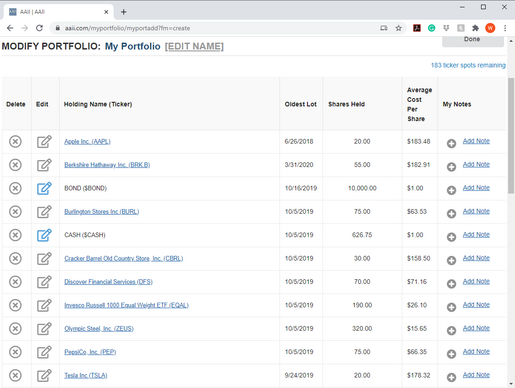
I own shares of Apple and Tesla, so I need to make adjustments to both the number of shares that I own as well as the purchase price.
The image above shows some of my portfolio holdings, including those of Apple and Tesla. Both of the cost per share values are pre-split, as are the number of shares, so I need to adjust these figures to reflect the impact of the splits.
To edit your holdings in a portfolio you’ve created, first go to the My Portfolio tool. At the My Portfolio landing page, select the portfolio with the stocks that need adjusting from the drop-down menu. Once that portfolio is loaded, click the Modify link to the right of the portfolio drop-down menu.
From the list of portfolio holdings on the Modify Portfolio page, click on the pencil icon to the left of the holdings you wish to modify. For this example, I want to edit Apple, so I click on the pencil icon next to its name, which takes me to the Modify Transactions page for Apple.
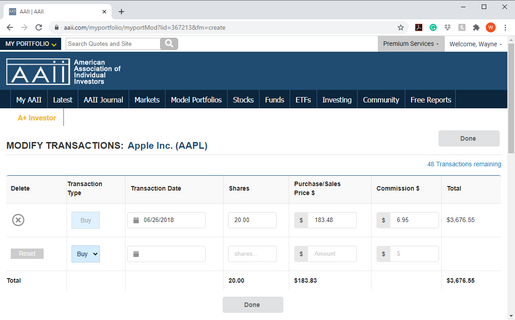
Here we see that I purchased 20 shares of Apple on June 26, 2018, for $183.48 per share.
To adjust for Apple’s 4-for-1 split, there are two values I need to adjust: the shares and price. To account for the 4-for-1 split, multiply the number of shares by the split factor, in this case, four. So the number of shares I own after the Apple split is 80. Since the number of shares is increased, the purchase price needs to drop. Specifically, for the Apple split, the purchase price is divided by four: $183.48 ÷ 4 = $45.87.
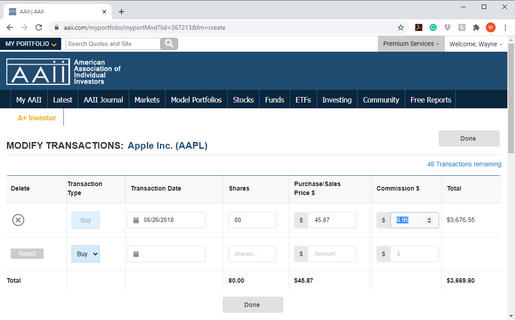
So, while the number of shares and purchase price have changed, notice that the overall holding value has not changed at $3,676.55.
To save the changes I made, I click the Done button.
I repeat the process for Tesla, although for a 5-for-1 split. This means I multiply the number of shares I own by five (20 × 5 = 100) and divide the purchase price by five ($178.32 ÷ 5 = $35.664).
A stock split is used primarily by companies that have seen their share prices increase substantially. Although the number of outstanding shares increases and the price per share decreases, the market cap (and the value of the company) does not change. As a result, stock splits help to make shares more affordable to smaller investors and provide greater marketability and liquidity in the market.
Stock splits are much more common than most investors think, although their impact is minor. The most important thing to keep in mind, though, is that they don’t change the value of your holding, although they may have some influence on the stock’s performance for a while after they happen.


