Emerging markets have remained a popular investment area since their introduction in the early 2000s. Since then, a number of new funds and tools for investing in emerging markets have been introduced. Emerging markets are a unique investment opportunity because they offer equal parts of risk and reward. While there is the potential for large gains for investors who can correctly identify the right emerging market investment at the right time, the risks involved are sometimes not well understood.
Emerging markets represent countries with younger and generally less developed economies. Since many also have younger and growing populations, they offer the potential for higher levels of long-term economic growth.
The phrase emerging markets was coined by economists in the early 1980s to define investing in developing countries. Although the term is widespread, there isn’t one agreed upon definition.
Here are some clarifications that may be helpful for investors looking at this segment of the market:
Current emerging market economies include India, Mexico, Russia, Pakistan and Saudi Arabia. When identifying emerging markets, investors and economists are looking for countries where there is very little political or social unrest and consistent economic growth.
When it comes to investing in emerging markets, many investors wonder whether they should. To that end, here are two potential advantages to consider:
It’s important to realize that the process of moving from an emerging market to a developed economy can be a roller-coaster trajectory. Countries can face political turmoil or natural disasters that can seriously (and suddenly) stifle their economic growth. Unfortunately, this can cost enthusiastic investors.
For example, Russia has alternated between an emerging market and a developing economy since the 1990s. The aftermath of communism and poor monetary management created a massive debt default, significantly devaluing the Russian ruble. For a time, as a result, the country was considered a poor investment. The political backdrop in Russia has also posed a problem for investors. However, Russia has access to large amounts of oil reserves and mineral deposits, making it very likely that it will evolve into a developed country in the near future.
Investing in emerging markets carries with it three distinct risks:
Mexico and Turkey are two emerging markets that have seen significant amounts of all three risks in the past year. First, there was the dubious sacking of the governor of Turkey’s central bank. This was followed by the surprise resignation of Mexico’s finance minister, citing political meddling in monetary policy. Markets in both countries saw significant volatility as a result. The Turkish lira and Mexican peso fell more than 2% against the U.S. dollar and analysts warned of further disarray ahead, jeopardizing economic growth and the ability of borrowers in both countries to repay their debts.
Investing too late in an emerging market is another risk of this type of investment. China is a good example of an economy that was previously considered an emerging market. However, by the time that the majority of people became aware of the growth of the Chinese economy, it was already well on its way to becoming an economic powerhouse. In addition, at the apex of an emerging market’s popularity, investing can be very costly. Also, the growth of emerging markets isn’t steady and can be very volatile, so the timing of an investment is very important.
When basic caution is exercised, the rewards of investing in an emerging market can outweigh the risks. Despite the volatility, the most growth and the highest-returning stocks are going to be found in the fastest-growing economies. The secret to adding growth from emerging markets to your portfolio is to limit yourself to reasonable risks.
In today’s global economy, many U.S. blue-chip stocks offer decent exposure to emerging markets because of their global operations. For example, the revenue mix of Coca-Cola reflects the fact that it is popular in China, Japan and the U.S. Buying blue-chip stocks or funds that invest in the stocks of multi-national firms can add emerging market exposure to the balance of developed market stability.
Exchange-traded funds (ETFs) are a great option for investing in emerging markets because you can add an entire country or a combination of countries to your portfolio.
Investors looking to gain exposure to emerging markets via an ETF appear to have a good selection from which to choose. AAII’s ETF universe currently tracks 76 ETFs that are in the diversified emerging market category. However, this is a relatively small segment given that there are nearly 2,400 ETFs traded on U.S. exchanges.
Taking a closer look at this universe, however, the question as to which one to select becomes more complex.
Roughly 10% of the 76 emerging market funds that AAII tracks are tagged by Morningstar as not being index funds. This means they are not trying to mimic the performance of a given index, instead use a variety of strategies to determine which stocks are held and in what amounts.
Beyond that, there are differences in the countries and sectors these ETFs invest in, which can lead to significant differences in their performance. Year to date, through the end of August, the 73 emerging market funds in the AAII ETF universe that reported performance for the year ranged from 53.6% for the EMQQ Emerging Markets Internet & Ecommerce ETF (EMQQ) to a loss of 31.9% for the iShares Emerging Market Infrastructure ETF (EMIF). For 2020, through the end of August, the average emerging market ETF is down 4.2%.
Fifty-four of the 76 emerging market funds in the AAII universe have three-year annual returns that range from a high of 15.9% a year on average for the EMQQ Emerging Markets Internet & Ecommerce ETF to an average annual loss of 12.1% for the iShares Emerging Market Infrastructure ETF. The average fund in this group has eked out an annual gain of 0.3% over the past three years.
Only 13 of the 76 ETFs have 10-year track records, while less than 40 were launched within the past five years.
Looking at the ETFs with the most assets, the $29 billion iShares MSCI Emerging Markets ETF (EEM) holds more than 1,200 stocks and returned 17.7% in 2019. However, it has an expense ratio of 0.68%, which is more than four times that of comparable ETFs, including the $54 billion iShares Core MSCI Emerging Markets ETF (IEMG), which holds over 2,500 stocks and charges just 0.13%.
If you are looking for broad exposure to emerging markets with relatively low costs, there is the Vanguard FTSE Emerging Markets ETF (VWO), which owns 4,200 stocks and charges 0.10% and the SPDR Portfolio Emerging Markets Equity ETF (SPEM), which holds 2,300 stocks and has an expense ratio of 0.11%.
As an A+ Investor subscriber, you can use the ETF+ screener to identify emerging market funds.
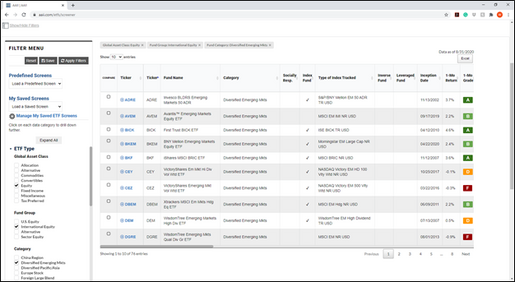
As an example screen, we looked for those ETFs in the Equity Global Asset Class, International Equity Fund Group and Diversified Emerging Markets Fund Category. With data as of the end of August, there are 76 ETFs that match these criteria:
Since expenses can play a major role in the long-term performance of ETFs (and mutual funds) we also looked for those emerging market ETFs that rank in the bottom half of their category in terms of expense ratio. This narrowed the emerging market ETF universe down to 40.
To avoid ETFs that may be on the verge of closing, we also required that emerging market ETFs have at least $100 million in total assets, leaving us with 21.
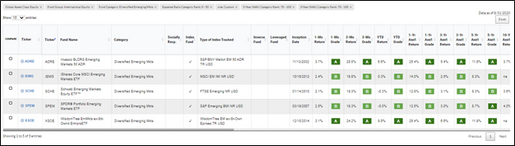
Shifting to performance, we further narrowed down this universe to look for funds that outperformed 70% of their category peers based on net asset value (NAV) returns over a three- and five-year basis. This reduced the universe of emerging market funds down to five:
Emerging market ETFs come in many shapes and sizes and it’s important to remember that not all emerging market ETFs are created equal. When investing in emerging market ETFs, there are two issues to keep in mind: Keep your fees down and invest in ETFs that are large and liquid enough to buy and sell without complications.


