Although October is only a few days old, it’s never too early to consider taxes in your overall investment strategy. In fact, it could be a costly mistake to only think about taxes in mid-April.
If you invest in mutual funds—whether you are just starting out or are looking to make changes to your portfolio—understanding a fund’s tax efficiency could save you money in the long run.
In this installment of Making the Grade, we examine the ways in which you can use A+ Investor to gauge the tax-friendliness of a mutual fund.
When it comes to investing in mutual funds versus individual stocks, fund investors are at a disadvantage when it comes to taxes.
Stock investors pay taxes on an investment only if they have pocketed dividends or income or have sold stocks for a profit. This means stock investors have a significant level of control over when they have to pay taxes.
But investors of traditional mutual funds can face a tax bill even if they haven’t sold any of their holdings or if they’ve lost money since investing in the fund.
Like all investors, mutual fund holders have to pay taxes on dividends from stocks and interest from bonds. However, they also have to pay taxes on fund distributions. A distribution generally refers to the disbursement of assets from a fund to an investor. Mutual fund distributions consist of net capital gains made from the profitable sale of portfolio assets, along with dividend income and interest earned by those assets. Mutual funds tend to be tax-inefficient from the standpoint that investors do not have control of when a fund manager sells portfolio assets.
There is also a difference in tax treatment between open-ended mutual funds and exchange-traded funds (ETFs). ETFs can be more tax-efficient compared to traditional mutual funds. Generally, holding an ETF in a taxable account will generate less tax liabilities than if you held a similarly structured mutual fund in the same account.
From the perspective of the IRS, the tax treatment of ETFs and mutual funds are the same. Both are subject to capital gains tax and taxation of dividend income. However, ETFs are structured in such a manner that taxes are minimized for the holder of the ETF, and the ultimate tax bill—after the ETF is sold and capital gains tax is incurred—is less than what the investor would have paid with a similarly structured mutual fund.
In essence, there are fewer “taxable events” in a conventional ETF structure than in a mutual fund.
Here’s why:
A mutual fund manager must constantly rebalance the fund by selling securities to accommodate shareholder redemptions or reallocate assets. The sale of securities within the mutual fund portfolio creates capital gains for the shareholders, even for shareholders who may have an unrealized loss on the overall mutual fund investment.
In contrast, an ETF manager accommodates investment inflows and outflows by creating or redeeming “creation units,” which are baskets of assets that approximate the entirety of the ETF investment exposure. As a result, the investor usually is not exposed to capital gains on any individual security in the underlying structure.
However, it’s worth pointing out that mutual fund managers take advantage of carrying capital losses from prior years, tax-loss harvesting and other tax mitigation strategies to diminish the impact of annual capital gains taxes.
Also, index mutual funds are far more tax-efficient than actively managed funds because of lower turnover.
So how can you gauge the impact of taxes on your fund holdings? High turnover can be a signal that a find may not be tax-efficient.
Using the A+ Investor Funds+ Screener, we isolated those non-index U.S. equity funds that track the technology sector. We also excluded institutional funds and other “non-investor” funds and those that are not open to new investors. Lastly, we looked for those technology funds with turnover ratios below their category average and not charging a load (no-load funds). As of August 31, 2020, there are 12 funds in the A+ Investor universe matching these criteria.
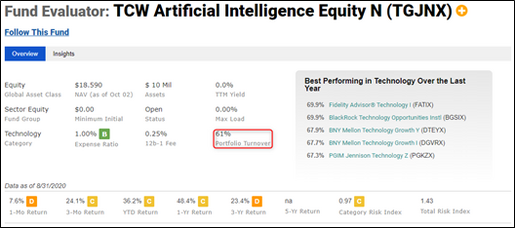
Among these 12 funds, the annual portfolio turnover ranges from 0% for the Firsthand Alternative Energy fund (ALTEX) to 61.1% for the TCW Artificial Intelligence Equity N fund (TGJNX).
The Fund Evaluator pages available to all A+ Investor subscribers provide portfolio turnover information, as shown in the image below.
Another useful metric is the tax-cost ratio, which comes from Morningstar and measures how much a fund’s annualized return is reduced by investors’ taxes on distributions. Mutual funds regularly distribute stock dividends, bond dividends and capital gains to their shareholders. Investors then must pay taxes on those distributions during the year they were received.
Think of the tax-cost ratio as you would an expense ratio. Like an expense ratio, the tax-cost ratio is a measure of how one factor can negatively impact performance. The lower the tax-cost ratio, the lower the tax impact if you hold the fund in a taxable account. Like an expense ratio, it is usually concentrated in the range of 0% to 5%. Zero percent indicates that the fund had no taxable distributions, and 5% indicates that it was less tax-efficient.
For example, if a fund had a 2% tax-cost ratio for the three-year time period, it means that each year investors in that fund lost 2% of their assets to taxes on average. If the fund had a three-year annualized pretax return of 10%, an investor in the fund took home about 8% on an aftertax basis.
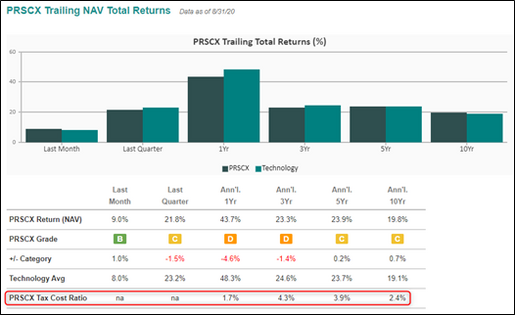
Among the 12 funds from the example above, the Firsthand Alternative Energy and TCW Artificial Intelligence Equity N funds have tax-cost ratios of 0.0%. In contrast, the T. Rowe Price Science & Technology fund (PRSCX) has a three-year tax-cost ratio of 4.3% (its annual portfolio turnover is 55.9%).
Tax-cost ratio data is also provided on the Fund Evaluator pages, as shown below.
This is not to say that you should automatically buy a fund because its tax-cost ratio is low or zero. Many good funds pay out distributions, so you shouldn’t necessarily avoid a fund just because it has a tax-cost ratio greater than 0%. However, you may wish to hold funds with high tax-cost ratios in nontaxable accounts, such as 401(k)s and IRAs.


