As an investor, an important consideration is how much risk you are willing to take. For many, risk sounds scary, especially if you aren’t a risk-taker in your everyday life. Add to that the risk associated with your future financial goals and needs, and the proposition takes on even more significance. But in investing, more risk generally means increased return over the long run. So in order to achieve your long-term financial goals, risk is a necessary evil. But like most things in life, too much can be dangerous to your financial health. Take on too much risk and you may lose a good proportion of your investment right before you need it. Likewise, take on too little risk and your money might not grow to the amount that you need—a type of risk that many investors don’t consider. Therefore, you need to take a “three bears” approach to risk—take on the amount that is just right for you.
You can determine the level of risk that is appropriate for you by following these three steps.
Setting the specifics of your goals is essential because different goals—like an emergency fund, a down payment on a house, a child’s college education or retirement—have different time frames that require different risk levels.
To be honest, however, goal-setting is more difficult that it perhaps would seem. Goal-setting requires you to answer big, important questions such as “When I retire, how much annual income will I need to live the lifestyle I desire?”
You then have to prioritize these goals and allocate your limited dollars to save for them. Since these questions are difficult to answer perfectly, you have to make your best estimate for each goal. Once you set these goals, however, it is important to re-evaluate them periodically to see if your proprieties and needs have changed.
By considering your capacity to accept risk, you gain a better understanding of the optimal amount of risk you can take on in order to maximize the chance that you reach your financial goal(s), taking into account how far away you are from that goal (time horizon). The longer your time horizon, the more you can handle short-term dips or losses. This short-term volatility is the price you pay for long-term gains. Over time, these “bumps” smooth out and investors tend to earn a greater return for taking on more risk. It is important to note that there are numerous definitions of risk. Volatility tends to be the most common measure of risk—how much returns vary around the average—but it is not the only measure, and is it not necessarily the measure that is most meaningful to you.
While “investing for the long term” is an oft-used phrase, what it means to individual investors varies greatly. For investors just starting out, the “long run” may be several decades, which means they can afford to take on a higher level of risk since they have a longer time horizon to weather shorter-term declines in their investments.
For investors nearing retirement, the long-term may only mean several years and they can afford little, if any, declines in their investment portfolio. Generally speaking, however, long term is 10 or more years away.
You risk capacity should play a large role in determining your risk level. But you should also consider your risk tolerance—your ability and willingness to accept market swings. You may be willing to accept periodic declines in your portfolio of 5% to 10%, knowing that this short-term weakness won’t ruin your long-term returns. But how would you feel about a 40% decline in your portfolio? Granted it’s hard to know exactly how you would feel until it actually happens. But if the thought of such steep losses makes you uncomfortable, you may need to lower your risk tolerance.
The risk—pun intended—of not considering your risk tolerance is doing greater harm by adjusting your portfolio’s risk at the wrong time. If a portfolio incurs a 40% decline, more risk-averse investors may get overly anxious and decide to move assets from stocks into cash or bonds. However, taking such a conservative stance after a large decline significantly reduces the likelihood of recouping those losses during the eventual rebound. This, in turn, decreases the probability of the investor reaching their goal(s). But if the portfolio was less risky at the onset and, thus, fell by “only” 25%, an investor with less of a stomach for risk might feel comfortable enough to ride out the losses without making any changes to their portfolio.
Always remember that you are investing for a goal. If you make adjustments that prevent you from generating the returns necessary to reach your goal, you’ve defeated the purpose of setting investment goals in the first place.
Risk-tolerance changes need to be small. Instead of adjusting your overall stock or bond allocation, you could fine-tune the individual stock and bond investments you own. Within a stock allocation, for example, more risk-tolerant investors might devote a higher concentration to small-cap stocks.
Asset allocation is one of the most basic, but essential, aspects of sound investing. Empirical studies have shown that perhaps more than 90% of a portfolio’s variability of returns can be explained by strategic asset allocation.
The volatility that we saw over the first four months of 2020 as well as in early September has made choosing an appropriate asset allocation even more significant.
Whether you feel you are taking on too much risk or want to gain more exposure to equities slowly, AAII and A+ Investor have resources to help you adjust your current portfolio to a more appropriate allocation.
AAII Asset Allocation Models
AAII offers members three Asset Allocation Models for three investor “personas” that are based on investment time horizon and risk aversion: aggressive, moderate and conservative.
The asset allocation area can be found by clicking on the Investing menu from the navigation bar. Here you will find the traits generally exhibited by investors in these three categories:
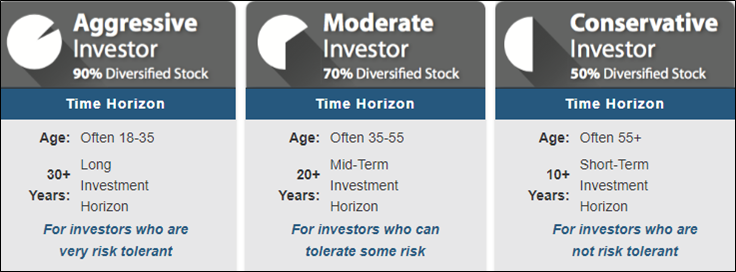
Generally speaking, the younger the investor, and the longer their investing time horizon, the greater their willingness to accept risk and portfolio volatility. For instance, if you are 30 years or more away from retirement, you could target about 90% in stocks and 10% in bonds and cash, but these figures should shift as your time horizon shrinks and the need for being more conservative grows.
Further down the page are suggested allocation breakdowns based on three different investor profiles—aggressive, moderate and conservative:
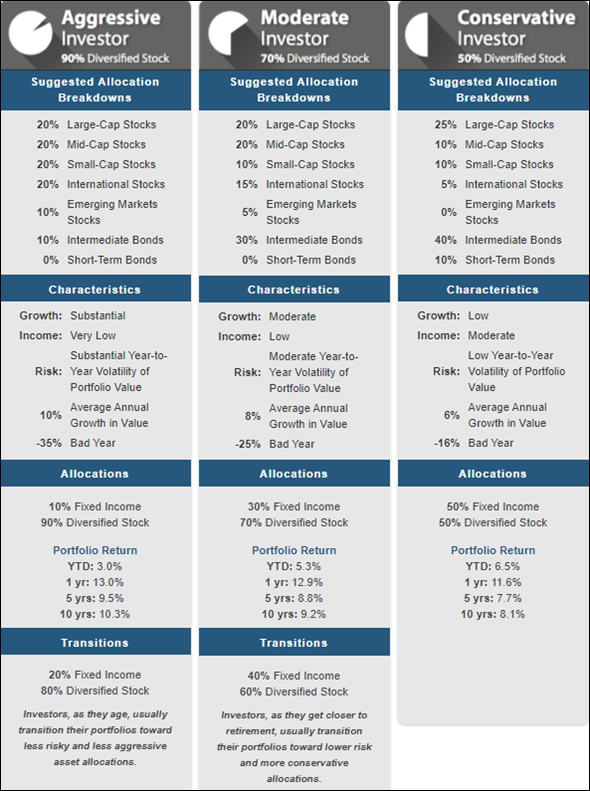
The broad asset allocation scenarios offer a clearer picture of each investor profile, showing the stock/bond allocation, risk and growth characteristics, time horizon and suggested transition allocations. You will find information such as the typical returns you can expect to generate and how much you can expect to lose in a very bad year as an aggressive, moderate or conservative investor.
The suggested allocations are meant to serve only as a guideline because everyone’s situation differs and no one knows how the markets will perform in the future. Aggressive investors are generally thought of as being younger and conservative investors are usually older, although specific situations can call for diversions from this general rule. For instance, tenured professors with a steady income and virtually no risk of losing their jobs might be more aggressive with their portfolios than a young entrepreneur selling high-end jewelry.
Maintaining an Asset Allocation That Fits Your Investment Profile
The first steps in establishing an asset allocation strategy are knowing what kind of an investor you are and establishing a target asset allocation. The next steps are to execute that strategy and then perform periodic portfolio analyses and, if needed, make portfolio adjustments to maintain your desired asset allocation.
For A+ Investors, the Diversification Analyzer in My Portfolio gives a breakdown of how your portfolio is allocated based on the number of shares you’ve entered for each stock, mutual fund and exchange-traded fund (ETF) plus any dollar amounts you’ve entered for cash and/or bond holdings. This information is used to tell you if you are being too aggressive or not aggressive enough given your chosen investing profile.
The first time you click on the Diversification Analyzer tab, you are asked to define what type of investor you are:
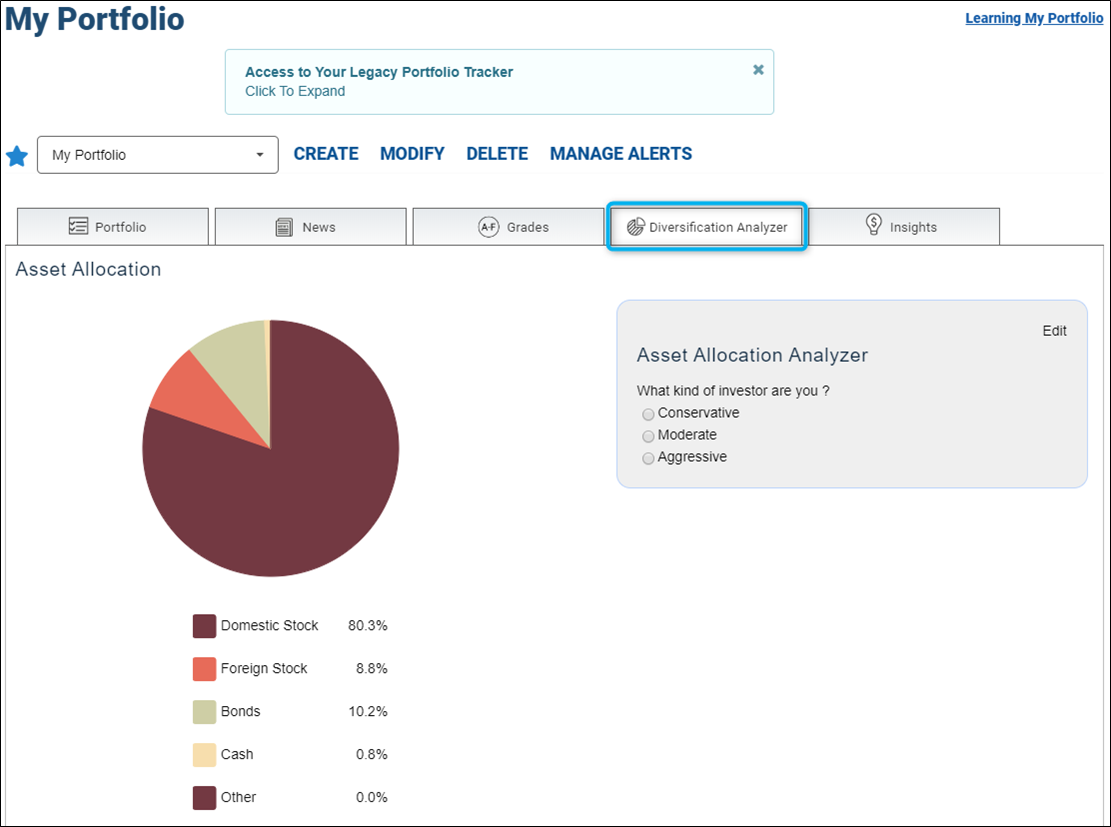
For this example, the investor identifies as being moderate when it comes to risk tolerance. The Asset Allocation Analyzer then presents an analysis of the selected portfolio compared to the selected asset allocation model. For mutual funds and ETFs, the analysis looks at the underlying portfolio, looking at cash and bond holdings as well as allocation between U.S. (domestic) and foreign (non-U.S.) stocks.
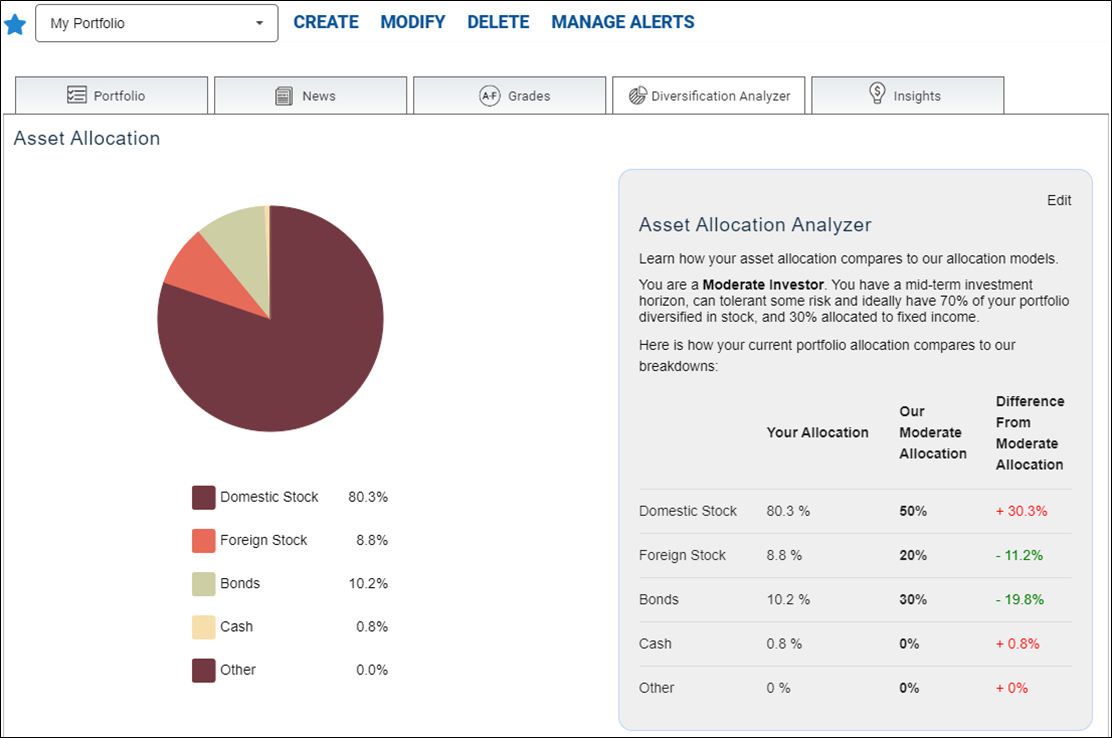
As the Asset Allocation Analyzer shows above, the actual portfolio’s allocation may be too aggressive, based on AAII’s asset allocation model.
Based on the moderate allocation model, this user’s portfolio is overweighted in equities as a group. However, at a more granular level, the portfolio is overweighted in domestic stocks (80.3% versus 50%) but is underweighted in foreign stocks (8.8% versus 20%).
Furthermore, the portfolio is underweight in bonds (10.2% versus 30%).
If this investor truly views themselves as someone who wishes to strike a balance between growing their portfolio yet not being overly aggressive and having some downside protection, they could use this information as a sign to consider reducing their exposure to stocks and increasing their allocation in bonds. On the other hand, if the investor is comfortable with their current allocation, the diversification analyzer is showing that they are not as conservative of an investor as they may have previously thought.
The diversification analyzer is not intended to offer portfolio suggestions but is a means of helping investors identify whether they are as aggressive or conservative in their asset allocation as they think they are.

