VFINX
VFINX
A+ Investor is AAII’s online investment discovery, analysis and tracking tool. It offers numerous resources for investors to analyze potential and current investments. For mutual fund and exchange-traded fund (ETF) investors, the Mutual Fund and ETF Evaluators allow you to take a deep dive into a fund to help you decide whether you wish to continue holding it or whether it is worth adding to your portfolio.
To access either evaluator, type in the fund name or ticker in the search box at the top left of the AAII website (www.aaii.com) and when it appears via the autofill drop-down box, click on the fund name:

Once you are on the Fund (or ETF) Evaluator, you will notice two tabs: Overview and Insights. Both can help you quickly assess a fund’s attractiveness.
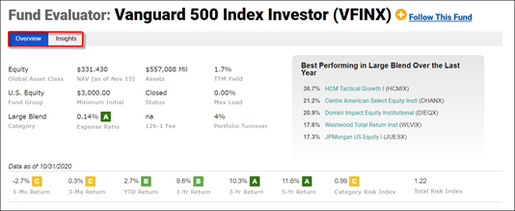
The Overview tab, as the name describes, gives you information about the fund. Here, you will find important statistics such as the fund’s size, its yield, expense ratio and—for mutual funds—the minimum initial purchase amount. You’ll also notice the fund’s grades. These grades measure a fund’s returns and risk against its peers. Grades of A or B signal that the fund is better than its category peers for a specific statistic, such as three-year return. Grades of D or F signal that the fund is worse than its category peers.
The letter grades are calculated by segmenting the funds in the respective mutual fund and ETF categories into quintiles (20% increments) and then assigning an A grade for funds or ETFs (or their overall categories) that rank in the top 20% for any performance-related fields and in the bottom 20% for any risk and expense fields.
We are using the Vanguard 500 Index Investor fund (VFINX) as an example here. The Vanguard 500 Index fund receives an A for its three-year average annual return of 10.3% compared the large blend fund category, meaning it ranks in the top 20% within its category for three-year performance. The fund has a total risk index of 1.22, indicating that it is about 22% more volatile than the overall mutual fund universe.
The category risk index compares the fund’s volatility to the other funds in the Large Blend fund category. Here, the typical large-cap blend fund has a category risk index of 0.99, indicating that it has been 1% less volatile than the overall fund universe, giving the category a risk grade of C.
Lastly, the Vanguard 500 Index fund rates in the lowest 20% of its category for its 0.14% expense ratio, which is why it received an A grade. Remember that the grades refer to a fund’s or ETF’s ranking within its category, which makes for better apples-to-apples comparisons.
As you scroll down through the overview, you will find that it offers trailing performance figures covering the past 10 years. Here you will find the performance for the chosen fund, along with grades, how the performance differs from the category average and the tax-cost ratio for the fund.
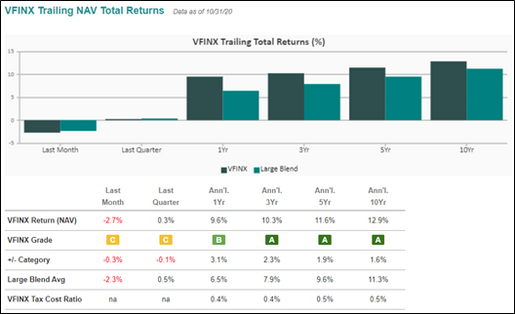
While the Vanguard 500 Index fund has lagged its category in terms of trailing performance over the last month and quarter, as indicated by its C grades, the fund has rated very highly relative to its category over the longer term, as its A grades reflect.
Over the last 10 years, the Vanguard 500 Index fund has averaged an annual gain of 12.9%, which has outperformed the average large blend fund by 1.6% a year.

The Fund and ETF Evaluators also provide annual performance data for the last 10 years (if the fund has been in existence for that long), along with grades showing how the fund stacks up against other funds in its category on a year-by-year basis for performance.
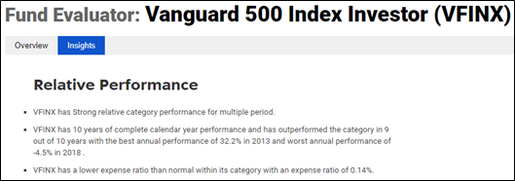
Over the last 10 years, the Vanguard 500 Index fund has outperformed the average large blend fund in nine of the 10 years, with 2013 the sole exception when the fund gained 32.2% while the average large blend fund gained 32.3%.
Scroll down further and you will find information about the fund’s risk profile and portfolio characteristics. Here you will see the fund’s standard deviation, its total risk index, category risk index and grade, beta and R-squared measures. The Vanguard 500 Index fund has a risk index of 1.22, whereas the average fund in the Large Blend category has a risk index of 0.99.
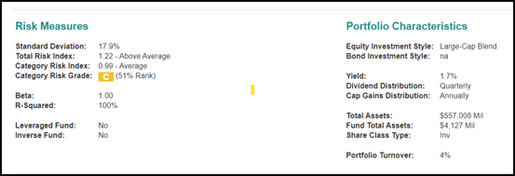
As of the end of October, the Vanguard 500 Index fund had a yield of 1.7% with the investor class shares having $4.1 billion of assets under management. Furthermore, the portfolio has an average annual turnover rate of only 4%.
The Management Team section tells you how many managers oversee the fund and the longest tenure of a manager and the average tenure of all managers.
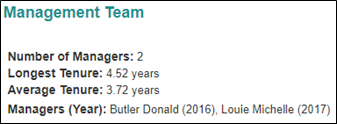
For the Vanguard 500 Index fund, two managers are overseeing the fund, with Donald Butler being the longest-tenured manager at 4.5 years while the average tenure of all the fund’s managers is 3.7 years.
The Portfolio Composition section of the Fund Evaluator provides you with such information as: number of holdings in the fund, the percentage of overall assets are invested in the 10 largest holdings and the fund’s portfolio allocation across domestic, foreign and preferred stocks and domestic, foreign and convertible bonds.
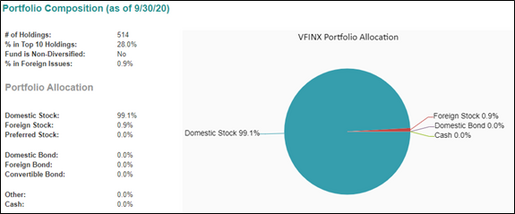
As of September 30, 2020, the fund had 514 equity positions, with the top 10 holdings accounting for 28% of the overall portfolio. Also, 99.1% of the fund’s portfolio is invested in domestic (U.S.) stocks.
Lastly, the Purchase Information section of the fund evaluator provides useful information if you are looking to invest in a specific fund for the first time.
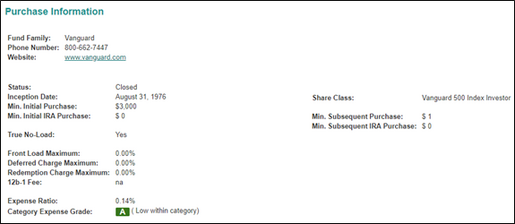
You will see if the fund is open or closed to new investors for mutual funds: The Vanguard 500 Index fund is not open. You can also see the front load maximum charge percentage, deferred charge percentage maximum, redemption charge percentage maximum and 12b-1 fee information. Fund Evaluator pages also provide the category expense grade, which for the Vanguard 500 Index fund is an A, meaning its expenses are very low relative to the typical large blend fund.
Clicking on the Insights tab gives you a quick qualitative analysis of the fund. It will tell you areas where the fund has fared strongly and highlight how consistently it has performed over the past 10 years. It makes getting a quick assessment of a fund easy.