Today marked the first trading day for Tesla Inc. (TSLA) as a component of the S&P 500 index. Friday saw a big jump in the electric carmaker’s shares, as index funds that track the S&P 500 began preparing to purchase billions of dollars’ worth of Tesla stock to match their holdings with the large-cap index.
Tesla shares jumped 6% on Friday, including in after-hours trading, to an all-time high, a day where the overall market was slightly down. On Friday, 222.1 million shares of Tesla changed hands compared to its 20-day average trading volume of 58.5 million (according to data from StockCharts.com).
Year to date, through Friday’s close, Tesla was up an astounding 731%. Its market cap of $621.7 billion makes it the seventh-largest U.S.-listed stock, ahead of Berkshire Hathaway Inc. (BRK.B), Walmart Inc. (WMT), Johnson & Johnson (JNJ) and Procter & Gamble Co. (PG). It trails only Apple Inc. (AAPL), Microsoft Corp. (MSFT), Amazon.com Inc. (AMZN), Alphabet Inc., the parent company of Google (GOOGL), Facebook Inc. (FB) and Alibaba Group Holding Ltd. (BABA).
Tesla poses an interesting, although not unique, situation for investors. When investing in individual stocks, many of us have two factors to consider: Is this a good company, and is it a good investment?
Many analysts warn that Tesla shares are vulnerable to a pullback following their sevenfold increase this year, mostly since the company has not posted similarly strong financial results.
This boils down to the question: Are “story stocks” suitable investments? Asking why a company is in the news and whether it is a good investment are two very different questions. Before investing in the stock of a company, it’s important to answer two questions: 1) It is a good business?; and 2) What is it worth?
I will limit my discussion of whether Tesla is a “good company” to its financial results. Its CEO, Elon Musk, is eccentric and erratic, especially in social media postings. In 2018 the U.S. Securities and Exchange Commission (SEC) charged Musk with securities fraud for a series of false and misleading tweets about a potential transaction to take Tesla private. As part of the settlement, Musk agreed to step down as Tesla’s chairman and have the company’s lawyers pre-approve written communications, including tweets with material information about the company. Even when not talking about landing humans on the moon or his electric cars, Musk still manages to make waves, as last week showed.
To answer these questions about Tesla, we need to dive into its financial data.
When analyzing a company, it is useful to have an objective framework that allows you to compare companies in the same way. This is one reason why we created the A+ Stock Grades, which evaluate companies across five factors that have been shown to identify market-beating stocks in the long run: value, momentum, growth, quality and earnings estimate revisions (and surprises).
The table below shows the A+ Stock Grades for Tesla as of the close on Friday, December 18.
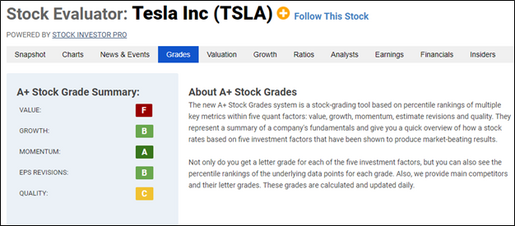
When evaluating whether Tesla is a good company, we will focus on three of these grades: growth, earnings estimate revisions and quality. Value and momentum will be part of the “good investment” discussion a bit later.
Growth Grade
Tesla has a Growth Grade of B. The Growth Grade considers both the near- and longer-term historical growth in revenue, earnings per share and operating cash flow.
By and large, Tesla has exhibited solid growth in its latest fiscal quarter and over the past five years. While sales dropped 49% year over year for the quarter ending September 30, 2020, the company managed to boost earnings by 125% and operating cash by 145%. All this data is available on the Grades tab of a stock’s A+ Stock Evaluator page. While not part of the Growth Grade, Tesla has managed triple-digit year-over-year earnings growth for each of the last three quarters.
While the company has been posting impressive quarterly growth, long-term earnings growth has been elusive for Tesla thus far, as it has contracted by an average of 15.6% a year over the past five years. However, sales have been growing by 50.4% a year, while cash from operations has been expanding by 113% a year over the past five years. Also, the company has seen earnings growth for its last two fiscal years, although this is not part of the Growth Grade calculation.
EPS Revisions Grade
Estimate revisions offer an indication of what analysts are thinking about the short-term prospects of a firm. Tesla’s Estimate Revisions Grade is B, which is based on the statistical significance of its last two quarterly earnings surprises and the percentage change in its consensus estimate for the current fiscal year over the past month and past three months.
Tesla has posted earnings surprises of 29.0% and 1,777.0% for its last two fiscal quarters. However, the EPS Revisions Grade considers the surprise relative to estimates’ dispersion to arrive at the statistical significance. The calculation, called the standard earnings, measures the earnings surprise in terms of its number of standard deviations above or below the consensus earnings estimate. SUE scores over 2.0 are considered statistically significant. So although Tesla has posted strong positive earnings surprises in percentage terms, the dispersion of estimates has been large, leading to SUE scores of 1.1 and 1.7 for the last two quarters. These rank in the 53rd and 66th percentiles among all stocks.
In addition, over the last month, the consensus estimate for the fiscal year ending December 31 has risen 1.4%, while it has increased 21.6% in the previous three months. These, in turn, rank in the 74th and 79th percentiles, respectively, among all U.S.-listed stocks. Over the last month, there have been five upward revisions to the fiscal-2020 estimate and three downward revisions. The estimate now stands at $2.89, up from $2.26 a month ago.
Quality Grade
A higher-quality stock possesses traits associated with upside potential and reduced downside risk. Backtesting of the Quality Grade shows that stocks with higher Quality Grades, on average, outperformed stocks with lower grades over the period from 1998 through 2019.
The Quality Grade is the percentile rank of the average of the percentile ranks of return on assets (ROA), return on invested capital (ROIC), gross profit to assets, buyback yield, change in total liabilities to assets, accruals, Z double prime bankruptcy risk (Z) and F-Score. The score is variable, meaning it can consider all eight measures or, should any of the eight measures not be valid, the valid remaining measures. To be assigned a Quality Score, though, stocks must have a valid (non-null) measure and corresponding ranking for at least four of the eight quality measures.
Tesla has a Quality Grade of C, putting it in the middle among all U.S.-listed stocks.
The company ranks poorly in terms of its return on invested capital, ranking in the 17th percentile of all U.S.-listed stocks, and in terms of buyback yield (the percentage change in the number of shares outstanding over the last year), ranking in the 27th percentile.
Tesla does rate well when it comes to its F-Score, a composite score of various fundamental factors used to evaluate a company’s overall financial strength. Tesla has an F-Score of 7 out of 9, which ranks in the 89th percentile.
Successful stock investing involves buying low and selling high, so stock valuation is an important consideration for stock selection.
Buying stocks that are going to go up typically means buying stocks that are undervalued in the first place, although momentum investors may argue that point.
Based on Tesla’s Value Grade of F, value investors may take pause.
The Value Grade considers six different measures, ranking the average of the percentile ranks for the six measures to arrive at the grade.
In the A+ Investor database, Tesla does not have a price-earnings ratio. The company does have positive GAAP earnings over the trailing 12 months of $0.51 per share, which translates into a price-earnings ratio of 1,376.2 based on Friday’s closing price of $695.00. The range of acceptable price-earnings ratios only goes up to 999.9. In the A+ Investor 6,168 stock universe, Tesla ranks 24th in price-earnings ratio, removing the range restriction. This would have ranked in the 99th or 100th percentiles, which would push Tesla’s current Value Score of 97 even higher, making it even more highly valued.
Among the five other valuation metrics used in the Value Grade, Tesla ranks higher than the 74th percentile (a lower percentile indicates a more attractive valuation). In four of these five metrics, Tesla ranks in the 92nd percentile or higher.
Part of the reason why Tesla rates poorly in terms of valuation is its dizzying price performance over the last year. Over the 52 weeks ended December 18, Tesla shares are up 760%, outperforming the S&P 500 by 645 percentage points and ranking in the 99th percentile among all U.S.-listed stocks. This momentum has been pretty persistent as well. Over the last four weeks, Tesla shares have risen 42%, besting the S&P 500 by 37 percentage points as well as 92% of all stocks.
As a result, Tesla has a Momentum Grade of A, based on its Momentum Score of 94. This means it ranks in the top 6% of all stocks in terms of its weighted relative strength over the last four quarters. The weighted four-quarter relative strength rank is the relative price change for each of the past four quarters. The most recent quarterly price change is given a weight of 40% and each of the three previous quarters are given a weighting of 20%.
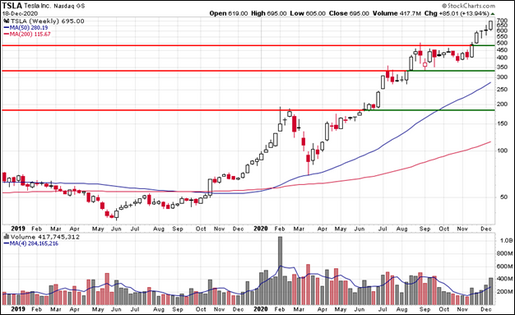
The weekly price chart below, from StockCharts.com, shows that Tesla’s stock has seen multiple breakouts since June, the latest occurring in mid-November after trading sideways for a few months. The lower panel shows the weekly trading volume, which has risen significantly since the November 16 announcement that Tesla would be joining the S&P 500 index.
In pre-market trading on Monday, Tesla shares were down nearly 6% at their lowest. This isn’t much of a surprise, given Tesla’s run up to being added to the S&P 500, and there will most likely be a period of volatility as traders and retail investors take profits.
The A+ Stock Grades offer a framework that is applicable across companies, too.
As of the close on Friday, December 18, there were 15 companies in the auto & truck manufacturers index that had valid grades for all five of the A+ Stock Grades. These companies are listed in alphabetical order by ticker in the table below.
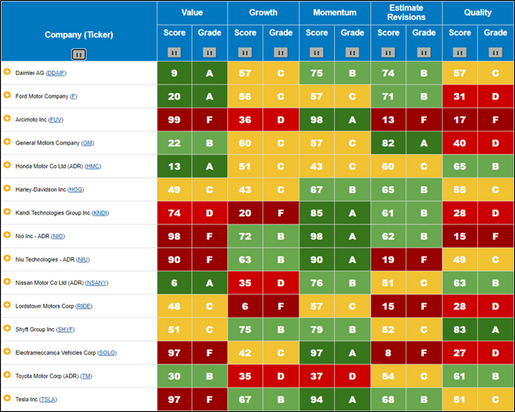
When it comes to its Growth Score of 67 (Growth Grade of B), Tesla ranks third among auto & truck manufacturers. Tesla also ranks fourth among these 15 with its Estimate Revisions Score of 68 (Estimate Revisions Grade of B) but ranks in the middle of the pack with its Quality Score of 51 (Quality Grade of C).
Whether Tesla fits in your portfolio is a personal decision. Are you a growth- or value-oriented investor? What is your time horizon? What is your risk tolerance? Answering these questions will also help you answer whether Tesla is a good investment.
The Making the Grade email will be on hiatus next week, with much of the AAII staff on break for the holidays. AAII offices will be closed for Christmas (December 24 and 25) and New Year’s (December 31 and January 1). The U.S. stock markets will close early on December 24 (Christmas Eve) and will be closed on Friday, December 25, for Christmas Day. Next week, the markets will again close early on New Year’s Eve and will be closed on New Year’s Day, Friday, January 1, 2021.
I hope you have a safe and healthy holiday season and I wish you and yours all the best in 2021.


