The U.S. markets put an exclamation point on an otherwise turbulent but surprisingly strong 2020 in December. Certain sectors thrived while the coronavirus lockdown ravaged others. The Dow Jones industrial average gained 7.3% for the year, the S&P 500 index returned 16.3%, while the Nasdaq composite turned in its best year since 2009, soaring 43.6%.
Technology was once again the top sector of 2020, with a gain of 39%. On the flip side, energy was the poorest-performing sector, losing 37% for the year.
Looking at the exchange-traded fund (ETF) market, investors rushed back into equity funds at the end of the year. ETF inflows totaled $81.8 billion in November and $44.8 billion in December, according to Morningstar. The November ETF inflows were a record, while December’s inflows still managed to rank sixth all-time, Morningstar found.
For all of 2020, ETFs had taken in a record $499 billion in net flows and held roughly $5.5 trillion in assets under management, per Morningstar.
Per data from Morningstar, 2020 was a record year for ETFs. New records were set for total flows; flows into bond funds; flows into environmental, social and governance (ESG) ETFs; and flows into active (non-index) ETFs. Also, there were a record number of new ETFs launched, while a record number of ETFs also closed.
Though the $231.8 billion that flowed into equity ETFs fell shy of a record, they still were greater than the record $212.1 billion that investors placed in bond ETFs.
While fund families such as Vanguard saw significant inflows into their ETFs, relative unknowns with hot active ETFs saw tremendous growth. Among them was the ARK family of ETFs. The firm’s five actively managed “innovation” ETFs produced triple-digit returns in 2020. Along the way, the firm attracted $20.5 billion in net flows in 2020, representing 646% organic growth, according to Morningstar. At the end of 2020, ARK ranked as the 11th-largest ETF provider, according to data from Morningstar.
Narrowing the focus to the best-performing industries, solar and clean energy ETFs were at the top in 2020, following up on their extraordinary performance in 2019. Analysts point to the falling cost of renewable energy generation and technological innovation as catalysts for the industry. Looking forward, the election of Joe Biden as president has also boosted the industry, as he has pledged $2 trillion to take on climate change.
As an A+ Investor, you have access to the Funds+ and ETF+ screeners, allowing you to rank the respective mutual fund and ETF universes by performance over a number of time periods.
As of the end of December, there were 2,454 ETFs in the A+ Investor universe. With the ETF+ Screener, we can limit our focus to equity ETFs (1,507) and exclude inverse and leveraged funds (1,499 remaining ETFs).
Here is a listing of the top 10 ETFs from this universe of 1,499 based on their 2020 return (YTD return as of December 31, 2020).
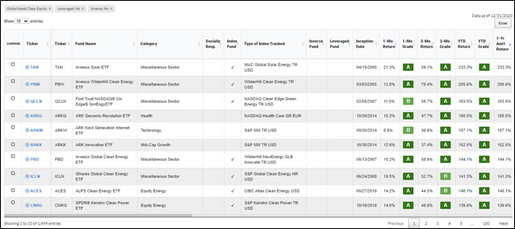
Nine of these 10 ETFs are in the sector group, as designated by Morningstar, the A+ Investor data provider for ETFs and mutual funds. Only one—ARK Innovation ETF (ARKK)—is not designated as a sector ETF; it is in the mid-cap growth category.
Five of the 10 equity ETFs in 2020 are in the miscellaneous sector, with two more in energy and one each in health and technology.
The top-returning equity ETF in 2020 was Invesco Solar (TAN). For the year, the fund returned 233.3%. This was the second year in a row that Invesco Solar was the top ETF. In 2019 the ETF returned 65.7%, for a two-year cumulative return of 452.3%. The ETF was the second-best performer over the last three years, second only to Invesco WilderHill Clean Energy ETF (PBW), which was the second-best equity ETF in 2020 and the seventh best in 2019.
According to the Invesco website, its Invesco Solar ETF is based on the MAC Global Solar Energy Index. The ETF will invest at least 90% of its total assets in the securities, American depositary receipts (ADRs) and global depositary receipts (GDRs) that comprise the index. The index is composed of companies in the solar energy industry.
The fund has generated an average annual return of only 6.5% over the past 10 years, which earns the ETF an F grade based on its 10-year performance relative to the other ETFs in the miscellaneous sector category. This is an important illustration of why outsized returns over the near term shouldn’t seduce us. However, one-year returns should not be ignored, as they do factor into longer-term returns.
Here is a breakdown of the Invesco Solar ETF’s portfolio as of the end of December:
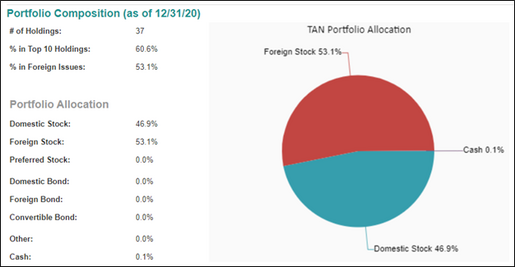
As of the end of December, the Invesco Solar ETF was invested in 37 stocks. Sixty percent of its assets under management (AUM) were invested in the top 10 holdings and more than half of its holdings were in foreign stocks.
According to data at the Invesco site, the solar ETF is invested roughly 55% in the information technology sector, 31% in utilities, 10% in industrials and 4% in financials. The largest holding in the ETF is Enphase Energy Inc. (ENPH) at roughly 11%. Enphase Energy is a provider of energy management solutions and is engaged in the designing, developing, manufacturing and selling of microinverter systems for the solar photovoltaic industry. Its semiconductor-based microinverter system converts direct current (DC) electricity to alternating current (AC) electricity.
Three of the top 10 ETFs for 2020 are from the ARK family, which we mentioned earlier:
ARK’s active ETFs “seek to capitalize on the technology adoption curves of innovation,” per the firm’s website. Its ETFs focus on companies involved in “disruptive innovation and developing technologies to displace older technologies.”
All of these ARK ETFs were formed in 2014, so five-year performance is the longest performance period measure available. All three have A grades for their five-year performance, meaning they each rank in the top 20% of average annual return over the past five years within their respective ETF category.
As a footnote, while “energy” was hot in 2020, it depended on which segment of the sector you were in. Among the worst-performing ETFs in 2020 (among those that traded for the entire year), eight were also in the energy sector. The lowest equity ETF return for 2020 was turned in by InfraCap MLP (AMZA). The ETF is from Virtus Investment Partners and its website states that the ETF “seeks to provide exposure to midstream master limited partnerships (MLPs) with an emphasis on high current income.”


