The year 2020 may go down as the year of the SPAC, or special purpose acquisition company.
According to Investopedia, a SPAC is “a company with no commercial operations that is formed strictly to raise capital through an initial public offering (IPO) for the purpose of acquiring an existing company.”
SPACs are also known as “blank check companies,” which have been around for decades. In recent years, they have become more popular, attracting big-name underwriters and investors and raising a record amount of IPO money. According to Dealogic and Goldman Sachs Global Investment Research, SPACs accounted for 53% of total U.S. IPO proceeds in 2020. The $76 billion raised through more than 200 SPACs in 2020 was 80% more than the $42 billion raised in total between 2013 and 2019 (seven years).
One can look at a SPAC as the reverse of a traditional IPO. A SPAC goes public first and that money is placed in a trust. Meanwhile, the sponsor searches for a business (or businesses) to acquire to put in its shell, usually within 24 months. If the SPAC does not complete a deal within that timeframe, it faces liquidation.
Companies typically pursue IPOs to raise capital and create brand awareness. However, more and more companies are considering merging with SPACs instead of going with an IPO to achieve these goals. This trend will likely continue as a growing number of private equity firms and venture funds form more SPACs.
SPACs are created solely to raise capital through an IPO in order to merge with private companies. While SPACS have been around since the 1980s, their surge comes as more blue-chip private equity firms, banks and high-profile investors form SPACs. Currently, SPACs have been formed by the likes of Pershing Square Capital Management, Goldman Sachs and TPG Capital.
Smaller firms looking to raise capital may not be ideal candidates for IPOs. So instead they merge with a SPAC sponsor, thereby retaining a stake in their business while at the same time gaining access to liquidity that otherwise may not be available to them.
SPACs also offer more certainty to companies seeking liquidity. Companies can be too conservative in pricing their IPO, thereby “leaving money on the table.” Market volatility and uncertainty has also led some companies to postpone or call off their planned IPO.
SPACs also offer speed to market. Going public through a SPAC can accelerate a company’s market entry by perhaps as much as four months. Without a company in the SPAC shell, there tends to be fewer SEC comments and questions to answer since there are no financial statements and related material. This also shortens the auditing process for the SPAC.
With SPACs, target companies can negotiate the price of their stock with the SPAC sponsor as part of the merger agreement. By locking in their price, the target company is shielded from market uncertainty. SPACs offer other flexible terms, such as the ability to structure the transaction to bring in additional capital through a private investment in public equity (PIPE), as well as additional debt or equity. Furthermore, the target’s board of directors is subject to negotiation.
However, companies looking to raise capital via a SPAC merger must still undergo regulatory scrutiny. This includes an audit, internal control assessments and measures to ensure the company has processes in place to meet public company reporting guidelines.
While it’s hard to imagine that SPACs will grow at the same level they did in 2020, most analysts expect their popularity to continue. The main reason is that SPACs are an efficient way to raise capital. Data from SPAC Research shows that an average of two or three SPACs have been coming to market per day.
However, investors should keep the credo “buyer beware” in mind when considering investing in SPACs. Some analysts warn that SPACs allow companies to avoid the stringent IPO process, which is in place to protect investors. Companies that raise capital through an IPO must go through careful institutional and regulatory vetting.
One high-profile case is Nikola Corp. (NKLA), which specializes in battery-electric and hydrogen trucks and powersports vehicles. The company’s shares started trading on the Nasdaq composite on June 4, 2020, after merging with a SPAC—VectoIQ Acquisition Corp.—backed by investors including Fidelity and ValueAct Capital. The transaction was funded by VectoIQ cash in trust and a $525 million private placement of common stock at $10 per share.
In September, General Motors Co. (GM) made an announcement that it was entering into a “strategic partnership” with Nikola. According to the terms of the agreement, General Motors would receive an 11% equity stake in Nikola in exchange for manufacturing the Nikola Badger pickup truck using General Motors’ own hydrogen fuel cell and battery technologies.
Shortly after the deal was announced, Hindenburg Research—a short-selling firm—published a report called “Nikola: How to Parlay an Ocean of Lies Into a Partnership With the Largest Auto OEM in America.” The report claimed the authors had evidence of fraud perpetrated by Nikola.
Since then, the founder and chairman of Nikola has stepped down, the U.S. Securities and Exchange Commission (SEC) and the Department of Justice (DOJ) are looking into the claims made in the report, and the stock has fallen nearly 75% from its high on June 9, 2020. Stephen Girsky, a former General Motors vice chairman and a member of Nikola’s board, has taken over as chairman.
Critics point out that if Nikola had gone the traditional IPO route, there would have been a more stringent due diligence and audit process than with the SPAC reverse-listing. It is important, however, to note that these claims of fraud are just allegations. In a statement following the report’s release, Nikola said there were “dozens” of inaccurate allegations in the report, and it outlined specific examples. But Nikola didn’t dispute one of Hindenburg’s largest claims—that it staged a video showing a truck that appeared to be functional but wasn’t, as well as claims that the truck was fully functional.
In November, Nikola announced in a regulatory filing that it has received subpoenas from the SEC and the DOJ in connection to the fraud allegations.
Some argue whether the whether the claims would have gotten as far as they have if the firm had gone through the traditional IPO route.
Individual investors who don’t have deep enough pockets to invest directly in a SPAC are starting to have some options. As SPACs have garnered more attention, fund companies are trying to capitalize on the trend.
Currently, there are two exchange-traded funds (ETFs) that invest in SPACs, with a third on the way:
Per the Defiance Next Gen SPAC Derived ETF prospectus, the SPAC ETF seeks to track the total-return performance, before fees and expenses, of the Indxx SPAC & NextGen IPO Index, thus making it a passive fund. This index tracks the performance of the U.S.-listed common stock of SPACs and companies derived from SPACs. To be eligible to be added to the index, a security must be U.S.-listed; have a minimum total market capitalization of $250 million; have a free float (i.e., the proportion of shares that are publicly available) of at least 10%; have a trading price of less than $10,000; and meet minimum liquidity thresholds. To be eligible to be added to the index, SPACs must have traded on 90% of the eligible trading days in the last three months and SPAC-derived companies must be actively trading. As of each reconstitution and rebalance of the index, 80% of the weight of the index will be allocated to SPAC-derived companies and 20% will be allocated to SPACs. As of September 22, 2020, the index was composed of 35 constituents.
According to the SPAC and New Issue ETF prospectus, the fund is actively managed. The fund will invest at least 80% of its net assets in units and shares of SPACs that have a minimum capitalization of $100 million and companies that completed an IPO within the last two years.
ETF Evaluator pages are available to A+ Investor subscribers for the Defiance Next Gen SPAC Derived ETF and the SPAC and New Issue ETF.
Both funds are classified by Morningstar as being U.S. equity (fund group), small growth (category). Defiance Next Gen SPAC Derived ETF’s inception date is September 30, 2020, while the SPAC and New Issue ETF’s inception date is December 15, 2020. As a result, investors have little to judge the ETFs by from a performance standpoint. This lack of performance track record also means their risk measurements are not yet available.
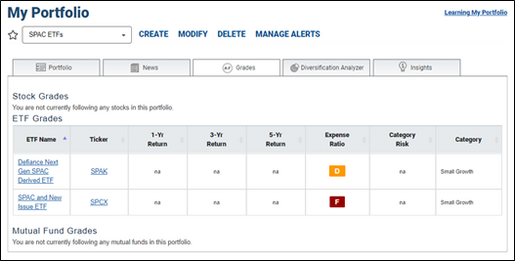
Looking at the expense ratios of the two ETFs, however, both charge fees well above the typical ETF in the small growth ETF category. The SPAC and New Issue ETF has an expense ratio of 0.95%, which ranks in the top 20% among all small growth ETFs tracked by Morningstar, thus its F grade. The Defiance Next Gen SPAC Derived ETF has an expense ratio of 0.45%. Although it is half that of the SPAC and New Issue ETF, it still rates in the top 40% of its category peers, which is why it has an expense ratio grade of D.
Only the Defiance Next Gen SPAC Derived ETF has performance data for the last month and three months ending December 31, 2020. The fund posted a price return of 6.6% for December and a 13.3% NAV return for the three months ended December 31. Both returns rank in the bottom 20% of the small growth ETF category, which rates an F for the fund. The typical small growth ETF registered a NAV return of 27.6% over the last three months of 2020.
If you are looking to invest in SPACs, these ETFs may offer a viable avenue. However, it would also appear that they carry with them unique risks compared to investing in more traditional ETFs or individual stocks. As is the case with any investment, it is important to consider whether they fit into your overall risk-return profile.


