Today, companies such as Tesla Inc. (TSLA) have made electric vehicles—EVs for short—more popular than ever. However, the history of electric cars dates back to the 1880s. According to Wikipedia, perhaps the first human-carrying electric vehicle with its own power source was tested in Paris in April 1881 by inventor Gustave Trouvé. However, he was unable to patent it, so Trouvé adapted his battery-powered motor to marine propulsion and in the process invented the outboard motor.
To overcome the limited operating range of electric vehicles, and the lack of recharging infrastructure, an exchangeable battery service was first proposed as early as 1896 in the U.S. The concept was first put into practice by Hartford Electric Light Company through the GeVeCo battery service and initially available for electric trucks. The vehicle owner purchased the vehicle without a battery from General Vehicle Company (a subsidiary of the General Electric Company), and the electricity was purchased from Hartford Electric through an exchangeable battery. The service was provided between 1910 and 1924 and during that period covered more than six million miles.
Acceptance of electric cars was initially hampered by a lack of power infrastructure, but by 1912, many homes were wired for electricity, enabling a surge in the popularity of the cars. In the U.S. by the turn of the century, 40% of automobiles were powered by steam, 38% by electricity and 22% by gasoline. Sales of electric cars peaked in the 1910s.
By the 1920s, improved roads throughout the U.S. reduced travel times, creating a need for vehicles with a greater range than that offered by electric cars. Furthermore, worldwide discoveries of large petroleum reserves led to the wide availability of affordable gasoline, making gas-powered cars cheaper to operate over long distances. Electric cars were limited to urban use by their slow speed and low range, while gasoline cars were able to travel farther and faster than equivalent electrics.
Gasoline cars also overcame many of their negatives compared to electrics. Chief among them was the invention of the electric starter by Charles Kettering in 1912, eliminating the need of a hand starting crank. Also, the initiation of mass production of gas-powered vehicles by Henry Ford brought their price down. By contrast, the price of similar electric vehicles continued to rise and, by 1912, an electric car sold for almost double the price of a gasoline car.
Most electric carmakers stopped production at some point in the 1910s, and it wasn’t until the 1960s when interest in electric cars reemerged. In 1959, American Motors Corp. (AMC) and Sonotone Corp. announced a joint research effort to consider producing an electric car powered by a “self-charging” battery. In the mid-1960s a few battery-electric concept cars appeared, but none made it to mass production.
The energy crises of the 1970s and 1980s brought about renewed interest in electric cars, but again, none achieved mass production or commercial success.
From the 1960s to the 1990s, a number of companies made battery electric vehicles converted from existing manufactured models. However, none were sold in large numbers due to high cost and a limited range.
The passage of the Electric and Hybrid Vehicle Research, Development and Demonstration Act of 1976 in the U.S. provided government incentives for the development of electric vehicles.
In the early 1990s, the California Air Resources Board (CARB), began a push for more fuel-efficient, lower-emissions vehicles, with the ultimate goal of a move to zero-emissions vehicles such as electric vehicles. In response, automakers developed electric models, but were accused of pandering to the wishes of CARB in order to continue to be allowed to sell cars in the California market. At the same time, automakers joined oil industry lobbyists in vigorously protesting CARB’s mandate.
As climate change has become a more important issue for governments, corporations and consumers, car manufacturers around the globe have embraced cutting carbon dioxide emissions. This, in turn, has led automakers to shift from internal combustion engine (ICE) to electric vehicle. China is leading the way, with Deloitte estimating that China will hold 49% of the global electric vehicle market by 2030. Europe will account for about 27% and the U.S. will take about a 14% share.
In the U.S. electric vehicle market, Tesla alone accounts for almost half of all sales. The company has plans to develop a dramatically long-lasting “million miles” battery. Tesla has also revealed plans to further reduce the already low cost of its battery cells and packs to $100 per kilowatt-hour, at which point the price equivalence of electric cars should become similar to combustion engine vehicles, according to industry experts.
Recently, I came across research on Seeking Alpha related to the electric vehicles trend. Electric car sales hit new records in December 2020, with global electric sales of over 500,000 for the month. This was up 105% compared to December of 2019. Furthermore, the study indicated that market share reached 6.9% for December 2020. For full-year 2020, electric vehicle sales reached 3.24 million, up 41% from the previous year and following a 43% year-over-year increase in 2019.
The research also cites several growth projections for the electric vehicle market over the next several years:
Some analysts believe that we will see parity between electric vehicles and internal combustion engine vehicles by 2023.
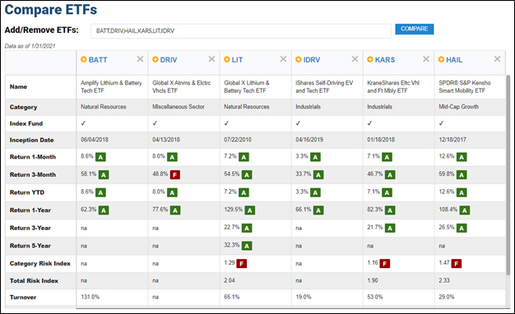
The growth rates required to achieve these forecasts are exponential in nature and have spurred significant investor interest. This has prompted exchange-traded fund (ETF) issuers to come up with electric vehicle and battery-related funds. There are several ETFs out there directly or indirectly tied to electric vehicles. They are tracked by the A+ Investor ETF universe:
Amplify Lithium & Battery Technology ETF
Amplify Lithium & Battery Tech ETF (BATT), launched in 2018, has been managed by Michael Venuto since its inception. The fund’s primary benchmark is the EQM Lithium & Battery Technology PR USD index.
The ETF seeks investment results that generally correspond to the price and yield of the EQM Lithium & Battery Technology index. The fund will normally invest at least 80% of its total assets in the securities comprising the index. The index seeks to provide exposure to global companies deriving material revenue associated with the development, production and use of lithium battery technology.
As of the end of January, the ETF had 72 holdings, with 83.5% invested in foreign issues. Its top 10 holdings accounted for 43.7% of its assets under management.
Its expense ratio is average compared to funds in Morningstar’s natural resources category. Amplify Lithium & Battery Tech has an expense ratio of 0.59%, which is 16% higher than its category.
The fund has returned 62.3% over the 12 months ended January 31, 2021.
Global X Autonomous & Electric Vehicles ETF
Global X Autonomous & Electric Vehicles ETF (DRIV), launched in 2018, has been managed by Chang Kim since its inception. The fund’s primary benchmark is the Solactive Autonomous & Electric Vehicles NR USD index. The underlying index tracks the price movements in shares of companies which are active in the electric vehicles and autonomous driving segments.
The fund seeks to provide investment results that correspond generally to the price and yield performance, before fees and expenses, of the Solactive Autonomous & Electric Vehicles index. The fund invests at least 80% of its total assets in the securities of the index. The index is designed to provide exposure to exchange-listed companies that are involved in the development of electric vehicles and/or autonomous vehicles, including companies that produce electric/hybrid vehicles, electric/hybrid vehicle components and materials, autonomous driving technology and network connected services for transportation. It is non-diversified.
Its expense ratio is above average compared to funds in the miscellaneous sector category from Morningstar. Global X Autonomous & Electric Vehicles has an expense ratio of 0.68%, which is 9% lower than its category.
The fund has returned 77.6% over the past year ended January 31, 2021.
As of the end of January, the fund had 82 holdings, with 27.4% of its assets invested in the 10 largest holdings. The ETF is 58.5% invested in domestic stocks, with 40.8% invested in foreign issues.
SPDR S&P Kensho Smart Mobility ETF
The SPDR S&P Kensho Smart Mobility ETF (HAIL), launched in 2017, has been managed by Michael Feehily since October 31, 2018. The fund’s primary benchmark is the S&P Kensho Smart Transportation TR USD index. This means that the SPDR S&P Kensho Smart Mobility ETF is focused mostly on autonomous and electric vehicle technology, commercial drones and advanced transportation systems.
The underlying S&P Kensho Smart Transportation index comprises U.S.-listed equity securities of companies domiciled across developed and emerging markets worldwide that are included in the S&P smart transportation sector.
As of the end of January, the ETF had 60 holdings. The top 10 holdings accounted for 29.5% of total assets and foreign issues accounted for 28.1%.
Its expense ratio is average compared to funds in the mid-cap growth category, as designated by Morningstar. SPDR S&P Kensho Smart Mobility has an expense ratio of 0.45%, which is 3% lower than its category.
The fund has returned 108.4% over the past year and 26.5% annually over the past three years, both periods ended January 31, 2021.
iShares Self-Driving EV and Tech ETF
The iShares Self-Driving EV and Tech ETF (IDRV), launched in 2019, has been managed by Greg Savage since its inception. As its name suggests, the ETF is focused on both electric vehicle self-driving and the technology behind it.
The fund seeks to track the investment results of the NYSE FactSet Global Autonomous Driving and Electric Vehicle index. The index is composed of equity securities of companies listed in one of 43 developed or emerging market countries that derive a certain specified percentage of their revenue from selected autonomous or electric vehicle-related industries, as defined by Intercultural Development Inventory (IDI).
As of the end of January, the fund had 113 holdings, with 39.0% of the fund’s assets invested in the top 10 holdings. Slightly more than half of the fund’s holdings (52.3%) are foreign issues.
iShares Self-Driving EV and Tech’s expense ratio is average compared to funds in the industrials category. It has an expense ratio of 0.47%, which is 1% lower than its category.
The fund has returned 66.1% over the past year.
KraneShares Electric Vehicles & Future Mobility ETF
KraneShares Electric Vehicles & Future Mobility ETF (KARS), launched in 2018, has been managed by James Maund since January 14, 2020. The fund’s primary benchmark is the Solactive Electric Vehicles and Future Mobility index, which tracks the equity market performance of companies engaged in the production of electric vehicles or their components or engaged in other initiatives that may change the future of mobility.
As of the end of January, the ETF had 60 holdings, 61.2% of which were foreign issues. The fund’s top 10 holdings accounted for 32.7% of its assets as of the end of January.
The ETF’s expense ratio is above average compared to funds in the industrials category, as designated by Morningstar. It has an expense ratio of 0.72%, which is 52% higher than its category.
The fund returned 82.3% over the past year and 21.7% annually over the past three years.
Global X Lithium & Battery Technology ETF
Global X Lithium & Battery Tech ETF (LIT), launched in 2010, has been managed by Chang Kim since February 15, 2014. The fund’s primary benchmark is the Solactive Electric Vehicles and Future Mobility index, which tracks the equity market performance of companies engaged in the production of electric vehicles or their components or engaged in other initiatives that may change the future of mobility.
As of the end of January, the ETF had 48 holdings, 78.1% of which were foreign issues. In addition, its top 10 holdings accounted for 60.8% of total assets.
Global X Lithium & Battery Tech’s expense ratio is above average compared to funds in the natural resources category, as designated by Morningstar. The ETF has an expense ratio of 0.75%, which is 48% higher than its category.
The fund has returned 129.5% over the past year, 22.7% annually over the past three years, 32.3% per year over the past five years and 5.8% per year over the past decade. It is the longest-tenured ETF within this group.
The table below shows select data for the six ETFs mentioned here using the Compare ETFs feature of A+ Investor: