In my 24-plus years at AAII, one article that we have published that has resonated with me the most was written by AAII president John Bajkowski in 2016: The Advantages of the Do-It-Yourself Approach to Investing in Stocks.
I found that article to neatly encapsulate AAII’s mission. In the opening paragraph, John wrote that:
With the right education and information, individual investors are fully capable of becoming effective managers of their own assets. If you have the time, interest and discipline, we truly believe that you can manage a stock portfolio that can outperform most mutual funds.
To be fair, there are investors out there that shouldn’t invest in individual stocks. For them, mutual funds and exchange-traded funds (ETFs) are better avenues to the stock market.
Investing in individual stocks takes time that many of us don’t have or want to devote to managing a stock portfolio.
Another key ingredient to successfully investing in individual stocks is discipline. No matter what type of investor you are, it is important to have a plan that fits your financial goals, time horizon and risk tolerance.
However, to be truly successful, you need to have the discipline to follow that program once you’ve committed to it.
So why, as an individual investor, should you think about an investment path that involves investing in individual stocks?
While many investors may not believe it, they have tremendous advantages over institutions.
First and foremost, you have a level of flexibility most institutional investors can only dream of. You can own as many, or as few stocks as you wish. In contrast, institutional investors face several constraints that limit not only the stocks they own but the timing of their transactions. Due to redemption demands, institutional investors—mutual fund and ETF managers—may be forced to sell when the market is falling, meaning they miss out on bargain-shopping opportunities. Individuals, on the other hand, have much greater control over when to buy or sell their positions.
The flexibility individual investors enjoy when investing in stocks also means that, for the most part, they can buy and sell without impacting the underlying bid/ask spread (the difference between the price at which you can sell the stock and the price at which you can buy the stock).
Because of the large amounts of money that many institutional investors are moving into and out of stocks, they have to consider liquidity—the ability to buy and sell stocks quickly without distorting the prices. This forces them to focus on the larger stocks that everyone else already owns. Realistically, most institutional investors are limited to the largest 1,000 or 2,000 companies.
Diversified funds cannot own more than 10% of the shares of a given company or more than 5% of fund assets in a given investment. As a result, the biggest funds are further forced to limit themselves to the largest 100 to 200 companies.
A diversified mutual fund with $1 billion in assets under management (AUM) needs to invest in at least 20 stocks (to comply with the no-more-than-5%-of-assets rule) resulting in an average of a $50 million investment in each company ($1 billion ÷ 20 = $50 million). Since a fund cannot also own more than 10% of the shares of any given company, a large fund cannot effectively invest in smaller companies.
For this $1 billion fund example, each of the 20 companies would need a market capitalization (shares outstanding times market price) of at least half a billion dollars (10% of $500 million equals $50 million).
Therefore, the bigger the equity fund, the harder it becomes to outperform the competition, as they are forced to concentrate holdings among the largest companies.
Research and real-money returns show, however, that the best long-term returns come from investing in micro-cap stocks that are well outside the universe of investable stocks for institutional investors.
Another important advantage of managing your own stock portfolio is the ability to time trades to yield the greatest tax benefits. Most mutual funds are focused on pretax returns and may saddle their investors with a substantial annual capital gains tax bill, even if they have not held the fund for long or sold any of its shares.
Mutual funds must distribute realized gains and interest or dividend income to their shareholders every calendar year. If you hold shares in a taxable account, you are required to pay taxes on mutual fund distributions, whether the distributions are paid out in cash or reinvested in additional shares.
However, if you manage your own portfolio, you control the stocks you sell, and when. You can even look at your holdings at the end of the year and do some selective tax-loss harvesting. Tax-loss harvesting is the selling of securities at a loss to offset a capital gains tax liability. This strategy is typically employed to limit the recognition of short-term capital gains, which are generally taxed at a higher federal income tax rate than long-term capital gains.
The average mutual fund expense ratio is a 1.25% annual drag on portfolio performance; more if you include load funds. With most deep discount brokerage firms no longer charging for stock transactions, you can keep that annual 1% to 2% fee you are paying someone else in a mutual fund. It may not sound like much at first, but over the long term even small increases in your realized rate of return will have a big impact on your wealth thanks to compounding. For example, $100,000 invested at just 1% over 20 years will net you more than $22,000.
A+ Investors have access to a number of resources and tools to help them identify promising stock candidates, as well as to evaluate their current holdings.
To access the enhanced Stock Ideas section of AAII.com, go to www.aaii.com/stockideas or hover over the Investing Ideas section of the AAII.com navigation bar and click on Stock Ideas.
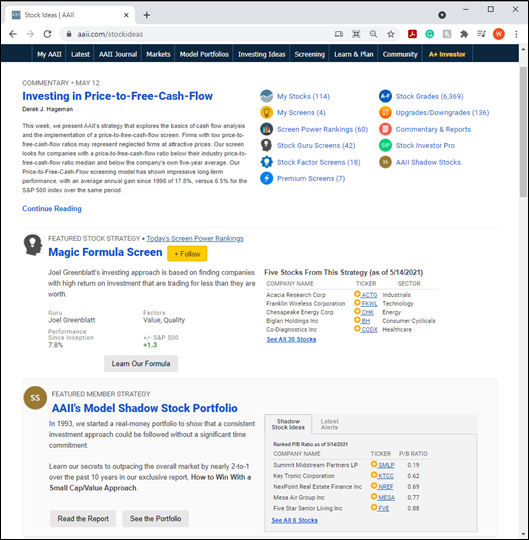
Clicking on the My Stocks link takes you to My Portfolio. If you have specified a favorite/default portfolio, that portfolio will be loaded.
The Stock Grades link takes you to the A+ Stock Grades Screener. There are roughly 6,300 companies in the A+ Investor stock universe and you can see how many stocks have a specific letter grade across the five A+ factors: value, growth, momentum, estimate revisions and quality.
For each factor, there are sliders that you can use to limit the grade for that particular factor. For more on using this tool, see the A+ Stock Grades Screener section of the A+ Investor User Guide.
The My Screens link takes you to a page where you can see the listing of any AAII stock screens you have favorited. Clicking on individual strategies from this page takes you to an article explaining the strategy and the exact filters used for the screen, the latest set of passing companies (as of the close of the previous trading day) and a performance chart since 1998.
If you have not favorited any screening strategies, you are taken to the Screen Power Rankings tool, where you can sort the 60 AAII stock screening strategies by performance over a number of different time periods. You are also able to isolate those strategies based on popular investment factors or guru investors.
The Upgrades/Downgrades link gives you a listing of all the stocks in the A+ universe that have seen at least two letter grade upgrades or downgrades among the five A+ Grades over the last trading day. In addition, you can see a listing of the stocks held in any of your portfolios that have seen similar upgrades or downgrades over the last trading day.
The Stock Guru Screens & Stock Factor Screens links take you to the respective listings of AAII stock screening approaches. These lists identify the underlying investment factors for each strategy, the investment guru the strategy attempts to mimic (when applicable), as well as select risk and performance data, all of which is sortable.
The Commentary & Reports link is an archive of our featured stock screen articles, which are emailed to A+ Investor subscribers biweekly.
Even if you are not a subscriber to any of AAII’s premium portfolios—Stock Superstars Report, Dividend Investing or VMQ Stocks—the Premium Screens link takes you to lists of companies currently passing the criteria used to identify candidates for each of these portfolios. Keep in mind that these companies may never be added to the respective portfolios, but they meet the initial search criteria used to pick stocks that are added to each portfolio. These lists are also updated daily, Tuesday through Saturday.
The AAII Model Shadow Stock Portfolio takes sound academic research and translates it into a real-world, real-money portfolio that has significantly outperformed the market since its inception in 1992. The AAII Shadow Stocks link takes you to the latest portfolio changes and portfolio commentary as well as the current holdings of the Model Shadow Stock Portfolio and those stocks that currently meet the requirements to be considered for the portfolio.
Three strategies are also highlighted on the Stock Ideas on a rotating basis: the Featured Stock Strategy, selected daily from our list of 60 stock strategies and including five stock ideas from the strategy; the Featured Member Strategy, which displays AAII’s Model Shadow Stock Portfolio information including five stocks with the lowest price-to-book ratios currently and the portfolio’s latest alerts; and a Premium Strategy, which highlights one of AAII’s premium portfolios (one of the four portfolio groups from the Stock Superstars Report, or the Dividend Investing or VMQ Stocks portfolio) and five stock ideas from the corresponding portfolio.

