Friday, June 11, 2021, Illinois entered phase five of its reopening, lifting all pandemic capacity restrictions on businesses for the first time in roughly 18 months. But not all coronavirus health and safety measures are disappearing. Businesses in the state are still advised to allow for social distancing and can require additional precautions. Depending on where you are at, restrictions may have been lifted sooner (if they were ever in place) or they may still exist.
Even as businesses open and the economy recovers from the pandemic, the road to “full” recovery will undoubtedly be long.
Much of that recovery will lie with the success and speed of the most extensive vaccination program in the world’s history. According to the Bloomberg vaccine tracker, more than 2.26 billion doses have been administered across 178 countries as of the afternoon of June 10, 2021. The latest rate was roughly 34.8 million doses per day.
However, less than 7% of the world’s population is fully vaccinated. At the current pace of 34.8 million doses a day, it would take another year to achieve a high level of global immunity. This means that drug companies will have to produce billions of additional doses in the coming months and years.
Coronavirus vaccine stocks have been on a stellar run, driven by the urgency to end the pandemic and the unprecedented speed at which companies developed vaccines. Many publicly traded vaccine makers have seen their share prices soar more than 20% this year and by more than 10 times since the beginning of the pandemic. Most major players are scaling up deliveries of their shots, but there are still many companies with vaccines in the trial stages. These vaccines will be vital to achieving broad global vaccination rates.
The new vaccines are also worth hundreds of billions of dollars to the companies developing and manufacturing them. Pfizer Inc. (PFE) expects sales of its vaccine, which it developed with BioNTech SE (BNTX), to total around $15 billion this year, with a profit margin of nearly 30%, according to CNN Business. Johnson & Johnson (JNJ), on the other hand, has said that it will provide its vaccine on a not-for-profit basis, but this doesn’t mean that it won’t ever make money from it or the research that went into developing it. In defending its earnings from its vaccine, Pfizer points out that it did not receive taxpayer dollars to cover the $1 billion to $2 billion cost to develop its vaccine, and that it is providing it at cost to poorer countries.
Some companies tried to develop their own vaccines but failed, including Merck & Co. Inc. (MRK). Others, such as AstraZeneca PLC (AZN), saw use of their vaccines suspended due to side effects that were reported once more widespread use began.
While vaccination programs are still in their early phases globally, the financial markets are starting to look beyond the pandemic. Economies are opening up, some more quickly than others, and bond yields are rising. There has been some rotation away from “pandemic stocks”—vaccine companies and work-from-home names—to more cyclical and value stocks. Even among companies that are seen as direct plays on coronavirus vaccines, including Moderna Inc. (MRNA) and Novavax Inc. (NVAX), their recent price behavior has been quite different. Moderna closed on Friday less than 4% away its all-time high of June 7. Novavax, on the other hand, closed Friday 37% off its all-time high set on February 9. However, it has rebounded nearly 80% from its recent mid-May lows.
The market for coronavirus vaccines will only become more crowded, as at least 10 companies have seven or more coronavirus drugs and vaccines in development as of June 3, according to Statista. Pfizer announced that it could scale up capacity from two billion doses this year to as much as three billion in 2022.
Perhaps the biggest question mark has to do with the coronavirus variants that may pop up as we move forward. As I mentioned earlier, the widespread use of vaccines is concentrated in the developed world. The World Health Organization (WHO) reported that 90% of African countries will miss a September target to vaccinate at least 10% of their populations. A Reuters report quoted the Africa Centres for Disease Control and Prevention director as saying that 14 African countries were “aggressively” heading toward a third wave of the coronavirus pandemic.
Experts worry that as long as vaccination rates remain low in parts of the world, they could serve as incubators for more virulent variants that could be resistant to current vaccines. Research has shown that some variants have the capability to evolve to evade vaccines. So there may be an ongoing need for booster shots to tackle these variants. This means that, even longer term, the need for continued research and development and the demand for additional vaccines should be high. However, the booster market, by definition, cuts demand in half, since only one shot is needed versus the two doses that most current coronavirus vaccines require. This, in turn, means that revenues tied to coronavirus vaccines is cut in half. Secondly, it is likely that a much smaller percentage of people will get the vaccine or a booster next year, further lowering the revenue stream.
After reading numerous articles on this segment of the health care and biotech market, I came up with a list of 15 publicly traded companies that have developed or are developing coronavirus vaccines. This list is by no means comprehensive, as some European drug makers are not part of our stock universe. It does, however, represent a wide swath of companies involved in the fight against the coronavirus.
Here is the listing of these stocks, with those stocks with the highest A+ Quality Score at the top.
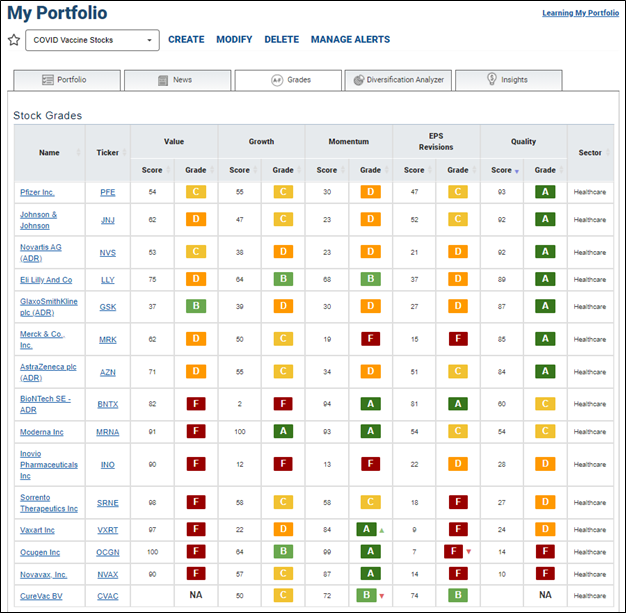
Seven of the companies here have Quality Grades of A, while five have grades of D or F. Backtesting of the quality factor showed that that companies with lower grades underperform those with higher grades. Pfizer has the highest Quality Score among these companies, at 93, while Johnson & Johnson and Novartis AG (NVS) are close behind at 92. Novavax has the lowest quality score at 10. CureVac BV (CVAC) does not have the necessary underlying data points to calculate a quality score. The company has yet to turn a profit in the four years it has been in operation.
Seeing the strong run many coronavirus vaccine makers have had over the last year, I also wanted to look the valuations for this group of stocks. Only one, GlaxoSmithKline PLC (GSK) has a Value Grade of A or B with its B grade. This is not surprising given that its momentum grade is D. GlaxoSmithKline shares have been flat over the last year and are up 2.7% over the four weeks ended June 11.
Six of the stocks on the list have a Value Score of 90 or higher (a higher value indicating a less attractive valuation). Four of them also have a momentum grade of A. Ocugen Inc. (OCGN), which is the most “expensive” of the 15 stocks here with a Value Score of 100, has seen its stock price skyrocket 2,436% over the last year. However, it has fallen nearly 28% over the past four weeks and is 66% off its 52-week high.
The revenues and earnings from their coronavirus-related operations have not seemingly had a significant impact on the growth of many of these stocks. Ocugen, Eli Lilly and Co. (LLY) and Moderna are the only companies on this list with Growth Grades of B or better, while five on the list have Growth Grades of D or F. Moderna saw its year-over-year growth in revenues jump more than 16,530% for its latest quarter ending March 31. Its earnings swung from a loss of $0.37 per share in the March 2020 quarter to $2.84 for the last quarter. Its free cash flow per share for the latest quarter was $6.93 compared to negative free cash flow of $0.32 per share for the same quarter a year ago.
The question for investors is whether these companies are still worth buying. Most likely, investors will need to evaluate these companies based on the potential of their future pipelines, rather than focusing on their coronavirus vaccines. The technology some companies are using for their coronavirus vaccines, especially mRNA technology, could have numerous applications beyond vaccines, including cancer vaccines.
The stock grades that are available exclusively to A+ Investor subscribers provide a starting framework for evaluating stocks. It is worthwhile, however, to dive deeper into the underlying numbers to see what they are saying about a company.


