Choosing mutual funds for your portfolio can be a daunting task, simply because of the number of options investors have. With over 20,000 mutual funds to choose from, you may think that getting started is an insurmountable task. Luckily, it doesn’t have to be difficult, assuming you take a moment to do some self-evaluation and due diligence.
Understanding your own tolerance for risk and getting a clear picture of your investment objectives will make the selection process significantly easier. Picking winning mutual funds involves choosing those that provide good returns at a low cost. However, and perhaps more importantly, you should select those “winners” that mesh with your investing objectives.
Once you’re ready to choose some mutual funds, there are ways to analyze them such as looking at each fund’s performance history, management team and expense ratios. You can also entertain different investment strategies to drive your fund choices, such as diversifying your portfolio with international exposure, buying a market index (S&P 500 index), or dollar-cost averaging your money into different funds.
Since 1924, when the first mutual fund was created, the mutual fund industry has become one of the largest in the world, controlling trillions of dollars in assets and allowing small retail investors access to the broader equity and bond markets, without having to select individual securities.
As an investor, you can choose from upward of 25,000 mutual funds offered by hundreds of fund management companies, so it helps to set some goals to narrow the field. Ask yourself the following questions to gain some clarity on your investing goals:
In terms of risk tolerance, it’s essential to decide how much volatility you can stomach with your portfolio balance:
Finally, think about the best time horizon for your investments, or how long you need to invest your funds:
The adage “there is no such thing as a free lunch” is applicable to mutual funds. In short, it takes money to run a mutual fund. Mutual fund companies have overhead they have to pay for—including portfolio management and analyst salaries, not to mention paper clips, office leases and electricity—before they can start investing your money. The percentage of assets that go toward these things—the management advisory fee and basic operating expenses—is known as the expense ratio. This is the cost of owning a mutual fund. Perhaps a better way of thinking about it is the amount a mutual fund has to earn to break even before it can even begin to start growing your money.
All else being equal, you want to own funds that have the lowest possible expense ratio. If two funds have expense ratios of 0.50% and 1.50%, respectively, the latter has a higher hurdle to clear before money starts accumulating in your account. Over time, these seemingly innocuous fees can have a significant impact on your long-term performance.
Furthermore, if you invest in mutual funds that have sales charges (or loads), they can add up if you’re investing for the short term. For this reason, an investing period of at least five years is ideal to offset these charges.
The turnover rate of a mutual fund is another important metric to evaluate. This is the percentage of the portfolio that is bought and sold each year. If you are investing in mutual funds for a taxable account, turnover plays an even more prominent role because of the impact of taxes.
If you are investing solely through a tax-free account such as a 401(k), 403(b), Roth IRA or traditional IRA, this is not a consideration. For everyone else, however, the tax man can take a massive bite from your proverbial investment pie, especially if you are in a higher tax bracket. For this reason, you should be wary of funds that habitually turn over 50% or more of their portfolio.
Getting to know the manager of a mutual fund is also a worthwhile endeavor. All else equal, a fund with a manager with an established, long-term track record is preferable. Even better is a manager with a history of generating market-beating results.
We all have a unique philosophical view of investing. Are you a value investor or a growth investor? Do you prefer companies that have a solid commitment to social or environmental causes?
In this day and age, there are mutual funds catering to almost every kind of investment philosophy imaginable. It is vital for you to find a mutual fund or family of mutual funds that shares the same investment philosophy you do.
Some mutual funds charge what is known as a sales load or charge. This is the commission you pay on your investment in a mutual fund. A financial intermediary, such as a broker, financial planner or investment adviser, receives the money from a sales charge. Keep in mind that sales charges are not paid to the fund itself, so they do not factor into the gross and net expense ratio of a fund.
Sales charges are expressed as a percentage of the investment value. Therefore, for an investor, their actual investment in the fund is equal to the difference between the investment value per share and the total sales charge. By regulation, the maximum permitted sales charge is 8.5%, but most loads fall within a 3% to 6% range.
Sales charges can vary across different types of funds and share classes. Many funds may not require sales charges due to distributor relationships. Investors should be sure that they clearly understand the sales charges and other fees associated with a fund. Fund companies typically provide comprehensive disclosure of their sales charges, and they are also usually discussed in a fund’s prospectus.
Some common types of sales charges include the following:
So why should you pay attention to sales charges of front-end loads? Let’s say, for example, you invest $100,000 and you buy a load fund with, say, a 5% sales load. You automatically lose $5,000 off the top, so your account balance starts at $95,000. If you hold the mutual fund for the next 25 years, and realize a 10% annual return, you will end up with a roughly $1,029,300 account balance. However, if you had invested the full $100,000 for 25 years with the same 10% annual return, you would have had around $1,083,500. By starting with $5,000 less because of the front-end load, you left more than $54,000 on the table! Investing in no-load mutual funds is an easy way to save serious money.
No matter the type of fund you look at, each has a different approach and goal. Therefore, it is crucial to know the style or purpose of a fund in order to understand what you should compare it against to judge whether the portfolio manager is doing a good job. For example, if you own a balanced fund that keeps 60% of its assets in stocks and 40% in bonds, you should be thrilled with a return of 10% even if the broader market returned 14%.
Some popular benchmarks include the Dow Jones industrial average, 30 of the largest U.S.-based companies; the S&P 500, the 500 largest U.S.-based companies; the Russell 2000, an index of roughly 2,000 small-cap American companies; and the Nasdaq composite, the common stocks listed on the Nasdaq stock market.
It’s easy to see which benchmarks funds are tied to and how well the manager or management team is achieving their objective.
Some successful stock-pickers, such as Warren Buffett, are known for concentrating their assets into a few key opportunities. However, Buffett also says that, for those who don’t know anything about the markets, extreme diversification makes sense.
If you don’t have the knowledge or comfort level to analyze individual stocks, it’s essential to spread your assets among different companies, sectors and industries, etc. While investing in an equity mutual fund means you are invested in dozens or hundreds of different companies, the fund’s style of objective could mean that you are still concentrated in stocks that, generally speaking, will move in tandem with each other. If you are invested in multiple value mutual funds or several funds all invested in the same sector, you are probably not adequately diversified.
So how do you know if your portfolio is sufficiently diversified? Here are some helpful guidelines to follow (but remember these are suggestions, not hard and fast rules):
There are many resources available to A+ Investor subscribers to filter and evaluate mutual funds.
Funds Page
The Funds area of A+ Investor is where to begin.
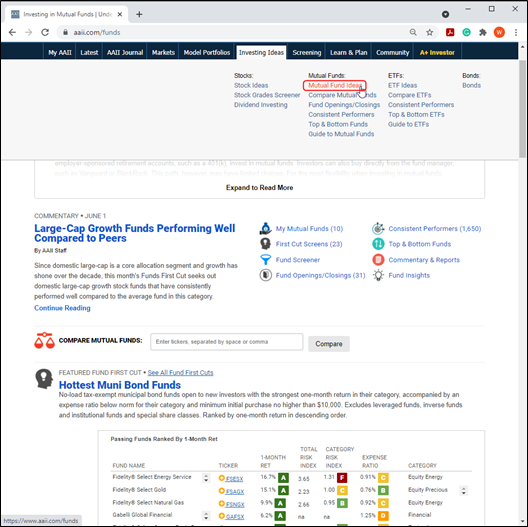
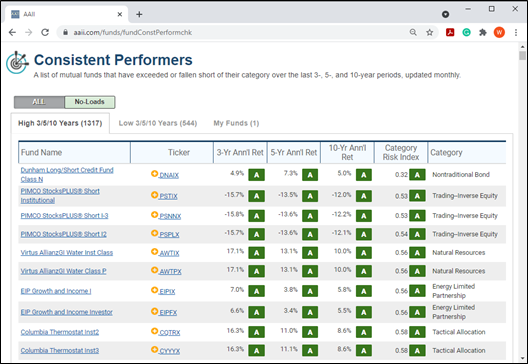
Clicking on the Consistent Performers link will take you to a page where you can toggle between load and no-load funds and view separate tabs with the lists of funds that have been consistent top performers or bottom performers over the last three, five and 10 years. The number in parentheses indicates how many funds have been tagged as consistent outperformers (or laggards). For each fund, you can see how it outperformed or underperformed its category average for each time period. The My Funds tab on the Consistent Performers page lists any funds held in portfolios you saved using the My Portfolio tool that are a top or bottom performer over the last three, five and 10 years.
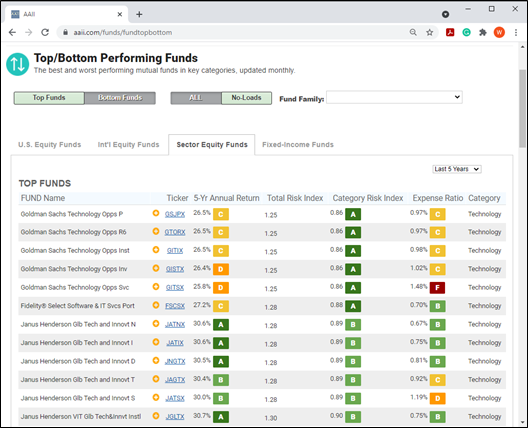
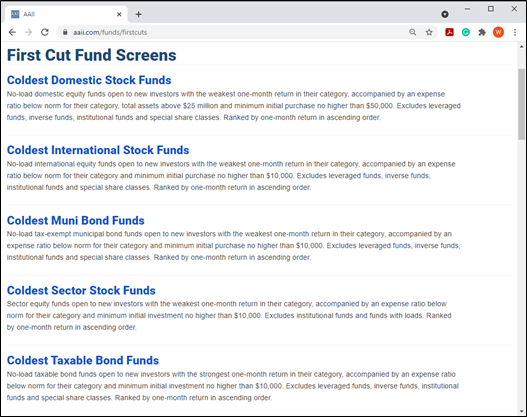
Clicking the First Cut Screens link gives you a list of more than 20 predefined mutual fund screens that have been developed for A+ Investor. These screens will help you winnow down the entire mutual fund database based on pertinent mutual fund selection criteria. These First Cut screens look for top and bottom index, stock, domestic stock, sector stock, taxable bond, municipal bond and high-yielding equity funds. Selecting any of these First Cut Fund Screens will take you to the listing of mutual funds meeting that screen’s criteria.
These predefined screens include:
New screens are added periodically to the list.
Funds+ Screener
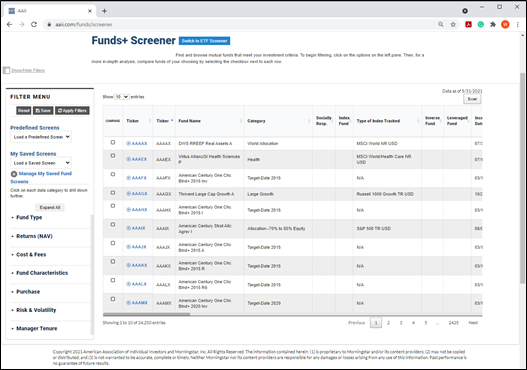
The Fund Screener link will take you to the Funds+ Screener built exclusively for A+ Investor.
The Funds+ Screener allows you to:
The Fund Screener’s filters are divided into several categories:
Clicking on an individual data category will expand that specific one, or you can click on the Expand All button to show all of the filters you have at your disposal.
As you add filters, those you are using are listed at the top of the screen. Clicking on an “x” next to any of the selected screening criteria will remove it from the screen. You can then click the Apply Filters button to update the list of passing mutual funds as well as click the Save button. You cannot overwrite a predefined screen, but you can revise it by changing the name, at which point it will be available from the My Saved Screens drop-down menu.
You can rename, delete and add a description or revise the filters of any of your personal mutual fund screens by clicking on the Manage My Saved Fund Screens button. From that page, change the Screen Name or Description and add or delete filters and then click the Save button to retain those changes.
Compare Funds
Lastly, you can compare multiple mutual funds that pass a given screen. In the Funds+ Screener, click the box in the Compare column next to those funds you wish to compare and then click on the Compare Selected Funds button above the fund listing table.
From the comparison table, you can add a mutual fund to an existing portfolio/watchlist.
You can also use the Compare Funds tool to manually enter in mutual fund tickers you wish to compare. You’ll find it listed on the Investing Ideas menu drop-down.
Fund Evaluator Pages
If you wish to take a deeper dive into an individual mutual fund or exchange-traded fund (ETF), A+ Investor offers Fund Evaluator pages. Entering in a mutual fund name or ticker into the search box at the top of each AAII webpage and choosing the name from the drop-down list—or clicking on any fund ticker from the fund tables or screens—will take you to the corresponding fund.
Be sure to check out this Making the Grade where I discuss the A+ mutual fund and ETF evaluator pages.
There is a wealth of resources available to A+ Investor subscribers for choosing and selecting a mutual fund. As with any type of investment, the key is to remain disciplined and rational and avoid being swayed by short-term price movements in the market. Your goal is to build wealth over the long term. You simply can’t do that moving in and out of funds, incurring fractional expenses and triggering tax events.

