 ATKR
ATKR
At this point in the current earnings season, more S&P 500 index companies are beating their consensus earnings estimates for the second calendar quarter (April 1 through June 30) than average, and they are beating earnings estimates by a wider margin than average, according to FactSet.
Overall, 89% of the companies in the S&P 500 have reported actual results for the second calendar quarter of 2021, through August 6. Of these companies, 87% have reported actual earnings above estimates, which is above the five-year average of 75%, per FactSet data. If 87% is the final percentage for the quarter, it will mark the highest percentage of S&P 500 companies reporting a positive earnings surprise since FactSet began tracking this metric in 2008.
In aggregate, companies are reporting earnings that are 17.1% above estimates, which is also above the five-year average of 7.8%. If 17.1% is the final percentage for the quarter, it will mark the fourth-largest earnings surprise percentage reported by the index since FactSet began tracking this metric in 2008.
Stock prices of firms that significantly exceed analyst expectations (positive earnings surprise) tend to outperform the market, while those with negative surprises tend to underperform.
The impact of the earnings surprise is longer lasting than most would think. The greatest effect of the surprise can be seen immediately, but the impact of the surprise can be felt for as long as a year. The impact tends to be longer lasting for negative earnings surprises. It simply takes time for the market to recognize that a fundamental shift is taking place. This means that it does not generally make sense to be a bargain hunter and buy a stock after the initial price decline on a negative earnings surprise. There is a good chance the stock will continue to underperform the market for some time. Separately, it may not be too late to buy into an attractive stock after a better-than-expected earnings report is released, provided the fundamentals are still valid.
Not surprisingly, large firms tend to adjust to surprises faster than small firms. Larger firms are followed by more investors, analysts and portfolio managers acting on the information more quickly and thoroughly.
Changes in estimates reflect changes in analyst expectations of future performance and lead to price adjustments similar to earnings surprises. When earnings estimates are revised significantly upward—5% or more—stocks tend to show above-average performance. Stock prices of firms with downward revisions show below-market performance.
Changes in analyst estimates are more meaningful when individual estimates move away from the average, rather than toward the consensus.
A+ Investor subscribers have exclusive access to Stock Grades for over 6,300 stocks for factors of value, growth, momentum, quality and estimate revisions. The estimate revisions grade ranks companies by the statistical strength of their two latest quarterly earnings surprises and earnings revisions for the current fiscal year over the last month and three months.
Earnings estimates are an important element to consider as investors look for stock ideas and manage their holdings.
Using the A+ Stock Grades Screener, you can isolate those companies that grade highly based on earnings estimates (along with growth, value, momentum and quality).
Now that we are into the second month of the current earnings season, we can start to identify companies that have reported strong (or weak) earnings surprises as well as those seeing their consensus estimates revised (upward or downward).
The A+ Stock Grades Screener allows you to filter for stocks with specific factor grades. As of the close on August 6, 2021, there were 393 stocks out of the universe of 6,781 companies with an estimate revisions grade of A.
This is still a large universe of companies to sift through, but applying filters for above-average (B or better) value, growth, momentum and quality to the universe of companies with A grades for estimate revisions narrows the number down to 24 (compared to 30 at the same point in the earnings season last quarter):
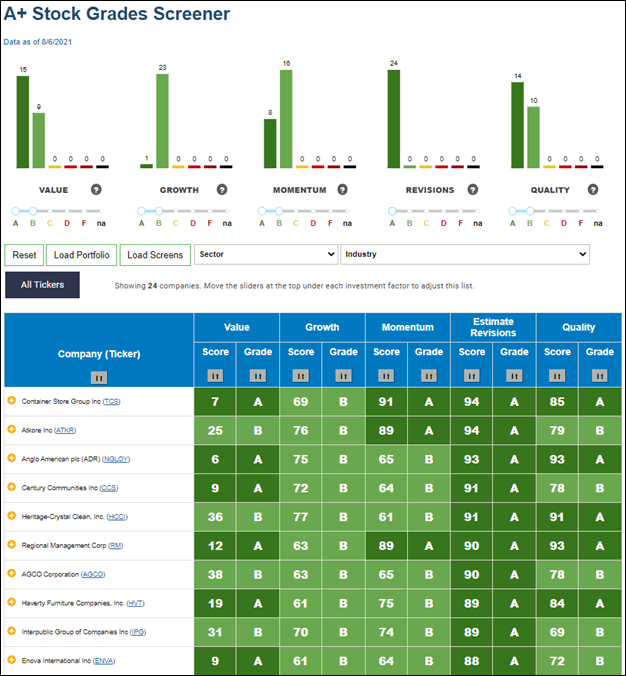
This table shows the top 10 of the 24 passing companies based on their Estimate Revisions score.
This quarter, none of the 24 companies passing the stock grades screens have A grades across all five factors, compared to two at the same point in the previous quarterly earnings season.
Atkore Inc. (ATKR) and Container Store Group Inc. (TCS) have the highest estimates revisions scores among these 24 companies at 94. Both companies have A momentum grades, while Container Store also has A grades, and Atkore has B grades, for value and quality. Both companies have growth grades of B.
Clicking on the ticker for Container Store takes us to its Stock Evaluator page. From there, clicking on the Grades tab takes us to a detailed explanation of each of the five factor grades. For this example, we focus on Container Store’s Estimate Revisions Grade:
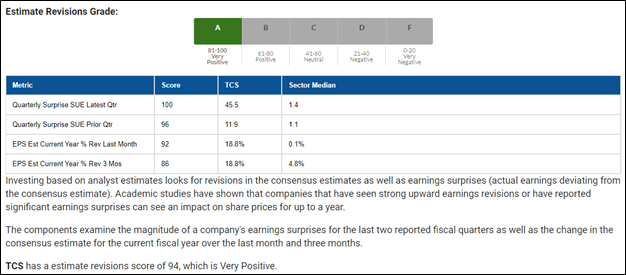
Container Store has an overall Estimate Revisions Score of 94, which translates into an A grade. This grade is arrived at by using four different pieces of data:
To say that a company missed or exceeded its quarterly consensus estimate does not necessarily capture the real significance of such an event. There are several ways of measuring the significance of an earnings surprise. One method of measuring the magnitude or significance of earnings surprises is with the standardized unexpected earnings (SUE) score. SUE measures the earnings surprise in terms of its number of standard deviations above or below the consensus earnings estimate.
An earnings surprise is considered more significant the farther it is outside the statistical range of estimates expected at the time of the announcement. Assuming a normal distribution of earnings estimates, 68.2% of actual earnings will be within one standard deviation of the consensus estimate, 95.4% will be within two standard deviations and 99.7% will be within three standard deviations. The absolute value of SUE measures the degree of unexpected earnings. There is no earnings surprise when the SUE score equals zero; the actual earnings per share is in line with the consensus earnings estimate.
The standard deviation of Container Store’s estimates for its quarter ended June 20, 2021, was $0.006. Given this, along with the difference between its reported earnings for the quarter of $0.36 per share and the consensus estimate of $0.087, we arrive at an extremely statistically significant SUE score of 45.5 for the latest quarter. The SUE score for the quarter ending March 31, 2021, was also highly statistically significant at 11.9.
The consensus earnings estimate for Container Store’s current fiscal year ending in March 2022 stood at $1.22 per share as of August 6. One month ago, analysts were forecasting earnings for the year of $1.027 per share. Three months ago, the consensus estimate for the year was also $1.027 per share. Using these numbers, we arrive at the percentage change over both the last month and previous three months of 18.8%.
The “raw” values of the four metrics used for the Estimate Revisions Grade are then converted to percentile ranks, which compare them against all of the stocks in the universe. Container Store’s SUE score for the latest quarter of 45.5 ranks in the 100th percentile among the nearly 6,800 stocks in the universe, while the 11.9 SUE score from the previous quarter also ranks in the 96th percentile.
The percentage changes in the current year’s consensus estimate over the last month and three months rank in the 92nd and 86th percentiles, respectively. The percentile ranks for the four underlying metrics are then averaged; for Container Store, this translates into an Estimate Revisions Score of 94, which places it in the A or “very positive” range.
While investing in companies seeing significant upward earnings revisions has been shown to generate promising results over the long term, it is important to take into consideration elements of financial strength, quality or price momentum. As an A+ Investor, not only can you evaluate the estimate revisions of individual stocks, but you can also use the Stock Grades Screener to isolate those companies with high estimate revisions scores along with elements of growth, momentum, quality and value.

