Stocks form the backbone of many investor portfolios.
Even if you don’t own individual stocks, which many investors see as too daunting, chances are you own hundreds of stocks indirectly through mutual funds or exchange-traded funds (ETFs).
Mutual funds and ETFs are the preferred means of participating in the stock market because they offer more diversification and convenience.
However, many investors, especially those new to investing, still ask, “What are stocks, and how should you invest in them?”
The typical company doesn’t start as a publicly traded entity. Instead, most companies are privately held at first, meaning funding comes from the founders or their friends and families. Eventually, however, a growing company eventually needs more funding sources. This is where issuing stock comes into play.
A company can issue public shares of stock through an initial public offering, or IPO. Once the IPO is complete, the stock debuts on a market exchange such as the Nasdaq or the New York Stock Exchange. In turn, investors can buy these shares, making them part owners of the business. This provides the publicly traded company the money it needs to hire new employees or develop new products.
The primary benefit of owning stocks is seeing the stock’s price increase or “appreciate.” However, it’s important to realize that stock price appreciation isn’t guaranteed. Sometimes, investors can make the correct bet and enjoy dizzying returns. Additionally, there is downside risk when investing in stocks. When these bets don’t work out, the losses can be painful. In some cases, such as when a company goes bankrupt, investors can lose everything they put into the stock.
Because of the long-term upside offered by stocks, they are some of the best investments for maximizing your wealth. But you want to protect yourself from individual company meltdowns, which is why building a diversified portfolio of stocks is a less risky way to meet your investing goals.
Another benefit some shareholders receive is a dividend—a cash payment from the company to stockholders.
Not all companies offer dividends. Fast-growing companies often plow excess cash back into the business rather than distributing it to investors. Generally, the more mature and established companies are the ones to pay dividends.
Proxy voting is another right stockholders enjoy. It allows them to choose the board of directors, vote on shareholder resolutions and even have a say on CEO pay.
These rights only extend to investors in individual stocks. However, if you own mutual funds or ETFs, the investment company that manages these funds has these rights and exercises them on your behalf.
One of the most attractive features of stock funds over individual stocks is the diversification they offer. Owning mutual funds or ETFs exposes you to dozens if not hundreds of stocks rather than making active bets on a small number of individual companies.
Some investors also feel they don’t have the know-how to select individual stocks. In contrast, many stock fund managers are experienced investors. Many individual investors don’t have the time, or interest, to keep up with markets and make tactical portfolio decisions. Fund managers get paid to make these choices, and many investors prefer to let these professionals do the stock-picking for them.
While some investors argue that the large number of stocks to choose from is too intimidating, you still have tens of thousands of choices when it comes to mutual funds and ETFs. For example, the Funds+ Screener available exclusively to A+ Investor subscribers tracks more than 11,500 stock funds, while the ETF+ Screener allows A+ Investor subscribers to search a database of more than 1,500 equity ETFs.
A+ Investor Stock Resources
AAII was founded more than 40 years ago on the premise that do-it-yourself investors have definite advantages compared to the “big boys”—institutional investors such as mutual funds, pension funds, etc.
We passionately believe that individual investors are more than capable of becoming effective managers of their own assets with the proper education and information. If you have the time, interest and discipline, we genuinely believe you can manage a portfolio of individual stocks that outperforms most mutual funds.
So if you have capacity to try investing in individual stocks, A+ Investor offers several resources to help you identify potential stock investments as well as evaluate them to see if they fit in your portfolio.
There are thousands of individual stocks trading on U.S. exchanges. So, where do you begin? For some, including myself, choosing a specific stock selection strategy is an excellent way to start narrowing down the pool of potential stocks. This involves quantitative stock screening.
Simply put, stock screening is the process of applying a set of filters to a stock universe that narrows down the focus from possibly several thousand stocks to a more reasonable handful. From there, we can focus our time on those stocks that meet our base criteria instead of randomly picking stocks to analyze. However, there isn’t a “one size fits all” approach to selecting and buying stocks.
So the question becomes: With so many ways to get stock ideas, how do you know which strategies are right for you?
AAII tracks over 60 stock screening strategies, and A+ Investor offers several ways to parse this listing to focus on those of most significant interest to you, whether it be growth, value, short-term, long-term or a combination of factors. These include:
Strategy Power Rankings
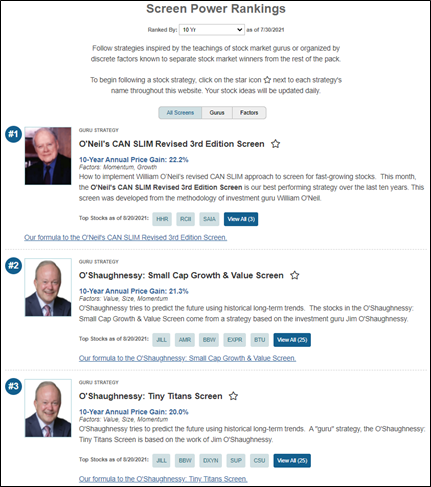
The Strategy Power Rankings allow you to rank the 60+ AAII stock screening strategies based on several different performance periods (year-to-date, one-year, three-year, five-year, 10-year and since inception) as well as on a risk-adjusted basis and over the last bear market and current bull market. You can also sort only the factor-based screens or only those based on investment gurus. The performance data is updated monthly, while the screening results for the various strategies are updated daily (Tuesday through Saturday) for A+ Investor subscribers.
If you looked at the top strategies over the three, five and 10 years ended July 31, 2021, two rank in the top five for all those periods: Motley Fool’s Foolish Small Cap 8 and James O’Shaughnessy’s Small Cap Growth and Value.
Factor Strategies
Factor investing chooses stocks based on attributes shown to generate above-average returns. These attributes have become called factors and include small stocks, low valuation, high price momentum and high yield. AAII has developed several screens based on these common investment factors, and you can view a sortable listing of these factor screens. With this listing, you can identify top-performing strategies that follow investment factors that may interest you.
If we look at the top-performing factor strategies over the last 10 years, upward estimate revisions and value strategies are the most prevalent, with estimate revisions claiming the top two spots.
Guru Strategies
If you prefer to invest like other successful investors, AAII tracks dozens of stock screening approaches based on the methodologies of some of the most successful guru investors in history.
Over the last 10 years, the top-performing guru screen is William O’Neil’s CAN SLIM Revised 3rd Edition Screen.
Even with these guru screens, we also show which investment factors underlie each approach. For example, among the guru strategies, growth and momentum factors were underlying most of the top guru strategies over the last 10 years, followed closely by value.
For all of the strategies AAII has developed and tracks, you can read about the underlying approach and see the daily passing company listings and performance dating back to 1998.
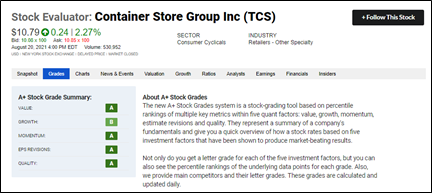
The A+ Stock Grades are a stock evaluation tool based on percentile rankings of multiple key metrics within five investment factors: value, growth, momentum, earnings estimate revisions and quality. They represent a summary of a company’s fundamentals and give you a quick overview of how a stock rates based on the five investment factors that have been shown to produce market-beating results.
There are several places where you can find A+ Stock Grades:
Stock Evaluator
To access a Stock Evaluator data sheet for any of the 6,500+ stocks in the A+ Investor stock universe, type a company name or ticker in the search box at the top-left of the AAII website (www.aaii.com) and when it appears via the autofill drop-down box, click on the company name.
Once you are at the Stock Evaluator page, click on the Grades tab in the gray ribbon near the top to review the A+ Stock Grades for that company.
A+ Stock Grades Screener
Investing is a very personal endeavor. As I mentioned, the strategies you choose and the stocks you select should be based on specific factors, including risk tolerance, investing time horizon, liquidity needs and much more.
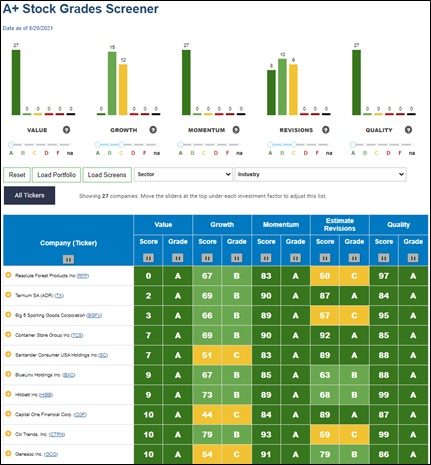
Not only can you review the A+ Stock Grades for specific companies, but with the A+ Stock Grades Screener, you can identify stocks with particular letter grades across the A+ ratings on value, growth, momentum, estimate revisions and quality factors.
For me, I gravitate toward “value” stocks—strong companies trading at attractive valuations based on earnings, book value, sales and dividends. This is based mainly on the overwhelming academic research and real-world success that shows value investing is a successful long-term investment strategy.
Using the A+ Stock Grades Screener, I can isolate those stocks that grade the highest in terms of value, momentum and quality, as well as those with above-average estimate revisions and surprises and average-or-better grades for growth. In a matter of seconds, the A+ Stock Grades Screener can narrow down the universe of thousands of stocks to a handful that I can focus on and research further:
I have revealed some of the tools and resources A+ Investor subscribers have to identify and analyze potential stock investments.
However, I continue to work with our developers to improve upon the A+ Investor service.
To that end, our hard-working team at AAII has been developing a new tool for stock investors. Some of you may have come across it in the last couple of weeks.
If you haven’t, don’t worry. In the next week or two, I will be revealing it in this Making the Grade email, so be sure to stay tuned.

