In my nearly 25 years as an investor, I have learned a few things that have served me well: diversify, reduce fees and expenses and avoid churning my portfolio (active trading).
These are the hallmarks of index mutual funds, which is one of the reasons they have become so popular. Index funds hold more than half of all U.S. stock fund assets, according to Morningstar.
However, it is essential to recognize that the way an index is constructed and thus how a fund that tracks that index is invested can significantly impact the overall diversification of your portfolio.
Most of the major U.S. stock indexes, including the S&P 500 index and the Nasdaq composite, are weighted by market capitalization. Also known as a cap-weighted index or market-value-weighted index, this is a type of stock market index where individual components of the index are included in amounts that correspond to their total market capitalization. A company’s market capitalization is calculated by multiplying its outstanding shares by the current price of a single share. In this way, market capitalization reflects the total market value of a firm’s outstanding shares.
With the cap-weighted method, the index components with a higher market cap will receive a higher index weight. Thus, proportionally, the performance of companies with a small market cap will have less of an impact on the overall index’s performance.
In the composition of a cap-weighted index, large movements in the share prices for the largest index companies can significantly impact the value of the overall index. On the other hand, small companies tend to have less of an impact.
Critics of cap-weighted indexes might argue that the overweighting of the largest companies can give a distorted view of the market. When larger companies are leading the market, investors in market-cap-weighted indexes are happy. However, when these same companies lag, they will have an outsized adverse impact on the index’s performance.
A different way to construct an index is with equal weighting. An equal-weighted index is a stock market index that invests an equal amount of money in each company’s stock that makes up the index. Thus, the performance of each stock carries equal importance in determining the total value of the index.
Equal-weighted indexes, in effect, favor smaller companies by according them the same importance as large-cap firms. They remove the market-cap bias, meaning that even the smallest of companies exerts more power in an equal-weighted index than it would in an index weighted by market capitalization.
Market-cap-weighted and equal-weighted index funds come with both advantages and disadvantages relative to each other.
Some of the primary pros of an equal-weighted index fund are:
However, there are some distinct disadvantages of equal-weighted index funds compared to market-cap-weighted index funds:
From a performance standpoint, there is no clear consensus on whether market-cap-weighted or equal-weighted index funds are preferable in the long term. However, during the last two bear markets—the financial crisis of 2007–2009 and the coronavirus pandemic last year, a market-cap-weighted portfolio outperformed an equal-weighted portfolio. But this is too small of a sample size to draw meaningful conclusions.
Between 1926 and 2021, equal weighting across every market cap decile outperformed market-cap weighting, according to data from Kenneth French and FactorResearch. However, the excess returns were mainly generated before 1981.
Some argue that investing in the smallest stocks is not feasible, given their low liquidity and related transactions costs (bid-ask spreads). However, this isn’t a huge hurdle for individual investors, who can invest in individual small-cap issues without impacting the stock price relative to large institutional investors such as mutual funds.
An equal-weighted portfolio invested in only the largest 80% of stocks by market cap between 1926 and 2021 would have generated an average annual return of 14.8%, based on data from Kenneth French and FactorResearch. Compare this to the 10.3% average annual return for a market-cap-weighted portfolio invested in the entire stock market over the same period.
Looking at the 18 worst stock market crashes between 1926 and 2021, the drawdowns of an equal-weighted portfolio excluding the smallest 20% of stocks and a market-cap-weighted portfolio invested in the entire stock market were similar. For example, the average drawdown for the equal-weighted portfolio invested in the largest 80% of stocks was 30%, versus 31% for the market-cap-weighted portfolio. However, the equal-weighted portfolio had smaller drawdowns in the five instances when the difference was 10% or more—1932, 1933, 1942, 1978 and 2002.
Whether you choose an equal-weighted index fund or a cap-weighted fund will result in a different overall sector breakdown. This means the overall diversification profile of the fund you select could be much different than its equal-weight or cap-weighted counterpart.
For example, let’s take the S&P 500, an index that tracks 500 of the largest companies traded on U.S. exchanges.
There are numerous mutual funds and ETFs that track this index, but we will use the Vanguard 500 Index Investor fund  (VFINX) and the Invesco S&P 500 Equal Weight ETF (RSP) for this example.
As of the end of July, here is the sector breakdown of the two funds using the My Portfolio Diversification Analyzer:
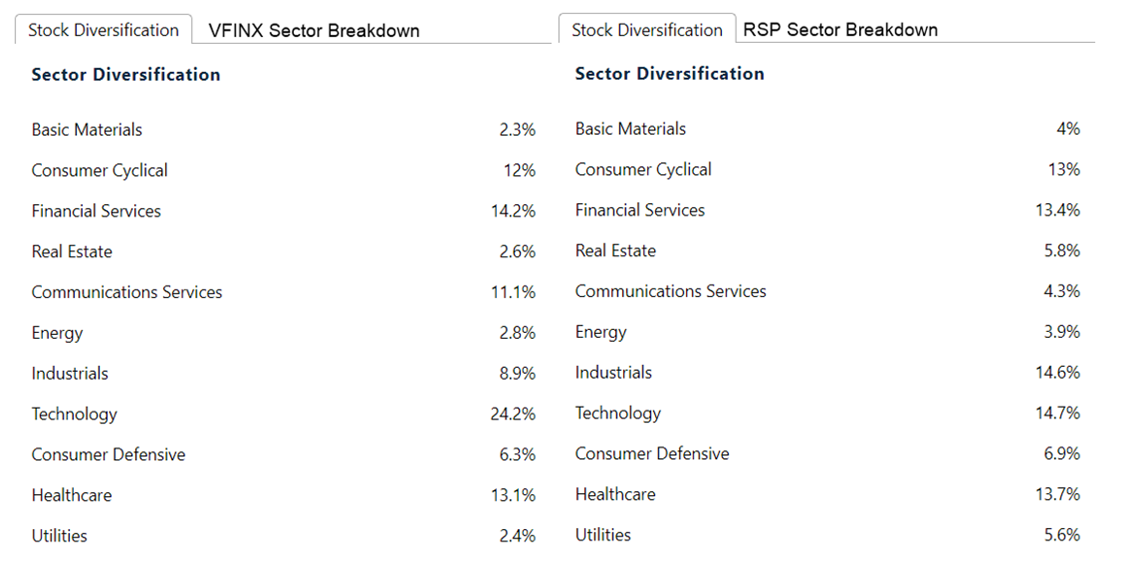

Among the 11 sectors tracked by My Portfolio, the two funds have a divergence of two percentage points or more in five: real estate, communications services, industrials, technology and utilities. The market-cap-weighted Vanguard S&P 500 fund has nearly 10 percentage points more in the technology sector than the Invesco S&P 500 equal-weight ETF. Conversely, the Invesco S&P 500 ETF is more heavily weighted by nearly six percentage points in the industrials sector.
By definition, the Invesco S&P 500 Equal Weight ETF will be invested in roughly equal percentages across all of the S&P 500 components, just under 0.3% per holding. In contrast, as of the end of July, the Vanguard S&P 500 fund was invested 6.2% in Apple Inc. (AAPL), 5.8% in Microsoft Corp. (MSFT), 3.8% in Amazon.com Inc. (AMZN) and 4.3% in Alphabet Inc. class A (GOOGL) and C shares.
Furthermore, whereas the top 10 holdings in the Invesco S&P 500 Equal Weight ETF account for roughly 3% of the total portfolio, the Vanguard S&P 500 fund is invested 28% in its 10 largest holdings.
These are vital issues to consider when investing in either an equal-weighted or cap-weighted index fund or ETF.

