VFINX
VFINX
ESG stands for environmental, social and governance. Investors are increasingly applying these nonfinancial factors to their investment analysis to identify material risks and growth opportunities. However, ESG metrics are not commonly part of mandatory financial reporting, though companies increasingly make annual or stand-alone sustainability disclosures.
ESG investing is growing exponentially as more investors and issuers utilize ESG and climate data and tools to support their investment decision-making. The practice of ESG investing began in the 1960s as socially responsible investing, with investors excluding stocks or entire industries from their portfolios based on business activities such as tobacco production or involvement in the South African apartheid regime.
Today, ethical considerations and alignment with values remain common motivations of many ESG investors, but the field has expanded to consider financial materiality. Many investors now look to incorporate ESG factors into the investment process alongside traditional financial analysis. ESG investing now commonly includes “positive” screens as well—in other words, actively seeking companies or sectors considered to have “best-in-class” ESG performance metrics relative to their industry peers.
There’s been a longstanding perception that screening one’s portfolio can hurt investment performance, as it may result in less diversification. However, an increasing amount of research has countered this notion—particularly for funds that use “positive” and “negative” screens instead of negative screens alone. Jon Hale of Morningstar reviewed the findings of numerous academic studies and concluded that ESG investors “can receive competitive performance while also addressing their sustainability concerns.”
Undoubtedly, ESG investing is rapidly evolving from a niche corner of the investment landscape into the mainstream. However, much of the growth in ESG investing has been concentrated among large institutional investors until recently. But now, interest has been growing among individual investors—particularly women and millennials. Moreover, the increased interest in ESG investing has dovetailed with another industry growth trend: index investing. Fortunately for ESG investors with a bias toward passive investment approaches, a growing number of options [particularly ESG-oriented exchange-traded funds (ETFs)] are becoming available. As a result, according to Morningstar, ESG funds captured $51.1 billion of net new money from investors in 2020, a record and more than double the prior year.
Of course, ESG screens, which often rely on an added layer of internal or third-party research services, can still result in higher embedded fund expenses than their non-screened alternatives. But it is getting easier for index-oriented investors to build well-diversified ESG portfolios at a reasonable cost. Portfolio managers following such strategies seek out securities with both favorable ESG ratings and other attractive investment characteristics.
A+ Investor subscribers have access to predefined ETF (Socially Responsible Stock ETFs) and mutual fund (Socially Responsible Equity Stock Funds) screens that seek out funds classified as following a socially responsible approach to investing by Morningstar. Morningstar defines “socially responsible funds” as any fund that invests according to noneconomic guidelines. These funds may make investments based on such issues as environmental responsibility, human rights or religious views. For example, socially responsible funds may take a proactive stance by selectively investing in environmentally friendly companies or firms with good employee relations. This group also includes funds that avoid investing in companies involved in the defense industry or promoting alcohol, tobacco or gambling.
The A+ Investor socially responsible fund and ETF screens seek socially responsible stock funds with below-average expense ratios and no loads. Passing mutual funds are also both open and available to individual investors.
The screens are available to A+ Investor subscribers at the respective Funds+ and ETF+ screeners.
A total of 33 ETFs and 24 mutual funds passed the respective socially responsible screens as of September 30, 2021. Thirty-four of these 57 socially responsible funds are termed index funds by Morningstar.
Nearly half (28) of these 57 funds have been in existence for less than five years, making long-term judgments difficult. However, only 16 have been around for less than three years. Of the 42 that have three-year performance data from Morningstar, 34 have B or better performance grades. This means they performed above or well above the category average. Comparing these funds to the broader market, 19 of the 42 socially responsible funds outperformed the Vanguard S&P 500 Index Fund (VFINX) over the past three years. This also suggests that it has been possible to do good while doing well.
Careful selection is still required, as evidenced by poor one- and three-year returns for certain funds.
Twenty-six of these 57 socially responsible funds have more than one-quarter of their assets invested in foreign securities. There are also a few small- and mid-cap funds passing these ESG fund screens.
As a whole, socially responsible mutual funds are less volatile than their ETF counterparts. Comparing the standard deviation of monthly returns over the past three years, only five mutual funds have a higher risk index than the average fund in their respective category (category risk grade of D or F). Ten of the socially responsible funds have a risk index that is lower or significantly lower than the category average (grade of B or A).
For the socially responsible ETFs, none of the 33 were rated an “A” based on category risk, while six have category risk grades of D or F.
Lastly, looking at the expense ratios for the 24 socially responsible funds, all have expense ratio grades of B or A. This indicates that they cost less than the average fund in their respective categories.
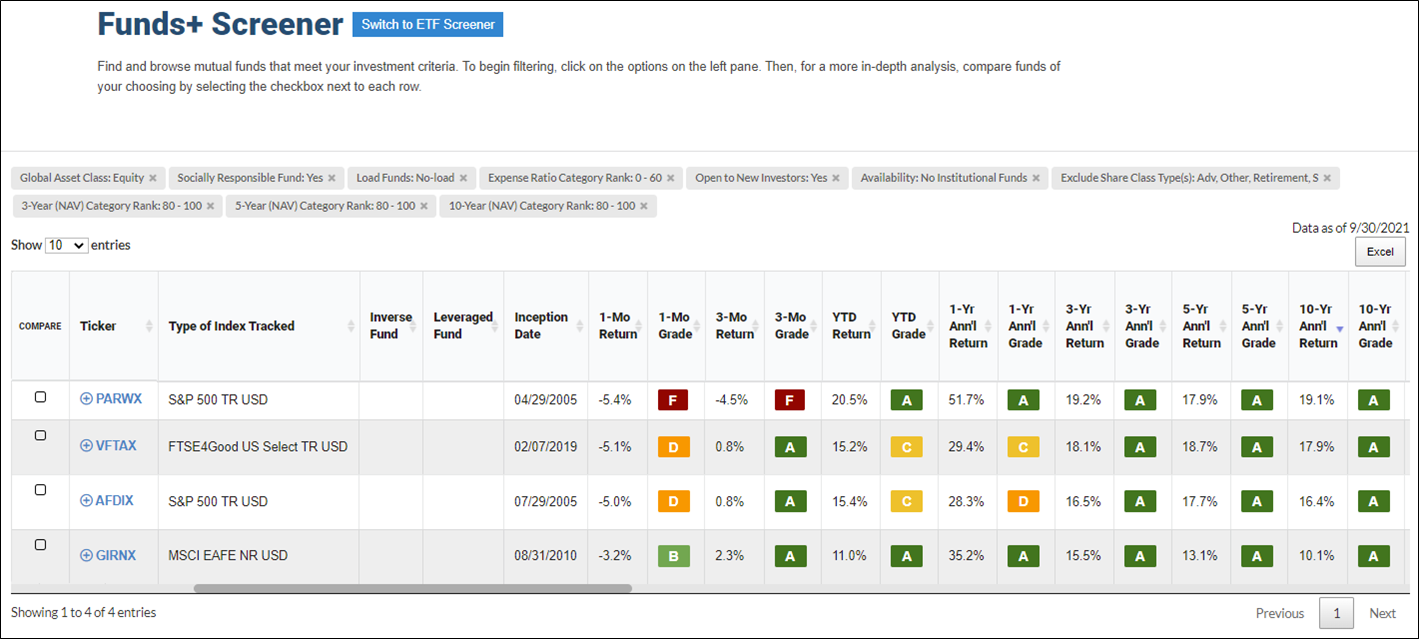
From the 24 socially responsible mutual funds passing the predefined Funds+ screen as of September 30, 2021, four rate in the top 20% of their category in terms of net asset value (NAV) performance over the last three, five and 10 years. Here is the list ranked in descending order by 10-year return:
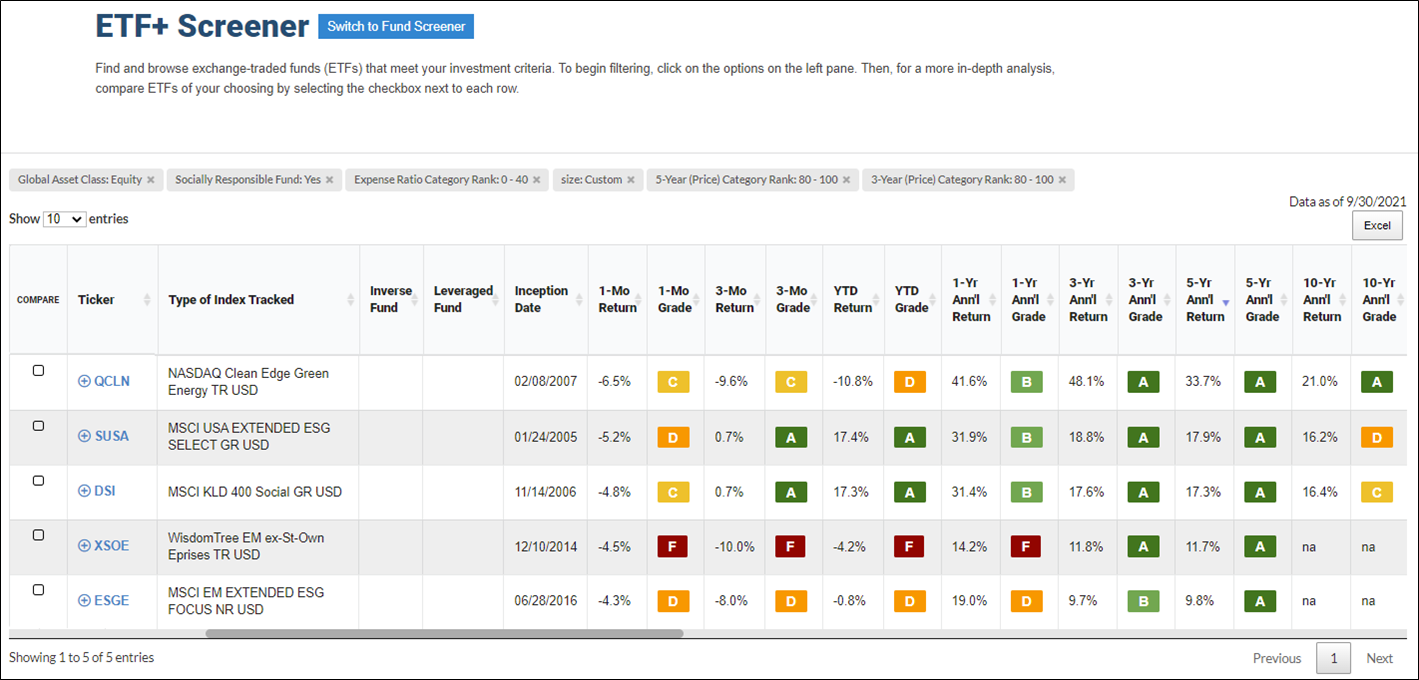
Of the 23 ETFs passing the ESG Stock ETFs screen with data as of the end of September, five rank in the top 20% in their category in terms of price return over the last three and five years. These five ETFs are presented in the table below, sorted from highest to lowest based on total five-year performance: