If my math is correct, as of today, November 8, 53 days are remaining in 2021.
I know for me, the months of November and December fly by, and before I know it, the new year is here. For investors, this is also the time to make end-of-year plans before the holiday rush sidetracks you. Now is the time to look for ways to improve your portfolio, lower your tax bill and get the most from your cash holdings.
This year is on pace to be one of the best of the past decade in terms of stock returns. When things are good, it’s easy to become complacent and fall into the thinking of “If it ain’t broke, don’t fix it.” However, this mindset can be dangerous and leave you flat-footed when the market hits a rough patch.
While I am not a believer of over-managing investment portfolios, I am a fan of periodic portfolio reviews. These reviews help make sure your portfolio and financial plans are on track. For me, an annual peek under the hood is enough, but I wouldn’t suggest more than quarterly. (This is my own opinion since I am not a registered investment planner or financial planner.)
Periodic reviews are also a way to instill some discipline into your investment plan. It prevents you from over-tweaking your portfolio while at the same time regularly ensuring that you are following your investment plan.
As an aside, while performing my year-end portfolio review, I discovered that some of my beneficiary information was out of date. So this is an excellent time to review that information as well.
The My Portfolio tool that is part of AAII membership offers additional resources that are exclusive to A+ Investor. With them, you can take a closer look at your current holdings to help you decide whether you need to make any changes to your overall asset allocation.
Just like it’s a good idea to get a regular health checkup, so too is it a good idea to perform a “wellness check” of your portfolio.
This means looking at the “bottom line” of your portfolio—the overall balance. This is the result of your savings efforts and market performance. This will tell you if you are on track to achieve whatever financial goals you have set for yourself.
The Default View of the My Portfolio tool provides the current market value for your holdings and the overall portfolio weight of each holding:
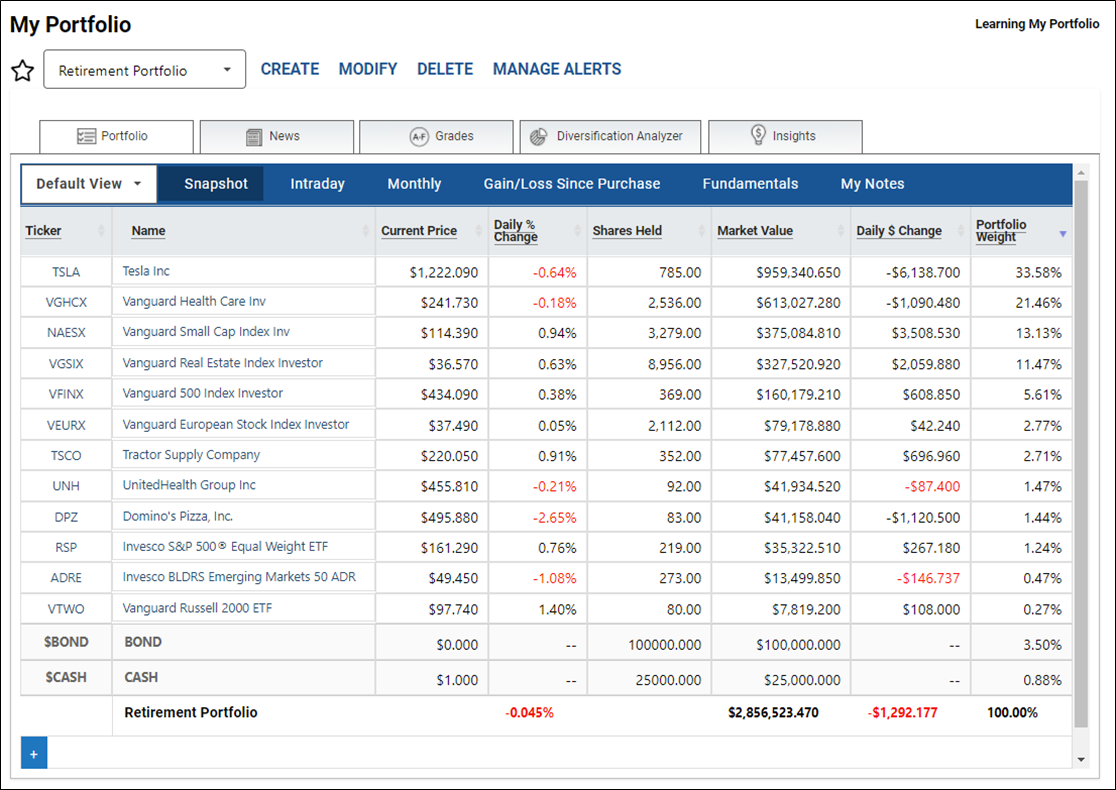
Based on your overall portfolio balance, you may need to increase your savings rate if you are working toward retirement. On the other hand, if you are already retired, you may need to adjust your withdrawal rate to ensure your portfolio lasts for as long as you need it to.
Based on your target allocation, this view also shows if any individual holding may have grown too large. For example, having one-third of the portfolio held in Tesla Inc.  (TSLA) stock has been good during its torrid five-year run, but having such a large percentage devoted to a single stock carries with it significant company-specific risk.
After looking at your portfolio from a “macro” point of view, the next step is to start looking at your holdings.
The Diversification Analyzer, an exclusive My Portfolio tool for A+ Investor subscribers, provides a look at your total portfolio’s mix of individual stocks, mutual funds and exchange-traded funds (ETFs), bonds and cash. With this information, you can compare your actual allocations to your targets.
Given stocks’ strong performance this year, many investors have probably seen their overall allocation skew toward equities.
For those farther away from retirement, this isn’t that big of a deal. However, any changes to allocation may be more related to individual holding exposure or sector/industry concentration, which I’ll talk about in a bit.
If you are nearing retirement or already retired, rising equity exposure poses a more significant risk.
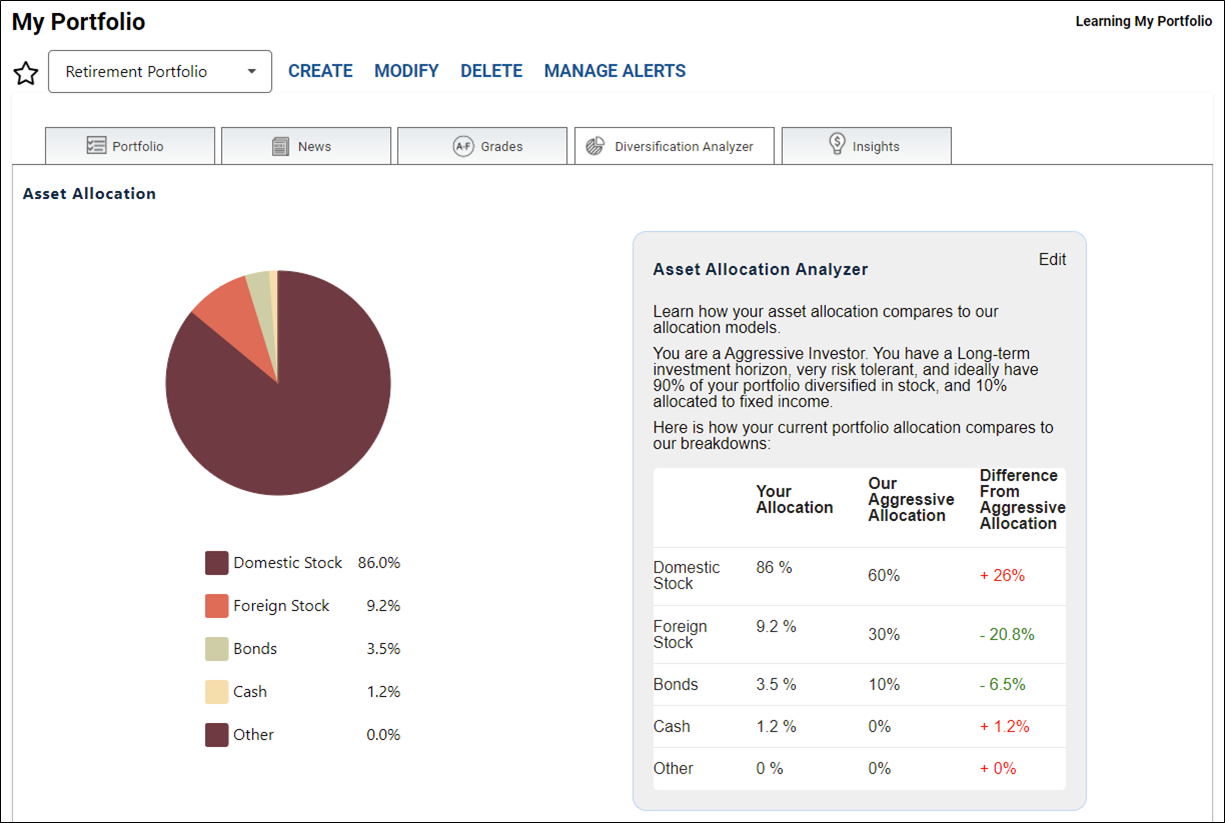
To analyze the holdings of an individual portfolio you’ve created with My Portfolio, first, go to the My Portfolio area of AAII.com. Then, after selecting the portfolio you wish to analyze from the drop-down menu, click on the Diversification Analyzer tab of the My Portfolio view.
If you haven’t set up a portfolio yet, there’s no time like the present. For information on how to set up a portfolio, please review this article.
The Diversification Analyzer in My Portfolio gives you a breakdown of how your portfolio is allocated based on the number of shares you’ve entered for each stock, mutual fund and ETF, plus any dollar amounts you’ve entered for cash and/or bond holdings. This information is used to tell you if you are being too aggressive or not aggressive enough, given your chosen investing profile.
Once you have entered the number of shares you own, the Diversification Analyzer in the My Portfolio tool gives you a breakdown of how your portfolio is allocated.
The Diversification Analyzer first compares your portfolio allocation to AAII’s asset allocation models for conservative, moderate and aggressive investors.
I am still 20+ years away from retirement, so I am willing to take a more aggressive allocation approach with my portfolio. While my retirement portfolio is heavily weighted in equities, based on AAII’s aggressive asset allocation model, I may still be underweighted in foreign stocks and bonds.
Keep in mind that these are just suggested allocation models. Everyone’s situation is different. I have heard some financial planners suggest looking at a target-date fund that corresponds with your target retirement date. For example, the Vanguard Target Retirement 2045 Fund (VTIVX), which would put me at age 70 at retirement, is invested 87% in stocks (52% total market and 35% international), 11% in bonds and roughly 2% in short-term reserves.
If you are closing in on retirement, or are in retirement, any money you will need within the next three to five years really shouldn’t be in the stock market. Having that cash cushion to cover your expenses over several years should prevent you from needing to sell during a market downturn. Again, though, this is a general rule of thumb. Looking at the Vanguard Target Retirement 2025 Fund (VTTVX), it is allocated 56% to stocks, 42% to bonds and roughly 2% to short-term reserves.
This year’s strong stock performance presents an excellent time to reallocate your portfolio, potentially by selling off overweighted segments of your portfolio and building up your cash reserves. First, however, you will need to consider the tax ramifications of doing so.
If you are underweighted in stocks, you may wish to consider upping your investment to that segment of the market, either by investing idle cash (without depleting your reserves for the next three to five years) or increasing your investment in stocks.
When performing a portfolio review, it is also a good idea to drill deeper into your portfolio, especially your stock holdings and the equity portions of your mutual funds and ETFs.
The My Portfolio Diversification Analyzer also breaks down the allocation of your stock holdings in your “favorite” portfolio by sector:
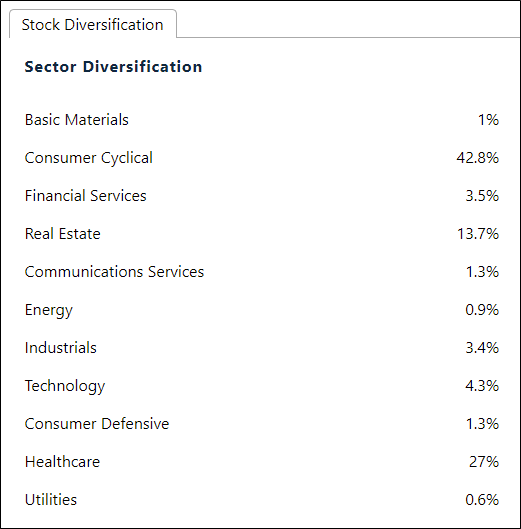
Whether you hold individual stocks or several funds or ETFs, knowing the sector breakdown of your portfolio also gives you an idea of how truly diversified it is.
For mutual fund and ETF investors, looking at the sector breakdown could be enlightening or be a rude awakening.
Depending on the funds or ETFs you own, you may not be as diversified as you think, either at the individual stock level or in terms of sector/industry allocation.
In the case of my retirement portfolio, I am heavily weighted in consumer cyclicals, health care and real estate. Seeing that I own a health care and real estate fund, the high weighting in those two sectors isn’t surprising. However, it is a bit surprising to see the portfolio’s very high weighting in consumer cyclicals, due in part to Tesla’s large portion of the overall portfolio.
Now that we have covered a high-level portfolio review, we need to look at individual holdings.
A+ Investor provides grades for stocks, mutual funds and ETFs that help you evaluate them. This is where you may find any red flags at the individual ticker level.
For funds, areas to look at include manager and strategy changes, persistent underperformance relative to equivalent lower-cost funds and heavy stock or sector concentration.
For stocks, red flags can include high valuations and poor quality.
The Grades tab of My Portfolio gives you a snapshot of the various grades from A+ Investor, broken down by stocks, mutual funds and ETFs:
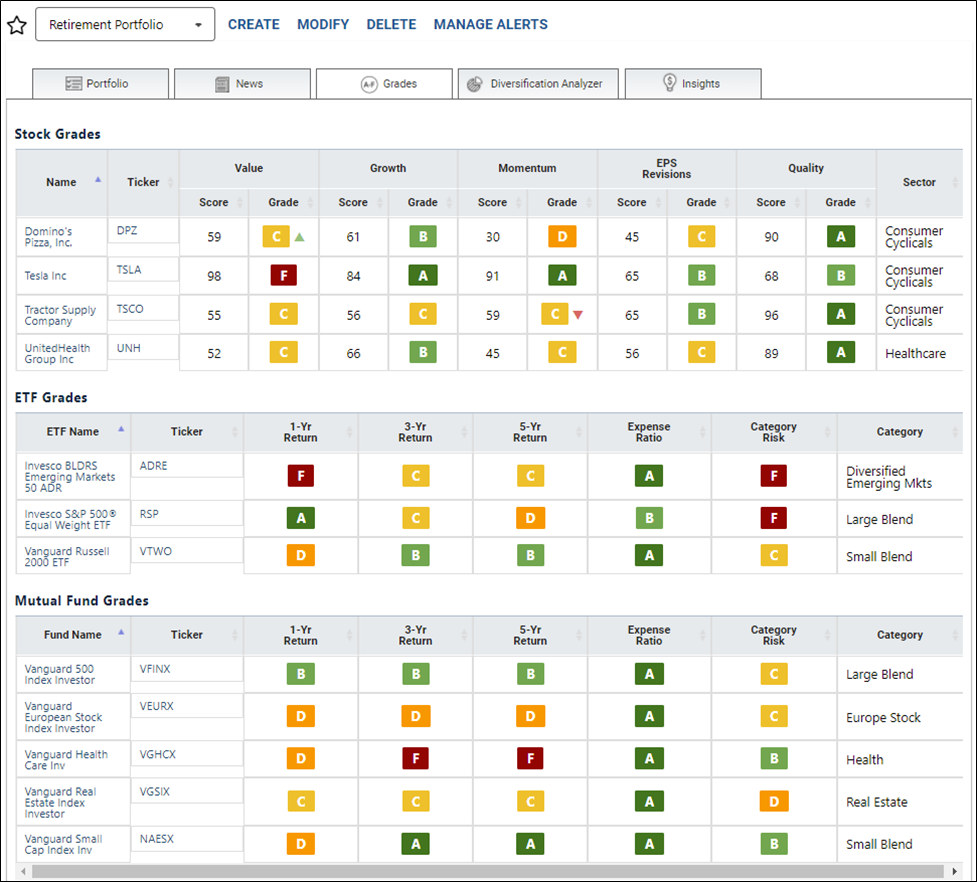
As someone who has more of a value slant to my investing, I pay attention to the Value Grades of my holdings. Tesla is an obvious exception, with a Value Grade of F. However, this reinforces its portfolio risk, given its significant position in the portfolio and F Value Grade.
I also look to invest in high-quality stocks, no matter their style classification. Here I see that three of the four stocks in my retirement portfolio have A Quality Grades, of which Tesla’s is B.
The first area I consider when looking at mutual funds and ETFs is expenses. All of the fund holdings in my retirement portfolio have A grades for expense ratio, with the sole exception of the Invesco S&P 500 Equal Weight ETF (RSP), which has a B expense ratio grade. However, it is more of an active fund because it keeps an equal weighting among all S&P 500 index stocks, which would lead to it having higher expenses.
I also want to see if I hold riskier or more volatile funds relative to those in the same category. Here, the results are not so great. Two of the ETFs in my retirement portfolio rate in the bottom 20% of their category based on risk, meaning they are much riskier than the average fund in the respective category. Another has a category risk grade of D. For these funds, I would look into why they are riskier than their category peers and decide whether I am being compensated for holding that higher risk.
Lastly, I look at the longer-term performance of the funds I hold. I am not overly concerned with the performance less than three years, as investment styles and sectors/industries fall into and out of favor over time. Underperformance over three-, five- and 10-year periods, however, does concern me.
I see that the Vanguard European Stock Index fund (VEURX) and Vanguard Health Care fund (VGHCX) have five-year performance grades of D and F, respectively. This indicates that the funds have underperformed their category averages over an extended period. Since these funds are part of my 403(b) retirement account, my options to gain exposure to health care and European stocks is limited. So I also consider the absolute performance. The Vanguard Health Care fund has averaged a 15.3% return over the past 10 years, while the European fund has averaged a 7.8% annual return over the same period.
When reviewing your asset allocation, you may only think about your long-term holdings, such as stocks.
If you are still working, having three to six months of living expenses in cash (or highly liquid assets) is a target suggested a lot. Depending on your needs or working situation, however, you may wish to have as much of a year’s worth in cash.
If you are already retired, having cash reserves to cover a more extended period is essential. AAII’s founder James Cloonan suggested having at least three years’ worth of withdrawals in cash in his book “Investing at Level 3.”
Year-end is also the time to attend to tax-related items, some of which are related to your investments. For example, if you are contributing to a retirement plan [401(k), 403(b) and 457 plans], now is the time to consider upping your contribution next year. In 2022, workers under the age of 50 will be able to contribute $20,500 to their 401(k), 403(b) or 457 plan, up from $19,500 this year; workers older than 50 can make an additional $6,500 “catch-up” contribution for a total of $27,000.
Currently, workers under age 50 can contribute up to $6,000 to an IRA. Workers aged 50 and over get a $1,000 catch-up contribution option that brings their total to $7,000. In 2022, these limits are holding steady.
For retirees, you must take minimum distributions from tax-deferred accounts before year-end. This provides an opportunity to correct some trouble spots in your portfolio, such as paring down outsized positions or moving away from stocks that no longer meet their initial investment thesis or underperforming funds.
This is also the time of year to consider tax-loss sales to offset gains elsewhere in your portfolio.

