This is the last regular Making the Grade of 2021. We will be taking a two-week hiatus to enjoy the holidays and will return on Monday, January 10, 2022. I want to wish all of you a happy, safe and healthy holiday season and all the best in the New Year.
A dividend is a distribution of profits by a corporation to its shareholders. When a corporation earns a profit or surplus, it can pay a proportion of the profit as a dividend to shareholders. Any amount not distributed is taken to be re-invested in the business.
A dividend is allocated as a fixed amount per share, with shareholders receiving a dividend in proportion to their shareholding. Dividends can provide stable income and boost morale among shareholders. For the company, paying dividends is not an expense; rather, it is the division of aftertax profits among shareholders. Retained earnings (profits that have not been distributed as dividends) are shown in the shareholder’s equity section on the company’s balance sheet—the same as its issued share capital. Public companies usually pay dividends on a fixed schedule, but may declare a dividend at any time.
Dividends are typically an indication that a business is established and financially healthy enough to return cash to shareholders. Dividends also force management to be focused on the long term and disciplined with their capital allocation decisions: After a company declares a dividend, it usually tries extremely hard to avoid cutting the payout, even during down times. A dividend cut is a signal that a company’s earnings are weakening, which will lead many investors to unload the shares.
Investing in high-yield stocks is not usually the most prudent investment strategy. Companies with high dividend yields are often facing financial difficulties and may be at risk of cutting or suspending their dividend.
Simply selecting stocks with the highest dividend yield can often lead to investing in risky stocks that are priced low relative to the dividends, due to possible financial troubles.
While not all high-yield stocks are poor investments, it is important to look for a high-yield stock with elements of financial stability and strength that will make it more likely that the company can sustain and even grow its dividend.
According to multpl.com, the yield of the S&P 500 is currently around 1.3%. The trailing yield on the Vanguard S&P 500 Index fund (VFINX) is around 1.2%.
Using the A+ Investor custom stock screener, we created a screen to narrow the universe of dividend-paying stocks to those with above-average yields and above-average quality.
The initial universe of stocks consists of dividend-paying companies, which is 2,141 stocks out of the universe of around 6,999 as of December 17.
We also excluded REITs to ensure that the dividends are coming from qualified income, which lowered the universe of prospective dividend-paying stocks down to 1,951.
We then required a dividend yield of at least 1.5%. This is slightly higher than the yield of an S&P 500 index fund. This requirement left us with 1,945 stocks.
As we mentioned before, high-yield stocks may be facing financial difficulties, which do not make them ideal investment candidates. To focus our search on high-quality companies, we next required an A+ Quality Grade of B or better. The Quality Grade is the percentile rank of the average of the percentile ranks of the return on assets (ROA), return on invested capital (ROIC), gross profit relative to assets, buyback yield, change in total liabilities to assets, accruals, Z Double Prime bankruptcy risk (Z) score and F-Score. The score is variable, meaning it can consider all eight measures or, should any of the eight measures not be valid, the remaining measures that are valid. To be assigned a Quality Score, stocks must have a valid (non-null) measure and corresponding ranking for at least four of the eight quality measures.
Our backtesting of the Quality Grade shows that stocks with higher quality outperform those with lower quality at every grade, F to A.
Out of the stock universe of roughly 7,000, less than 2,400 have quality grades of B or better. Adding this filter to our dividend-yield screen took us down to 1,242 passing companies.
We also looked for companies with positive trailing 12-month earnings per share and positive free cash flow. Requiring positive trailing earnings per share eliminates any potential turn-around situations, while companies with positive free cash flow are less inclined to reduce or cut their dividends. We do this by requiring a valid, non-null price-earnings ratio and price-to-free-cash-flow ratio. Using filters that look for values for these two valuation measures of 0 or higher achieved this. These filters reduced the number of passing companies down to 1,040.
Next, our dividend-yield screen looks for companies with net margins over the trailing 12 months to rank in the top 20% of the stock universe. Margins tend to be industry and sector specific, so it is important to point out that this will exclude companies with traditionally low margins, such as retailers and many industrial and basic materials companies. Furthermore, this filter does not exclude companies with margins that are lower than their sector or industry peers. This is functionality we expect to add to the custom stock screener in the coming quarters. Adding this filter to the dividend yield screen lowered the number of remaining companies to 466.
Lastly, we exclude foreign companies that trade on U.S. exchanges as ADRs, to avoid any possible special taxation issues.
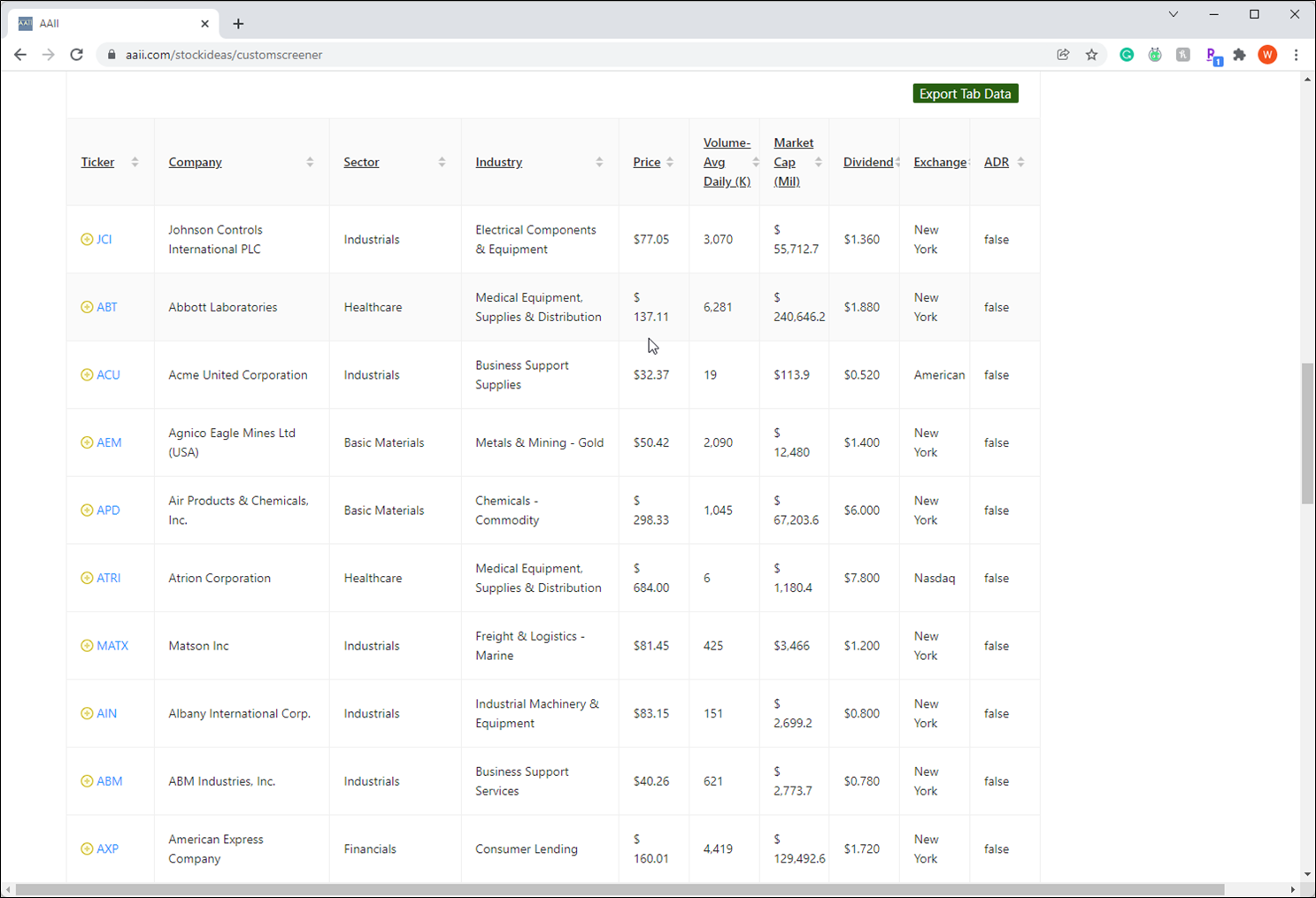
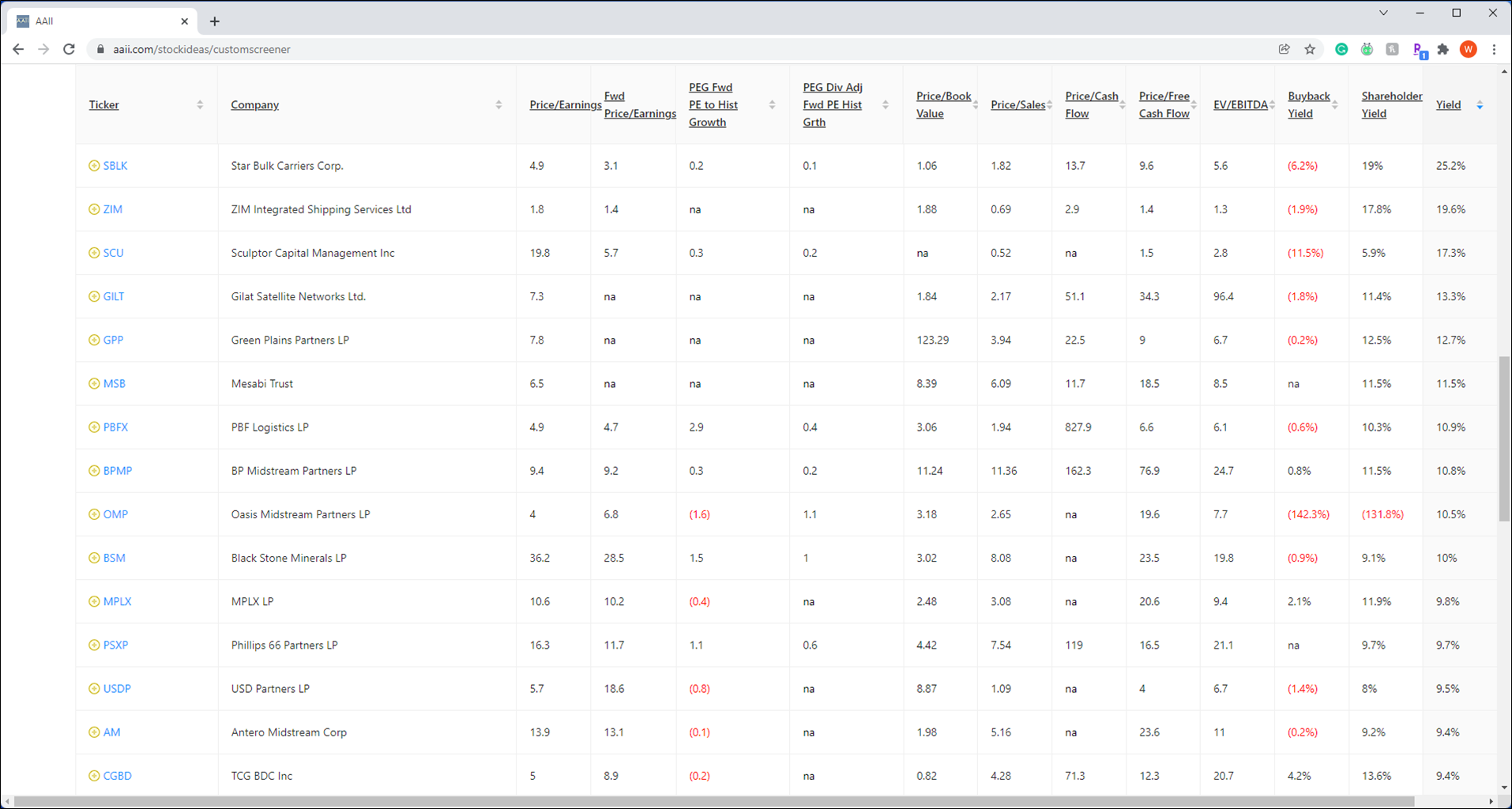
In the end, we are left with 411 companies as of December 17, 2021. We then ranked this list by dividend yield, from highest to lowest. The figure below shows a sub-set of these high-yielders.
The other side of the dividend coin are dividend-growers. These companies are generating sufficient cash flows so they may consistently raise their dividend. However, dividend-growers do not always have above-average dividend yields. Over time, though, as the dividend increases, all else equal, the yield will also rise.
Investors seeking current income may not be satisfied with the yield on a dividend growth portfolio. Out of the A+ stock universe of roughly 7,000 companies, a bit less than 550 have raised their dividends over each of the last six years and have a forward, indicated dividend that is greater than their trailing 12-month dividend. Th median dividend yield for these companies is only a bit higher than that of the market as a whole: 2.2% versus 1.3% for the S&P 500.
So why would dividend-seekers be interested in dividend-growers? Companies that are focused on growing their dividends tend to be higher-quality, cash-rich businesses that hold up well in down markets, participate in up markets, and are capable of excess returns over a full market cycle.
Companies that are growing their dividends also provide some protection from inflation: A rising dividend is fundamental to investors’ ability to preserve purchasing power through their equity portfolio.
History also shows that dividend-growth stocks tend to be less sensitive to losses during periods of rising interest rates. For example, high-yielding utility stocks become less attractive income sources when yields rise on bonds, which is a less risky asset class. But because dividend-growers tend to have lower yields, they were never the first choice for yield-seekers in the first place.
We also created a screen seeking companies that appear to be healthy enough to sustain and grow their payout.
We again began with the universe of dividend-paying companies and those stocks that do not trade as ADRs. So our initial universe of potential dividend-growers is 2,141.
This dividend-grower screen also looks for high-quality companies, so we again required an A+ Quality Grade of B or better. This filter reduced the passing companies down to 1,264.
We then looked for companies whose annualized average dividend growth over the last three, five and seven years is positive. These three filters lowered the remaining total to 596.
Lastly, we require that dividends have not fallen over the trailing 12 months and are not any lower than those paid out during the last fiscal year. This left 521 companies.
As a safeguard against dividend cuts and financial distress, stocks with an indicated dividend yield in the top 10% of the stock universe were excluded. We were then left with 423 passing companies.
Finally, we want companies with reasonable payout ratios, which represents the percentage of earnings paid out as a dividend. We excluded companies with payout ratios higher than 75% to avoid those with potentially unsustainable dividends. This left 384 companies passing this dividend-grower screen.
We ranked the resulting 384 companies passing this screen by their average annualized dividend growth rate over the past three years. A portion of that list is shown below.