Since Facebook announced it was changing its name to Meta Platforms Inc.  (FB) in late October 2021, the term “metaverse” has garnered much attention.
But what exactly is the metaverse? And how can investors invest in this trend?
Depending on who you listen to, metaverse has multiple meanings. It is used to refer to the future of the internet, and it is used when discussing video games.
An article in Wired offered this exercise. First, mentally replace the phrase “the metaverse” in a sentence with “cyberspace.” According to the article, the meaning won’t substantially change the vast majority of the time. That’s because, according to Wired, the term doesn’t refer to any one specific type of technology but rather a broad shift in how we interact with technology.
According to the article, the technologies that make up the metaverse can include virtual reality (VR)—characterized by persistent virtual worlds that continue to exist even when you’re not playing—as well as augmented reality (AR) that combines aspects of the digital and physical worlds. However, it doesn’t require that those spaces be exclusively accessed via VR or AR. For example, a virtual world, like aspects of the online game Fortnite that can be accessed through PCs, game consoles and even phones, could be metaversal.
The metaverse, according to Wired, also translates to a digital economy, where users can create, buy and sell goods.
In a Forbes article last year, Frank Holmes, CEO and chief investment officer of U.S. Global Investors, explained the progression of the internet over the years. According to Holmes, if Web 1.0 describes the earliest days of the internet with static, one-way sites, and if Web 2.0 describes the period of the internet that emphasizes interactivity and user-generated content, then an immersive 3D internet-like experience can only be called Web 3.0.
While Holmes and others caution that a true metaverse may still be a few years away, Meta Platforms (formerly Facebook) and other companies are laying the groundwork for a future that permits families, friends, coworkers and more to meet and interact in shared digital spaces that look and feel authentic.
Holmes adds that Web 3.0 doesn’t just mean VR headsets and video conferencing. People will need real-world services, from entertainment to finance, even in cyberspace. In the coming years, Holmes believes that companies as varied as Amazon, Netflix, DoorDash and Robinhood will develop contributions to a shared metaverse. Digital currencies will also be essential, benefiting cryptocurrency miners and brokers.
For investors looking to participate in the metaverse, Holmes believes that cryptocurrencies still offer attractive early-stage investments in the metaverse. As of the end of June 2021, as many as 221 million people worldwide were participating in the cryptocurrency ecosystem, including trading, investing and making transactions in bitcoin, ethereum and other digital coins.
Holmes adds, however, that it’s not just individual investors who are driving the adoption of cryptocurrency. Many companies have reported holding bitcoin on their balance sheets, among the largest being Michael Saylor’s MicroStrategy (holding more than 105,000 bitcoin at a dollar value of $4.1 billion in August of last year), Tesla (43,200 bitcoin/$1.5 billion) and Square (8,027 bitcoin/$220 million).
The volatility in cryptocurrency is a turnoff for many investors. Bitcoin is down more than 20% over the last month, while ethereum, is down more than 30%, according to Crypto.com. As we mentioned, though, there is much more to investing in the metaverse than cryptocurrency. According to Grayscale Investments, the digital ecosystem that is the metaverse could be as much as a trillion-dollar revenue opportunity. For those looking beyond cryptocurrency, Grayscale’s head of thematic research, Simon Powell, says investors should focus first on hardware providers, then software providers, then on companies operating within the metaverse. Initially, that could mean considering “traditional” tech companies such as Nvidia, Intel, Cisco and Apple, which stand to benefit from rising demand for semiconductor chips, processors, cloud services, etc.
According to market research firm International Data Corp., the total demand for augmented and virtual reality products, including VR headsets, is forecast to hit $36 million by 2025. Meta’s Oculus Quest 2 headset tops the list. Bill Gates says he believes that in the coming “two or three years,” most virtual meetings will move from two-dimensional, Zoom-style interfaces to the metaverse. Gates added that Microsoft is working on its own “interim” VR tools in conjunction with its planned virtual workspace, Mesh for Microsoft Teams.
A recent report from Reports and Data outlined that the metaverse industry is set to grow at a compound annual growth rate (CAGR) of 44.1% between 2021 and 2028 to an estimated $872 billion at the end of the forecast period. Another report from Brandessence Market Research outlined a similar CAGR of 44.8% to projected value of $596 billion by the end of 2027.
Do a Google search for “metaverse stocks,” and you will be bombarded with hundreds of lists, with names you know and those you don’t. Sifting through these lists, we narrowed them down to nine and present them below, along with the A+ Stock Grades. This list is not intended to be any type of recommended list. Instead, this is merely a sampling of companies that are part of the metaverse ecosystem.
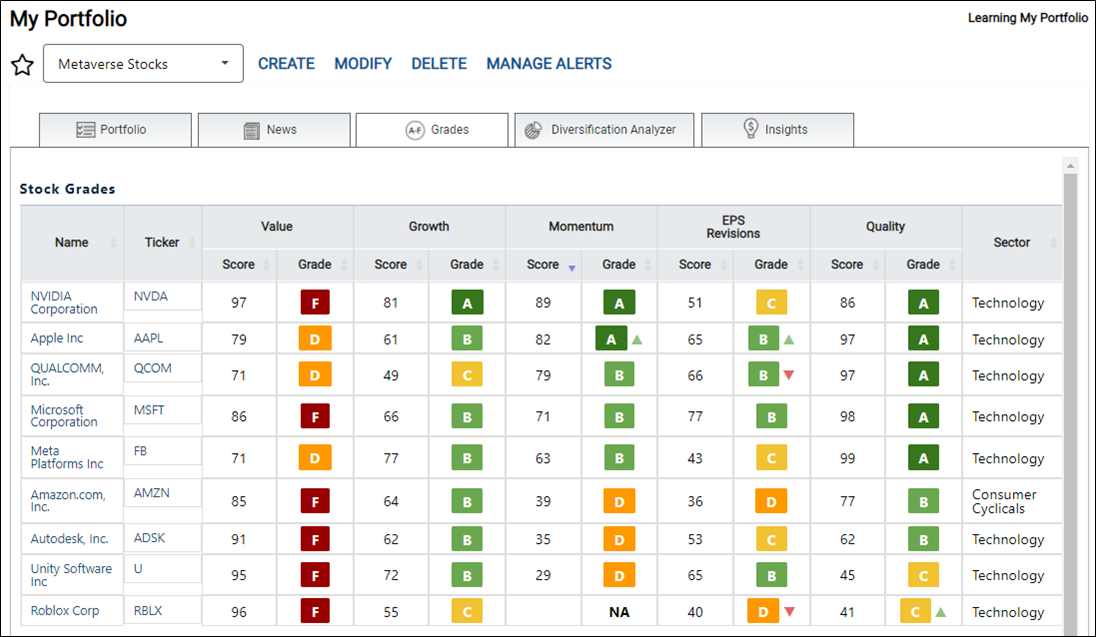
This list is ranked in descending order by the raw A+ Investor momentum score.
These stocks are hot or cold when it comes to their weighted price momentum over the last year. So it is perhaps surprising that five have momentum grades of B or better, given the sharp sell-off in tech stocks to start the year.
Nvidia Corp. (NVDA) ranks the highest with a Momentum Score of 89. This artificial intelligence (AI) computing company operates through two segments: graphics and compute & networking. Its graphics segment includes GeForce graphics processing unit (GPU), the GeForce NOW game-streaming service and related infrastructure and solutions for gaming platforms; Quadro/NVIDIA RTX GPUs for enterprise workstation graphics; virtual graphics processing unit (vGPU) software for cloud-based visual and virtual computing; and automotive platforms for infotainment systems. Its compute & networking segment includes data center platforms and systems for AI, high-performance computing (HPC) and accelerated computing; Mellanox networking and interconnect solutions; automotive AI Cockpit, autonomous driving development agreements and autonomous vehicle solutions; and Jetson for robotics and other embedded platforms. Its platforms address markets such as gaming, professional visualization, data center and automotive.
However, Nvidia shares have seen weakness over the last several weeks. Over the four weeks ending January 28, shares fell more than 22%, ranking in the bottom 22% of the stock universe and underperforming the S&P 500 index by more than 16 percentage points. Nvidia shares have fallen 7.2% for the latest calendar trading quarter, ranking in the 52nd percentile among all U.S.-listed stocks. It saw price gains of 23.7% and 24.8%, respectively, over the prior two quarters, buoying its overall score.
Roblox Corp. (RBLX) only began trading in March of last year, which is why it doesn’t have a weighted four-quarter relative strength score. Roblox is a technology company building a human co-experience platform that enables shared experiences among billions of users. The company offers a platform powered by user-generated content that draws inspiration from gaming, entertainment, social media and even toys. Roblox is focused on improving how the Roblox platform supports shared experiences, ranging from how these experiences are built by an engaged community of developers to how they are enjoyed and safely accessed by users across the globe. In addition, all Roblox platform users have identities in the form of avatars that allow them to interact and express themselves as whoever or whatever they want to be.
None of these nine stocks are what you would call cheap from an investment standpoint. They all have A+ Value Grades of D or F, meaning they rank in the bottom 40% of the stock universe in terms of their composite valuation scores.
Apple Inc. (AAPL) has a high Value Score at 79, meaning it still ranks in the top 79% of all stocks in terms of its value composite. Its price-earnings (P/E) ratio of 30.4 ranks in the 72nd percentile among all stocks, although it is in line with the median price-earnings ratio for companies in the phones and handheld devices industry. Apple’s price-to-book ratio of 38.81 ranks in the top 2% of the stock database and is well above the industry median of 1.7.
Apple is a rarity among tech companies in that it pays a dividend. However, its current yield is 0.5% based on its projected dividend payment of $0.88 per share over the next 12 months.
All of these nine stocks have average-or-better quality grades. AAII’s backtesting of these quality grades shows that companies with higher quality grades tend to perform better than those with lower quality grades.
Meta Platforms, Microsoft Corp. (MSFT), Apple, QUALCOMM Inc. (QCOM) and Nvidia all have Quality Grades of A.
Like any other sector, there will be winners and losers in the metaverse space in the coming quarters and years. Some of the stocks mentioned here have limited metaverse exposure and lofty valuations. Companies such as Microsoft and Apple are well-established and carry relatively lower risks. Others, like Roblox, are relatively young and carry a higher risk. An investor should consider risk tolerance and long-term portfolio goals when investing in the metaverse.

