The AAII office and U.S. stock markets will be closed on Monday, July 4, in observance of Independence Day. The weekly Making the Grade email will return on Monday, July 11. From everyone at AAII, have a happy and safe holiday.
If you have been shopping for index funds, have you ever run across those that track the same index but have different (in some cases, very different) returns?
An index fund is a collection of stocks, bonds or other securities that tracks a market index—a group of securities that’s used to represent a segment of the market. A stock index fund, for example, owns shares of the constituent stocks that make up the index that it tracks, and fund investors own a proportional stake in all of those stocks.
There are thousands of index funds, and they vary greatly according to the indexes they track. Index funds are available for a wide range of investments beyond stocks, including bonds, commodities and real estate investments. Some stock index funds own just a small number of stocks, while others own thousands of different stocks. Regardless of the index they track, the primary objective of an index fund is to match the performance of the underlying index.
Passive funds accounted for 16% of U.S. stock market capitalization at the end of 2021, surpassing the 14% held by active funds, according to the Investment Company Institute, an industry body.
The pattern represents a reversal of the picture 10 years ago, when active funds held 20% of Wall Street stocks and passive ones just 8%.
Since then, the U.S. has seen a cumulative net flow of more than $2 trillion from actively managed domestic equity funds to passive ones, primarily exchange-traded funds (ETFs).
Actively managed domestic equity mutual funds have seen net outflows every year since 2005, even as their passive peers have had inflows every year barring 2020 and 2021. Index-tracking ETFs have proved more popular still.
U.S.-listed ETFs, the overwhelming majority of them passive, have seen their assets rise fivefold to $7.2 billion since 2012.
It’s worth pointing out, however, that not all index funds and ETFs are created equal. In fact, there are a number of factors that can lead some funds or ETFs to track their indexes more closely than others.
Although index funds and index ETFs seek to mimic the composition and performance of an index, they are usually not exact copies of the index itself. Keep in mind that an index is merely a group of the securities’ prices run through a mathematical formula to arrive at a measure of the group’s performance.
But running an index fund or ETF still costs money. The fund company must pay a manager to buy and sell the securities in that index, as well as the administrative expenses of record-keeping, customer service, etc. These costs are passed along by index funds and ETFs to their customers in the form of fees, some of which are explicitly stated in the fund’s expense ratio while others are less transparent, such as brokerage costs. Funds’ construction methods along with practices such as securities lending can also have an impact on index fund investors’ take-home returns.
There are currently 35 “investor class” open-ended mutual funds (funds available for purchase by individual investors) in the A+ Investor mutual fund universe that track the S&P 500 market-cap-weighted total return index, including those that are closed to new investors.
With the Funds+ Screener, available exclusively to A+ Investor subscribers, you can isolate U.S. equity index funds by first selecting Equity under Global Asset Class and U.S. Equity under Fund Group. From there, you can toggle the Index Fund option to Yes at the bottom of the Fund Type section of the screening criteria. For this screen, we also exclude institutional funds under Purchase and any special share class types, also under Purchase.
The expense ratios for these 35 “S&P 500” funds range from 0.04% for the Vanguard 500 Index Admiral fund  (VFIAX) to 2.39% for the Rydex S&P 500 Class C fund (RYSYX).
Compared to other mutual fund share classes, class C shares often have lower expense ratios than class B shares. However, they have higher expense ratios than class A shares. As a result, class C shares may be a good option for investors with a relatively short-term horizon who plan to keep the mutual fund for just a few years.
The ongoing charges that constitute the C-share level load are officially known as 12b-1 fees. Total 12b-1 fees are capped at 1% annually. Other mutual fund share classes come with 12b-1 fees too but to different degrees. Those fees charged to class A shares usually are lower, compensating for the high upfront commissions this category pays. C shares tend to charge the maximum 1% and, since 12b-1 fees figure into the mutual fund’s overall expense ratio, their presence can push that annual expense ratio above 2% for the class C shareholder.
Expense ratios can and do play a role in the performance of a mutual fund. Over the last year, the Rydex S&P 500 C fund had the lowest return among these 35 funds (–2.6%), while the Vanguard 500 Index Admiral fund posted the highest performance (–0.3%) through the end of May 2022.
Over longer periods, the performance difference grows even more significant. Over the last five years, the Rydex S&P 500 C fund has an average annual gain of 10.6%, the lowest among these 35 funds, while the Northern Stock Index fund (NOSIX) has an average annual gain of 13.3% over the same period. This is tied for first with the Vanguard 500 Index Admiral fund.
You can learn more about a fund’s cost structure by viewing the Purchase Information section of its Fund Evaluator page. Here we see this data for the Rydex S&P 500 C fund:
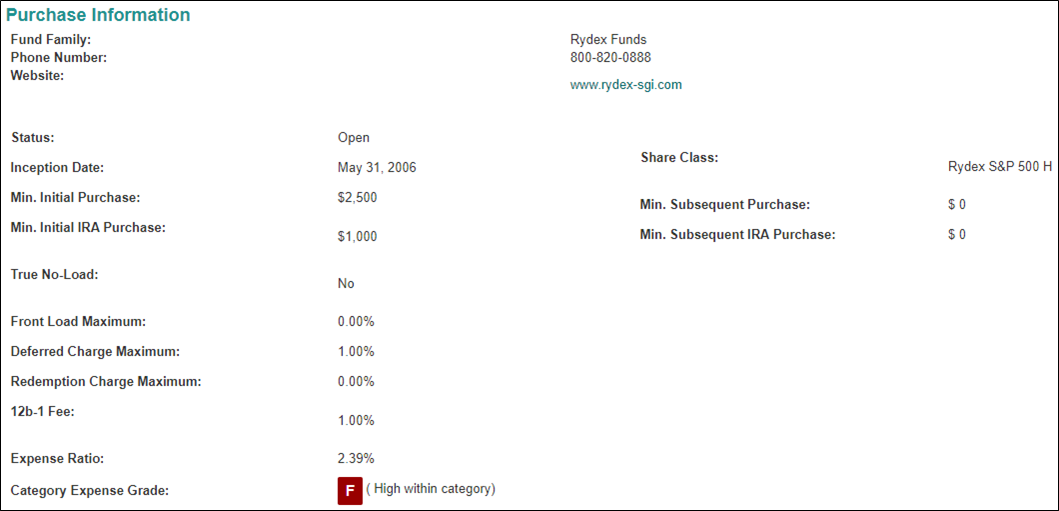
In this image, we can also see that the Rydex S&P 500 fund has a category expense grade of F, meaning it ranks in the highest 20% among all other funds in the large blend mutual fund category, as assigned by Morningstar.
Hopefully, this example reinforces the need to pay attention to how much you are paying for the privilege of owning a mutual fund. Seemingly small percentage differences in costs can add up over the long term.
This weekly Making the Grade email is a benefit of A+ Investor. However, we want to make sure we are providing users with the information they need to get the most out of their subscription. Please let me know what changes, if any, we can make to this email to maximize its value to you. You can email me at wayne@aaii.com. Thank you!

