A request we’ve heard from A+ Investor and AAII Platinum subscribers is for the A+ Value Score to match our other scores regarding the scaling. Higher scores are assigned to stocks with more attractive growth, momentum, earnings estimates revision and quality traits. However, lower scores were assigned to stocks with lower valuations, which are more attractive to value investors.
Today we “flipped” the scaling of the A+ Value Score. This will result in stocks with more attractive valuations being assigned higher Value Scores and stocks with less attractive valuations being assigned lower Value Scores.
The change will not impact the Value Grades. A grade of A will continue to be assigned to deep-value stocks. A grade of F will continue to be assigned to ultra-expensive stocks.
Flipping the Value Score will create uniformity across all of the A+ stock grades—Value, Momentum, Quality, Growth and Estimate Revisions. Now, A’s and B’s will indicate higher scores (more attractive stocks) across all the A+ stock grades.
To help you understand the change, let’s compare and contrast Analog Devices Inc.  (ADI) and Micron Technology Inc. (MU), using the “old” scaling methodology for the A+ Value Score and the new method.
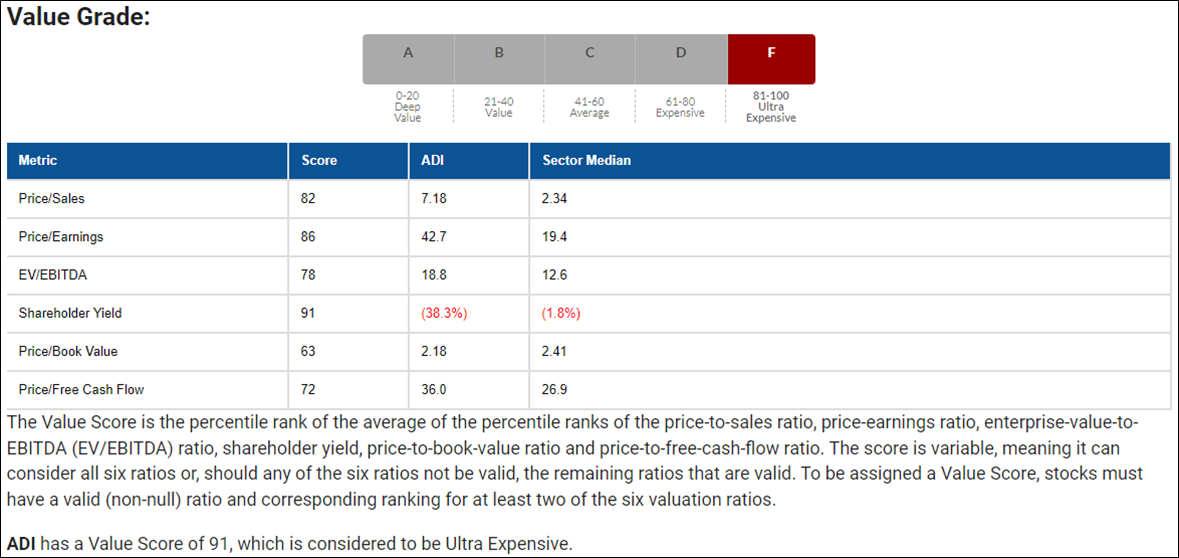
Previously, Analog Devices (ADI) had a Value Score of 91, which translated into an A+ Value Grade of F (Ultra Expensive). ADI’s Value Score was high because the underlying valuations are rich—a price-earnings ratio of 42.7 (86th percentile) and a price-to-sales ratio of 7.18 (82nd percentile).
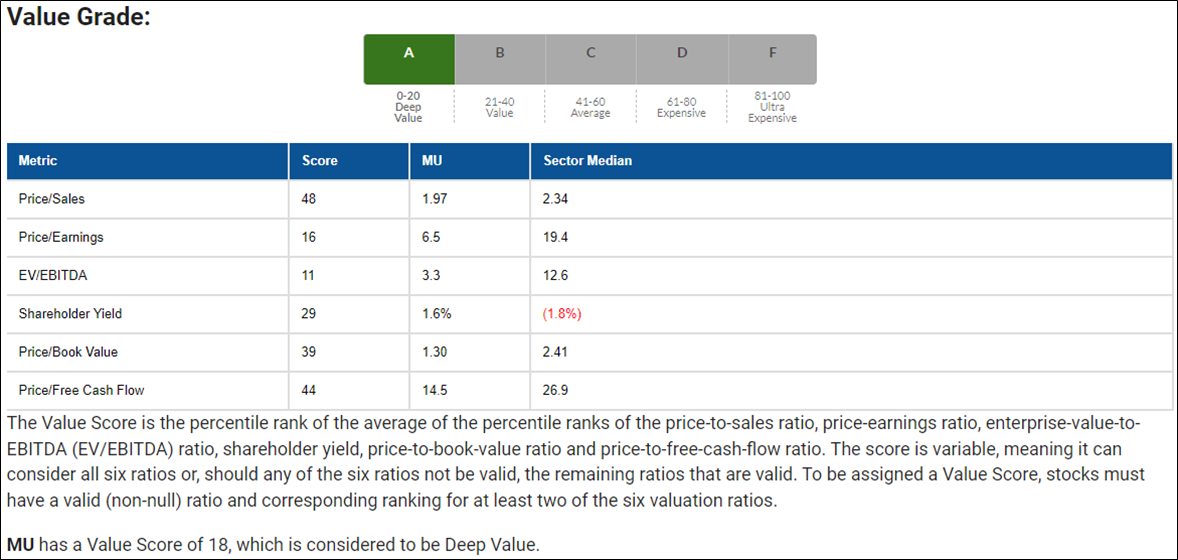
Micron’s old Value Score was 18 (Deep Value) due to its attractive valuations—price-earnings ratio of 6.5 (16th percentile) and price-to-book-value ratio of 1.30 (39th percentile).
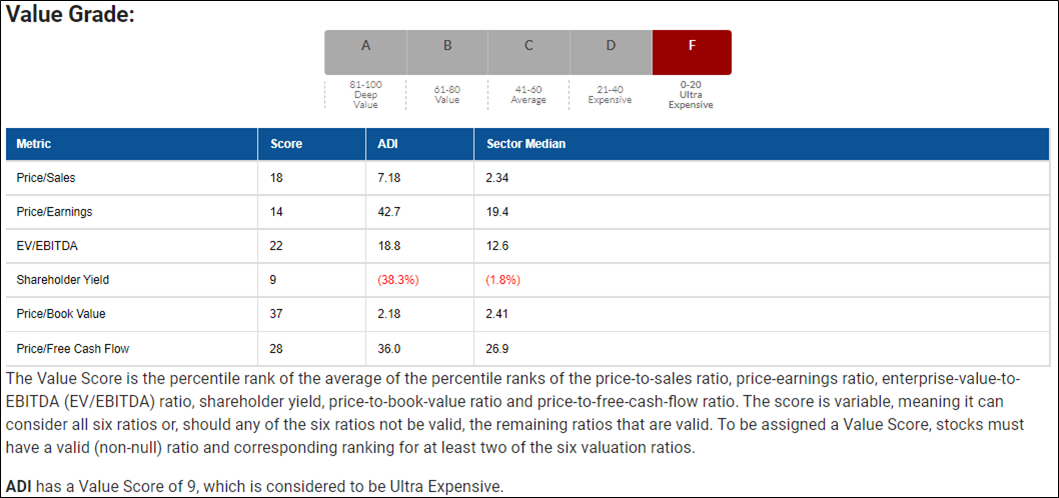
Now that we’ve flipped the scaling of the Value Score, Analog Devices has a Value Score of 9 (meaning the stock ranks among the most expensive 91% in terms of valuation).
Meanwhile, Micron Technology now has a Value Score of 82, which ranks in the cheapest 18% of stocks in terms of valuation).
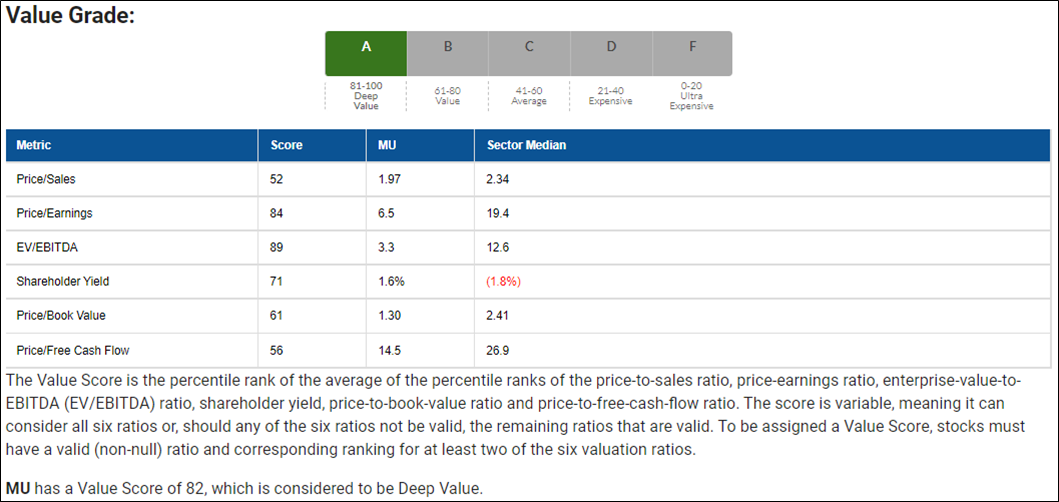
The math is simply 100 minus the current Value Score: for Analog Devices, 100 – 9 = 91, and for Micron, 100 – 18 = 82.
In the end, the interpretation of the Value Grade doesn’t change. Higher grades indicate more attractive stocks (lower or cheaper valuation).

