The number of investments required to be adequately diversified depends on a few factors. For most individual investors, the number is not very high. It does depend on what is held in the portfolio and the dollar size of the portfolio overall. This week, I provide a few guidelines.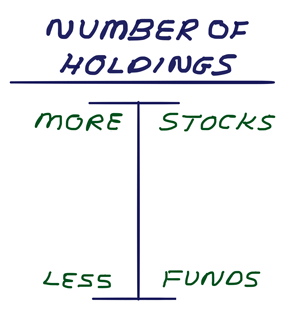
Let’s start with stocks. We suggest holding a minimum of 10 stocks to those following our Model Shadow Stock Portfolio or VMQ Stocks, 12 for those following AAII Dividend Investing (DI) and 16 for those following our Stock Superstars Report (SSR). The total number of stocks held in our portfolios are 20 for VMQ, 24 for DI, 31 for Shadow Stock and 36 for SSR.
Three of the four portfolios (VMQ Stocks, DI and SSR) have a fixed number of positions. The number of holdings in the Model Shadow Stock Portfolio can rise if a strong-performing stock is sold. This is because the proceeds from the sale will be split to fund two or potentially three purchases. With all of our model portfolios, a dollar amount equal to the average size of all existing holdings is allocated to new purchases. Using VMQ Stocks as an example, the portfolio was built by dividing the starting account balance of $100,000 evenly among 20 stocks. The target amount used to purchase replacements for stocks sold in the future will be the total portfolio value divided by 20, or 5% of the total portfolio. The AAII InvestoGraphic linked to below explains this concept further.
The reason why we do this is to prevent a disproportionately large position from becoming an even larger position. Having a single stock driving a portfolio’s returns is a double-edged sword. This same concept applies to the number of holdings. If you only hold, say, five stocks, then each stock has the potential to influence your portfolio’s value by 20%, including depleting it by 20% under a worst-case scenario. If you increase the allocation to 10 equally weighted positions, the biggest adverse impact any single stock can have is 10%.
I realize there is a school of thought about allocating based on your level of conviction. While I personally don’t see a benefit to going much over 30 stocks unless you are allocating a very large amount of money to stocks with lower levels of trading volume, I’m not keen on going in the other direction and holding just a handful of what you consider to be your best ideas. Doing so concentrates risk and exposes you to significant downside if you’re wrong. Plus, years of managing portfolios has taught me that the best- and worst-performing stocks in a diversified portfolio are often not the ones you would expect at the time you add stocks to the portfolio. Spreading your bets in a disciplined manner has benefits.
Bond positions can be more concentrated if you are focusing on high-credit-quality debentures. A bond ladder, for instance, can use Treasuries for maturity dates of two years, five years and 10 years. For corporate and municipal bond holdings, a mix of different issuers becomes more preferential to avoid any unexpected company/municipality-specific issues. When buying individual bonds, pricing and availability are also considerations.
Fund holdings (mutual or exchange-traded) can be the most concentrated. A single asset allocation fund (e.g., a target-date fund) can provide all of the needed allocation. A two-fund solution can also work, such as 60% allocated to an S&P 500 index fund and 40% allocated to a bond fund. Our Level3 Passive Portfolio holds just four ETFs. For those who want to include commodities, Craig Israelsen has a seven-asset portfolio. There are other examples, but the big point is that a small number of well-chosen funds can do the job.

- How Many Stocks Do You Need to Be Diversified? – This 2004 AAII Journal article gives a different take, but shows how diversification is affected by the number of stocks held.
- Asset Returns During High and Low Inflationary Periods – Craig Israelsen shows how different assets perform in high and low inflation environments and discusses his seven-asset portfolio.
- Adjusting Overweight Positions – This AAII InvestoGraphic explains how to pare down a position in a stock whose gains have caused it to have an outsized weighting relative to the other portfolio positions.
- Guidance on How to Follow the Level3 Passive Portfolio – Changes to this four-fund portfolio should be infrequent, with investors able to rebalance through additions or withdrawals.
Just two S&P 500 companies are scheduled to report: H&R Block Inc. (HRB) on Tuesday and Adobe Systems Inc. (ADBE) on Thursday.
The Federal Open Market Committee (FOMC) will hold a two-day meeting starting on Tuesday. The CME’s FedWatch Tool is placing a 91% chance of a quarter-point rate hike being announced. The meeting announcement and updated committee member forecasts will be released Wednesday at 2:00 p.m. Eastern Time. Federal Reserve Chairman Jerome “Jay” Powell will hold a press conference at 2:30 p.m.
The week’s first economic report will be the May Consumer Price Index (CPI), released on Tuesday. Wednesday will feature the May Producer Price Index (PPI). May import and export prices, April business inventories and May retail sales will be released on Thursday. Friday will feature the June Empire State Manufacturing Survey, May industrial production and capacity utilization and the University of Michigan’s preliminary June consumer sentiment survey.
The Treasury Department will auction $32 billion of three-year notes and $22 billion of 10-year notes on Monday, and $14 billion of 30-year bonds on Tuesday.
- Hagstrom’s Essential Buffett Stocks
- Guidance on How to Follow the Level3 Passive Portfolio
- Quantifying the Value of Retirement Accounts
The percentage of individual investors expressing optimism about the short-term outlook for stocks is at a 15-week high. The latest AAII Sentiment Survey also shows a decline in neutral sentiment and a modest increase in pessimism.
Bullish sentiment, expectations that stock prices will rise over the next six months, rose 3.9 percentage points to 38.9%. Optimism was last higher on February 21, 2018. The historical average is 38.5%.
Neutral sentiment, expectations that stock prices will stay essentially unchanged over the next six months, fell 4.3 percentage points to 34.4%. Even with the decline, neutral sentiment remains above its historical average of 31.0% for the 16th consecutive week.
Bearish sentiment, expectations that stock prices will fall over the next six months, edged up 0.4 percentage points to 26.7%. Bearish sentiment remains below its historical average of 30.5% for the eighth consecutive week and the 22nd time out of the past 26 weeks.
This is just the second time in the past 15 weeks that optimism is above average. The recent improvement mostly reflects a shift from investors describing their outlook as “neutral” to “bullish.” Pessimism, meanwhile, has stayed pretty stable. Bearish sentiment readings have been within a 1.5 percentage point range during four out of the last five weeks.
Many individual investors, but not all, anticipate continued volatility and/or think that the current political backdrop could have a further impact on the stock market. Trade policy is influencing some, but not all, individual investors’ sentiment. While many either approve of the Federal Reserve’s plan to gradually raise interest rates or don’t expect it to affect the stock market, some AAII members are concerned about the impact that rising rates will have. Also influencing sentiment are valuations, tax cuts, earnings and economic growth.
This week’s special question asked AAII members how the changes (actual and anticipated) to trade policies are impacting their expectations of how U.S. stocks will perform. Slightly more than two of out five respondents (41%) say the changes will hurt stocks and/or the economy. Conversely, nearly 24% of respondents don’t expect trade policy to have a lasting impact and 13% think it will eventually help stock prices. About 6% of respondents are waiting to see what happens, while another 6% say the effects will depend on whether a company operates in foreign or domestic markets.
Here is a sampling of the response:
- “I expect trade policies to be a negative for the market until they are reversed.”
- “I expect a trade war with our trading partners to negatively impact the U.S. economy.”
- “It will help the stock market. The U.S. economy will be stronger in the long run.”
- “The anticipated changes in trade policy will have a minimal effect on stock prices. If it turns into a trade war, the effect could be a major negative one.”
- “Overall, I think it will be a net benefit to small companies and possibly hurt mega-cap international companies.”

Bullish: 38.9%, up 3.9 points
Neutral: 34.4%, down 4.3 points
Bearish: 26.7%, up 0.4 points
Bullish: 38.5%
Neutral: 31.0%
Bearish: 30.5%
AAII Asset Allocation Survey
Individual investors’ allocations to bonds fell to their lowest level in nearly a decade last month. The May AAII Asset Allocation Survey also showed a rebound in equity allocations and a decrease in cash allocations.
Stock and stock fund allocations rose 2.5 percentage points to 70.0%. The rebound followed four consecutive monthly declines. Equity allocations are above their historical average of 61.0% for the 62nd consecutive month.
Bond and bond fund allocations fell by 1.8 percentage points to 14.1%. Fixed-income allocations were last lower in September 2008 (13.7%). May was the sixth consecutive month with bond and bond fund allocations below their historical average of 16.0%.
Cash allocations pulled back by 0.7% to 15.9%. Cash allocations are below their historical average of 23.0% for the 78th consecutive month.
Fixed-income allocations have not exceeded 16.0% since last November. They have been as low as 15.0% during both this past December and February. It is unclear what impact the yield on the benchmark 10-year Treasury note rising above 3.0% for the first time in several years had on individual investor allocation decisions.
The rebound in equity allocations occurred as the stock market rebounded. Optimism about the six-month outlook for stock prices in our weekly Sentiment Survey mostly remained below average throughout May, however.
Month-to-month changes in which AAII members take the survey can impact the Asset Allocation Survey’s results.
May’s special question asked AAII members how the change in interest rates has influenced how much they allocate to cash. Slightly more than three out of five respondents (63%) say higher interest rates are having little to no influence. Some of these respondents describe rates as not being large enough to warrant a change. An additional 6% of respondents say the increase in rates has not altered their allocations because their cash positions depend on allocation decisions.
Nearly 15% of respondents say they increased their cash allocations. Some of these respondents say they reduced either their stock or bond allocations, while others are waiting to use a future decline in stock prices as a buying opportunity. A small percentage of respondents (just under 5%) say they have either switched to higher-yielding savings accounts or are taking advantage of the higher rates to ladder CDs, meaning buying CDs with different maturities.
Here is a sampling of the responses:
- “No. Rates would have to go up a lot more. I am keeping cash for pullbacks.”
- “No. The rate of return on stock funds is greater than the rate of return on cash instruments.”
- “Rates may influence where I park my cash, but not the allocation.”
- “The moderate CD rate increases have had a positive impact on my five-year CD ladder.”
- “Reduced allocation to equities due to increased uncertainty. The increased interest rates are a welcomed side event.”
- Stocks and stock funds: 70.0%, up 2.5 percentage points
- Bonds and bond funds: 14.1%, down 1.8 percentage points
- Cash: 15.9%, down 0.7 percentage points
- Stocks: 31.2%, unchanged
- Stock funds: 38.8%, up 2.4 percentage points
- Bonds: 2.6%, down 0.5 percentage points
- Bond funds: 11.6%, down 1.2 percentage points
Take the Asset Allocation Survey.
Local Chapter Meetings

May 31, 2018 Paying a Premium to Take on More Risk
May 24, 2018 Global Stock and Bond Diversification With Just 2 ETFs
May 17, 2018 The Yield Curve Is Getting Flatter
May 10, 2018 Midterm Elections and the Worst Six Months