This fall, individual investors could be able to use just two exchange-traded funds (ETFs) to diversify both globally and by asset class. The annual expense of such a portfolio will be about one-tenth of a penny per dollar invested, exclusive of any transaction costs.
Vanguard filed a preliminary registration statement with the U.S. Securities and Exchange Commission (SEC) on Monday to launch a global bond fund. The Vanguard Total World Bond ETF will provide exposure to both domestic and foreign investment-grade bonds. The fund giant already has a similar ETF on the equity side, Vanguard Total World Stock (VT) .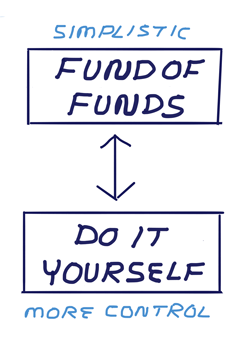
This could be a sign of the direction that the biggest ETF providers may be headed in. The plain-vanilla space is already dominated by the likes of SPDR S&P 500 (SPY), Vanguard Total Stock Market (VTI), iShares MSCI EAFE (EFA), PowerShares QQQ (QQQ), etc. Expense ratios have been cut on the largest ETFs and could eventually fall even closer to 0%. The smart beta category is getting crowded on the domestic side, with newer entrants such as Goldman Sachs and AQR Capital Management having already thrown their hats into the ring. Thematic ETFs continue to be rolled out, but have mostly remained in the shallow end of the pool with low levels of both assets and trading activity. Bluntly put, the ETF industry is maturing and, with the possible exception of actively managed funds, the amount of room for new ideas is getting to be rather small.
If approved, Vanguard will be giving investors the option of having a very simplistic approach to diversification. With two ETFs—VT and the proposed global bond fund—investors will be able to create a globally diversified portfolio comprising both stocks and bonds. The only decisions left will be how much to allocate to each fund and how frequently to rebalance the portfolio.
The Vanguard combination won’t be the only option for those who want a simplistic approach to global diversification. The Cambria Global Asset Allocation ETF (GAA) already provides exposure to global stocks, bonds, real estate, commodities and currencies. Like the proposed Vanguard bond ETF, which will invest directly in the Vanguard Total Bond Market ETF (BND) and Vanguard Total International Bond ETF (BNDX), Cambria’s ETF is a fund of funds. It invests in approximately 29 other ETFs (from both Cambria and other ETF providers). The expense ratio is 0.30%. IShares Core Moderate Allocation ETF (AOM) invests in seven other iShares funds and trades with an expense ratio of 0.25%.
You could also create your own globally diversified portfolio by handpicking the funds yourself. A slightly different approach would be to buy individual securities and then fill the desired allocation gaps (e.g., foreign bonds) with specific ETFs, mutual funds or closed-end funds. The decision depends on how much you desire simplicity or control and how much international exposure you want. I have yet to see any consensus on what level of international exposure is appropriate for individual investors.
The Vanguard and iShares funds are market-cap weighted, whereas the Cambria fund uses several alternatively weighted funds. In all cases—and with other asset allocation ETFs and mutual funds (e.g., target date funds)—investors need to be aware of what the underlying funds are investing in to avoid overlap. For example, an investor using the two-fund Vanguard lineup should look toward small-cap stocks, real estate investment trusts (REITs), high-yield (“junk”) bonds and commodities if they have a desire to supplement with additional funds or individual securities.

- How to Achieve the Right Asset Allocation – Sheldon Jacobs explained why there is “no single right allocation” and gave suggestions for constructing a two-fund portfolio.
- International Diversification: Why It Still Makes Sense – In this 2010 AAII Journal article, Bernard Horn of Polaris Capital Management made the argument for including foreign assets in a portfolio.
- Picking a Rate of Return to Use for Long-Term Planning – Historical data shows why long-term investors should look to long-term averages when setting return expectations.
- The Basics of Real Estate Investment Trusts (REITs) – Associate editor Jaclyn McClellan provides a full explanation of what REITs are, including their various types.
The U.S. financial markets will be closed on Monday, May 28, in observance of Memorial Day.
The earnings calendar lists nine S&P 500 companies: Salesforce.com Inc. (CRM) and HP Inc. (HPQ) on Tuesday; Analog Devices Inc. (ADI), Michael Kors Holdings Ltd. (KORS) and PVH Corp. (PVH) on Wednesday; and Costco Wholesale Corp. (COST), Dollar General Corp. (DG), Dollar Tree Inc. (DLTR) and Ulta Beauty Inc. (ULTA) on Thursday.
The week’s first economic reports will be the March S&P Case-Shiller home price index and the Conference Board’s May consumer confidence survey, released on Tuesday. The May ADP employment report, the first revision to first-quarter GDP, April international trade and the Federal Reserve’s periodic Beige Book will be released on Wednesday. Thursday will feature April personal income and spending, the May Chicago Purchasing Managers Index (PMI) and the April pending home sales index. May motor vehicle sales, the May jobs data (including the change in nonfarm payrolls and the unemployment rate), the May PMI Manufacturing Index, the Institute for Supply Management’s (ISM) May manufacturing index and April construction spending will be released on Friday.
Two Federal Reserve officials will make public appearances: St. Louis president James Bullard on Tuesday and Atlanta president Raphael Bostic on Thursday.
- The Basics of Real Estate Investment Trusts (REITs)
- A Look Back at History: Lessons From the Financial Crisis
- Picking a Rate of Return to Use for Long-Term Planning
Optimism among individual investors about the short-term direction of stocks continues to rebound and is now at three-month high. Pessimism is also higher in the latest AAII Sentiment Survey, while neutral sentiment has fallen back into its typical range.
Bullish sentiment, expectations that stock prices will rise over the next six months, extended its rebound to a third consecutive week by rising 1.9 percentage points to 38.6%. This is the largest amount of optimism recorded by our survey since February 21, 2018 (44.7%). The historical average is 38.5%.
Neutral sentiment, expectations that stock prices will stay essentially unchanged over the next six months, plunged 6.5 percentage points to 36.3%. The drop puts neutral sentiment at a five-week low. Nonetheless, neutral sentiment remains above its historical average of 31.0% for the 14th consecutive week.
Bearish sentiment, expectations that stock prices will fall over the next six months, rose 4.6 percentage points to 25.2%. Bearish sentiment remains below its historical average of 30.5% for the sixth consecutive week and the 20th time out of the past 24 weeks.
Prior to this week’s decline, neutral sentiment had been at an unusually high level for three consecutive weeks. Additionally, bearish sentiment was at an unusually low level last week.
Many individual investors, but not all, anticipate continued volatility and/or think that the current political backdrop could have a further impact on the stock market. Trade policy is influencing some individual investors’ sentiment. While many either approve of the Federal Reserve’s plan to gradually raise interest rates or don’t expect it to affect the stock market, some AAII members are concerned about the impact that rising rates will have. Also influencing sentiment are valuations, tax cuts, earnings and economic growth.
This week’s special question asked AAII members about the most important qualities or characteristics they look for in a stock. Topping the list is growth, cited by more than a third of all respondents (35%). Earnings growth and dividend growth are particularly singled out. A close second (32% of respondents) is fundamental factors like dividends and cash flow. A little more than 30% of respondents say they focus on valuation, especially the price-earnings ratio. Twenty-five percent of respondents name business characteristics, particularly defensible market share. Many respondents list more than one trait or characteristic.
Here is a sampling of the responses:
- “Rising earnings, persistent and rising dividends and a moderate P/E. Why? These spell low risk to me.”
- “Free cash flow allows the company to grow its business and/or dividends.”
- “Good value, nice dividend … these are the ones that have served me the best since I started investing.”
- “Solid company with a stable history of increasing revenue and earnings.”
- “Competitive advantage (moat); this is relatively easy to identify and to distinguish if it is eroding.”

Bullish: 38.6%, up 1.9 points
Neutral: 36.3%, down 6.5 points
Bearish: 25.2%, up 4.6 points
Bullish: 38.5%
Neutral: 31.0%
Bearish: 30.5%
Local Chapter Meetings

May 17, 2018 The Yield Curve Is Getting Flatter
May 10, 2018 Midterm Elections and the Worst Six Months
May 3, 2018 Coming Out Ahead by Doing Less
April 26, 2018 A Checklist Can Make You a Better Investor