

Strategies Individual Investors Can Use for Coronavirus-Related Volatility
by Charles Rotblut | February 27, 2020
This week we’ve seen a strong reaction in the financial markets to news about COVID-19 (coronavirus) spreading. Coronavirus-related headlines led to the S&P 500 index incurring its third pullback (a drop of at least 5%) in 10 months, the VIX—the CBOE Volatility Index that measures volatility—spiking to its highest close since 2015 and the yield on the 10-year Treasury note setting a new record low.
Those of you who saw the video we posted about how investors should react to the coronavirus will find similar themes in today’s commentary. When there are known unknowns, it’s best not to act on what you think might happen. Instead, continue to focus on your long-term approach to investing.
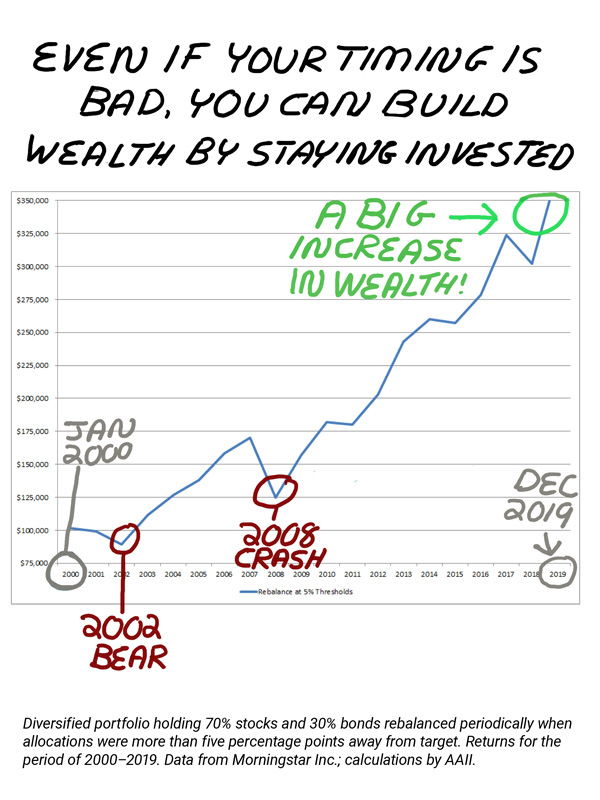
I fully realize this is often easier said than done. But we don’t know the extent to which this virus will spread, much less the extent to which the economy will be damaged. There is a big advantage to knowing the limits of your knowledge and staying within your sphere of competency. Pundits whose focus is investing and/or economics should keep this in mind before attempting to make forecasts based on COVID-19. As Warren Buffett explained in his latest letter to Berkshire Hathaway shareholders: “[Directors on corporate boards] would never have asked me for help in removing a tooth, decorating their home or improving their golf swing. Moreover, if I were ever scheduled to appear on Dancing With the Stars, I would immediately seek refuge in the Witness Protection Program. We are all duds at one thing or another. For most of us, the list is long. The important point to recognize is that if you are Bobby Fischer, you must play only chess for money.”
Given this, I’m going to stay in my proverbial box and offer suggestions on what you can do from the standpoint of investing. As you read these tips, understand that past outbreaks (SARS, MERS, Zika, etc.) only ended up having a temporary impact on the global economy.
• Stay the course. This is the biggest suggestion I can give. If you’ve set up your portfolio to reach your long-term goals, then continue to stick to your strategy. The risk of making a mistake by acting on what you think might happen is greater than the risk of what will actually happen. And if you’re now worried about being in the market at the wrong time, here’s something that might calm your nerves: Our data shows that an investor who got into the market in either January 2000 or January 2007—both terrible from the standpoint of timing—would have realized significant increases in wealth if they simply stuck with a diversified portfolio.
• Don’t sell a stock on coronavirus fears if the company’s longer-term fundamental outlook has not changed. If there is a reasonable expectation that nothing about the company has changed other than inventory and temporary demand issues stemming from the coronavirus, then don’t sell. If the virus follows the path of other more recent outbreaks and pandemics, the business disruptions should be temporary. The exceptions to this statement would be the specific and prior use of price in your strategy, meaning momentum, technical analysis and predefined stops.
• Consider doing a Roth IRA conversion while downside volatility is occurring. The IRS only cares about the dollar amount converted from a traditional IRA, a 401(k) or similar type of tax-deferred account to a Roth IRA, not the number of shares converted. So, when prices are down, you can move over more shares for the same tax impact.
• Go bargain hunting. An opportunity to open your wallet is when many other investors appear headed for the door. A lack of buyers causes prices to drop, putting stocks on sale. Patience is often required but if the business is sound and you don’t have any reason to believe that its longer-term prospects have changed, you may be able to pick up some bargains.
• Turn off the TV, stop visiting financial news websites and just breathe. If your investment horizon is not one week, one month or one year, then there is no advantage to watching the market on a minute-by-minute or day-by-day basis. Doing so may have the opposite impact by causing you to become more nervous. As long as you have cash flow needs covered—salary if working; pension, Social Security benefits, portfolio income and/or two to four years of cash savings if retired—there is no need to react to the market’s short-term moves. Rather, find something more calming to engage in. Even spending a few minutes simply focused on your breathing can help.
• Wash your hands regularly. Health officials say regularly doing so is one of the best defenses against viruses.

-
The Trinity Portfolio: Combining Diversification, Tilts and Trend-Following – With the S&P 500 now below its 200-day moving average, we’re highlighting this article from Mebane Faber that discusses how to combine buy-and-hold and trend-following approaches.
-
The Cost of Panicking – Getting out of the market due to fear over falling prices has a lasting negative impact on your wealth, as this InvestoGraphic shows.
The percentage of individual investors describing their outlook for stocks as bearish is at a four-month high. The latest AAII Sentiment Survey also shows a drop in optimism and a slight decline in neutral sentiment.
Bullish sentiment, expectations that stock prices will rise over the next six months, plunged 10.1 percentage points to 30.4%. Optimism was last lower on October 9, 2019 (20.3%). The historical average is 38.0%.
Neutral sentiment, expectations that stock prices will stay essentially unchanged over the next six months, declined by 0.3 percentage points to 30.4%. Neutral sentiment is below its historical average of 31.5% for the sixth time in seven weeks.
Bearish sentiment, expectations that stock prices will fall over the next six months, spiked 10.5 percentage points to 39.1%. Pessimism was last higher on October 9, 2019 (44.0%).
Pessimism is near the upper end of its typical range. Readings above 39.8% are unusually high (more than one standard deviation beyond the historical average).
The stock market’s steep drop to start the week combined with news of COVID-19 (coronavirus) spreading led to the shift in sentiment.
This week’s special question asked AAII members which factors are most influencing their six-month outlook for stocks. More than two out of five respondents state that the coronavirus and the market’s reaction to the outbreaks are having an impact. Other factors include the upcoming U.S. presidential election, named by 21% of respondents, and corporate earnings, named by 22% of respondents. Additionally, 15% of respondents state that consumer spending levels and other economic indicators are impacting their outlook.
Here is a sampling of the responses:
- “Political uncertainties and the coronavirus, but above all, the usual overreaction of the nervous nellies on Wall Street. The so-called ‘smart money’ is rarely smart.”
- “I think earnings will improve, economic growth will continue and interest rates will remain low.”
- “U.S. political turmoil, coronavirus and Boeing’s problems.”
- “The recent sell-off(s) on the negative COVID-19 news has been fast and furious but I think the recovery will be slower as investors continue to wonder what the real situation is.”

Bullish: 30.4%, down 10.1 points
Neutral: 30.4%, down 0.3 points
Bearish: 39.1%, up 10.5 points
Bullish: 38.5%
Neutral: 31.0%
Bearish: 30.5%
February 20, 2020 Yield's Role as a Valuation and Risk Indicator
February 13, 2020 The Value Premium’s Not Dead, but It Is Smaller
February 6, 2020 Nine Observations About Tesla’s Crazy Ride
January 30, 2020 Optimism Was Low Last Year, But Individual Investors Stayed With Stocks

Discussion
Don from Tennessee posted over 6 years ago:
Charles- Great closing line! Thanks.
You need to log in as a registered AAII user before commenting.
Create an account