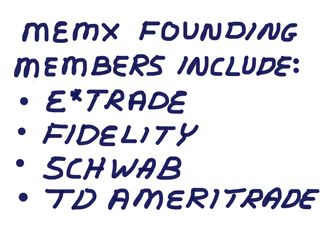
A new stock exchange was announced on Tuesday. Normally, this would not be particularly noteworthy for most individual investors. What differentiates the Members Exchange (MEMX) is who the founding members are: discount brokers Charles Schwab, E*Trade, Fidelity Investments and TD Ameritrade. Joining them are full-service brokers Bank of America Merrill Lynch, Morgan Stanley and UBS. Market makers Citadel Securities and Virtu Financial round out the group of nine.
 An application to operate as a national securities exchange will be filed with the U.S. Securities and Exchange Commission (SEC) in “early 2019.” Because of the approval process along with the various logistical, technical and compliance issues involved with launching such a venture, the exchange will not be operational this year.
MEMX will be joining an already crowded field. Once launched, it will be the 14th stock exchange. All but one is owned by Intercontinental Exchange Inc. (ICE)—the NYSE’s parent company—Nasdaq or Cboe Global Markets Inc. (CBOE), according to The Wall Street Journal. There are also other outlets for executing trades. A 2015 SEC report noted the existence of more than 40 trading venues plus more than 200 broker-dealers that fulfill client trades internally.
Many of you probably have questions about what this means for your buy and sell orders. Details are still sparse, but I’ll share what I know so far.
The exchange is being launched to reduce costs and increase transparency. The mission given by MEMX is to “increase competition, improve operational transparency, further reduce fixed costs, and simplify the execution of equity trading in the U.S.” Data costs have long been an expense for brokerage firms; MEMX’s website says the exchange will “lower pricing on market data, connectivity, and transaction fees.”
Whether these cost savings will be passed on to individual investors (e.g., through lower commissions) is unknown. MEMX will be a for-profit entity with all nine founding firms having a minority ownership stake in it.
The types of orders will be limited. A spokesperson for MEMX couldn't elaborate, but my expectation is that those used most by individual investors (such as limit orders) will be allowed.
Founding members will not be required to exclusively use MEMX. The spokesperson I talked to anticipates that the founding members will prioritize MEMX while continuing to seek out the best price for their clients. Rather than changing the existing model of orders being filled either with internal inventory or sent out to one of the existing exchanges or trading venues, MEMX will serve as another venue for fulfilling trades. (We, as individual investors, currently don’t know where our buy and sell orders are routed to for execution. I don’t expect this to change.)
MEMX will initially handle trades for U.S. stocks, but not bonds. It is unclear whether the exchange will facilitate the trading of exchange-traded funds (ETFs). Barron’s says MEMX will not seek to make money from listing public companies, like the NYSE and Nasdaq currently do.
Notably absent from the list of founding members are BlackRock and Vanguard. It is not publicly known why these two large firms are not participating. They will have the ability to direct trade orders to MEMX, as will other third parties, should they choose to do so.
Whether MEMX will have a significant impact is uncertain. IEX—the exchange featured in Michael Lewis’ “Flash Boys: A Wall Street Revolt” (W.W. Norton, 2014)—is reported to have a market share of only about 3%. A decade ago, various brokers banded together to create the alternative exchanges BATS and Direct Edge. Both ended up merging together before eventually being acquired by Cboe Global Markets, according to Reuters

- A Behind-the-Scenes Look at How Trades Are Executed – The chief market policy officer for IEX shed light on the complex structure that trades get executed through.
- How Your Buy and Sell Orders Get Filled – Chris Nagy, then with TD Ameritrade, explained what happens when you place a trade in this 2011 AAII Journal article.
- Comparing the Most Popular Online Brokers – The seven discount brokers most used by AAII members offer a comparable suite of tools and services but vary in subtle ways.
- The Position of the Individual Investor – As we celebrate the AAII Journal’s 40th anniversary, we're featuring this article, which appeared in the second issue of the AAII Journal, March–April 1979, and set the stage for AAII’s mission.
Fourth-quarter earnings season will begin to heat up, with 26 S&P 500 index companies scheduled to report. Many of these companies will be mega-cap in size, including Dow Jones industrial average components JPMorgan Chase & Co. (JPM) and UnitedHealth Group (UNH) on Tuesday, Goldman Sachs Group Inc. (GS) on Wednesday and American Express Co. (AXP) on Thursday.
The week’s first economic reports will be the December producer price index (PPI) report and the January Empire State Manufacturing Survey, both of which will be released Tuesday. Wednesday will feature the January housing market index and the Federal Reserve’s periodic Beige Book report. The January Philadelphia Fed business outlook survey will be released on Thursday. Friday will feature December industrial production and the University of Michigan’s preliminary January consumer sentiment survey.
Economic reports released by the Census Bureau may be delayed because of the ongoing government shutdown. Reports that would normally be expected next week are December retail sales, December import and export prices and November business inventories on Wednesday and December housing starts on Thursday. The Bureau of Labor Statistics (BLS) and the Energy Information Administration (EIA) are funded and open. Their reports include the PPI and weekly oil inventories, respectively.
Four Federal Reserve officials will make public appearances: Kansas City president Esther George and Dallas president Robert Kaplan on Tuesday; Minneapolis president Neel Kashkari on Tuesday and Wednesday; and New York president John Williams on Friday.
The Treasury Department will auction $13 billion of 10-year inflation-adjusted securities (TIPS) on Thursday.
- What You Need to Know About Bond Yields to Determine Your Returns
- Comparing the Most Popular Online Brokers
- Mighty Minis: Tiny Titans Stand Tall in 2018
Pessimism among individual investors, which had been holding at a high level, plunged to its lowest level in more than three months in the latest AAII Sentiment Survey. Both bullish and neutral sentiment rose strongly.
Bullish sentiment, expectations that stock prices will rise over the next six months, rose 5.4 percentage points to 38.5%. This is a nine-week high. The historical average is 38.5%.
Neutral sentiment, expectations that stock prices will stay essentially unchanged over the next six months, jumped by 8.0 percentage points to 32.2%. The increase put neutral sentiment above its historical average of 31.0% for just the second time in 10 weeks.
Bearish sentiment, expectations that stock prices will fall over the next six months, fell by 13.4 percentage points to 29.4%. Pessimism was last lower on October 3, 2018 (25.1%). The historical average is 30.5%.
The drop in pessimism ends a 13-week span of above-average readings for bearish sentiment. This was the longest consecutive-week stretch of above-average bearish sentiment readings since the 15-week period of August 30, 2012, through December 6, 2012.
A reversion to the mean occurred this week as the stock market continued to rebound over the survey period of Thursday through Wednesday. Market volatility remains on the minds of many investors, with some still anticipating larger losses. Others are focused on trade and the outcome of ongoing negotiations. Also having an influence are Washington politics (including President Trump and the change in House leadership), corporate earnings, the Federal Reserve, valuations and concerns about the pace of economic growth.
Last week’s special question asked AAII members how big of a percentage gain or loss the S&P 500 index will realize in 2019. Just under 45% of respondents expect an increase, though about half of them anticipate gains of 5% or less. Economic growth, earnings growth and the possibility of a resolution to the trade war with China were given as reasons. About 19% of respondents think stocks will fall, with a third of them anticipating losses in excess of 20%. Trade and Washington politics were given as reasons for the pessimistic outlook. Almost 13% think the stocks will end the year unchanged, with many expecting continued volatility to occur.
Here is a sampling of the responses:
- “For 2019, about 8%. Wages and salaries will be up nicely; assumes China tariff issues are resolved.”
- “Negative 20% as I expect trade issues to slow the world’s economies.”
- “I think that in 2019, the market will go up and down and will end with a single-digit loss or gain.”
- “Maybe 3% due to gridlock in Congress.”
- “5%; the downturn in December was overdone.”

Bullish: 38.5%, up 5.4 points
Neutral: 32.2%, up 8.0 points
Bearish: 29.4%, down 13.4 points
Bullish: 38.5%
Neutral: 31.0%
Bearish: 30.5%
Local Chapter Meetings

January 3, 2019 The Stretch of Low Optimism Continues
December 27, 2018 21 Investing Resolutions for 2019
December 20, 2018 One or Two Rate Hikes in 2019?
December 13, 2018 An Updated Look at the Yield Curve and Stock Market Volatility