As you have likely heard, Vanguard founder John (“Jack”) Bogle passed away yesterday. He was 89. Bogle not only founded the mutual fund giant Vanguard, but his influence on the world of investing will be felt for generations to come. This week, I’m going to share some of my thoughts and memories of him. If you had the chance to meet him, see him speak or were influenced by him, let us know. We may compile your response with those of other AAII members into a future commentary.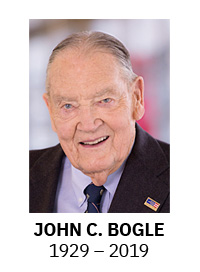
I was among those fortunate enough to have both met and talked with Bogle. Meeting him almost didn’t happen. I was invited to join Bogle for breakfast in 2010 while we were both at the CFA Institute’s Annual Conference, but I didn’t get to hear the voicemail with the invite until after the fact. A few years later, I got a second chance to meet him, this time at a Morningstar Investor Conference. We spoke for a few minutes and agreed to talk further after he finished the book he was then working on. The following spring, I interviewed him for an article in the AAII Journal.
While I didn’t know him well (my correspondence with him was infrequent, but Bogle did respond whenever I reached out to him), I had the sense that he was slowing down. For instance, he turned down an invitation to speak at our 2015 AAII Investor Conference because it meant traveling from Pennsylvania—where he lived—to Las Vegas. (He told me that “it’s just no longer on my agenda to take substantial airline trips,” but graciously recorded remarks for us to play at the conference.) Bogle suffered his first heart attack at the age of 31 and underwent a transplant at age 65.
I am one of the many people who has benefited from Bogle’s career. It’s not because I’m a long-time shareholder of the Vanguard 500 Index fund (VFIAX) and other Vanguard funds, but rather because of what he’s done for the entire investment industry. Bogle reduced costs by lowballing fund fees and then cutting them even more. He also proved how important systematic approaches to investing are. Part of the reason passive investing works so well is the limited role human decision-making has. A set list of stocks meeting specific criteria is established and the portfolio manager follows it—ignoring other influences. Low-cost, systematic approaches are hard to beat. The large number of fund managers who have been unable to beat the long-term returns of Vanguard’s index funds is proof of this.
For all of Bogle’s success, it was not always the case. He was fired. His first index fund, First Index Investment Trust (which is now the Vanguard 500 Index fund), was derided as being “un-American.” It was also referred to as “Bogle’s Folly.” In the 1970s, not many in the financial industry believed at the time that Bogle would succeed at his index investing endeavor.
Decades later, The Wall Street Journal describes Vanguard as the second-largest asset management company in the world. Some fans of Bogle refer to him as “Saint Jack.” A fan club even exists, the Bogleheads. Most exchange-traded funds (ETFs) are index funds. BlackRock, State Street and others realize a large amount of revenues from their index funds. Even Fidelity—long known for its active funds as well as active manager Peter Lynch—is in the index game, having fairly recently launched zero-expense-ratio funds.
There was more to Bogle than just Vanguard. He was married for more than 60 years. He was also charitable, helping to lead the rebuilding of the Blair Academy in New Jersey (a boarding school he attended) and helping to build the National Constitution Center in Philadelphia among other things.
One of my favorite quotes from Bogle has little to do with index investing. Rather, it has to do with advisers and is something I often refer back to when I speak to investors about working with a planner or an adviser. The comment came at the end of the interview I mentioned previously and appeared in the July 2014 AAII Journal:
I’ll close with a little story from an investment adviser I talked to some years ago, out in Milwaukee. He said, “Look, Mr. Bogle, I know you’re right. You could just stand there and do nothing, put 65% in the stock index, 35% in the bond index and never change anything. So I tell my client to do that, and he comes back a year later and says ‘What do I do now?’ and I say, ‘Nothing.’ And he comes back a year later and he says ‘I didn’t do anything last year, not one change. What do I do now?’ The answer remains, ‘Nothing. Do nothing again.’ And he comes back again a year after that, it’s now the third year, and he says, ‘What should I do now?’ I again answer, ‘Do the same thing. Nothing.’ Then the client says, ‘What do I need you for?’” The adviser asked me, “How do I answer that question?” I said, your answer is, “You need me to keep you from doing anything.”

- “Enhanced” Index Funds: Can They Beat the Market? – As indexes started to expand beyond their traditional market-cap weighting, John Bogle spoke out against them in this 2007 AAII Journal article.
- Six Questions With John Bogle – In late 2015, Bogle answered six questions about investing for us. You can read the transcript or scroll to the bottom of the article to see two videos he recorded for us.
- Steps You Can Take to Reduce the Risk of Behavioral Error – Psychologist Daniel Crosby believes combining a systematic, rules-based approach with an automated process to the extent possible is the easiest way to manage your emotions.
- Bucket Strategies Underperform Static Allocation Strategies – A study found that maintaining a fixed allocation of stocks and bills works better than bucket approaches for ensuring that retirees won’t outlive their savings.
No changes were made to the Model Shadow Stock Portfolio this month.
The Model Shadow Stock Portfolio, which is a real-money portfolio of micro-cap value stocks, fell 10.6% in December. The portfolio lagged the S&P 500 large-cap index, which fell 9.0% in December when including dividends (total return). It did, however, outperform two small-company benchmarks: The Vanguard US Small Cap fund (NAESX), which lost 11.1% on a total-return basis, and the DFA U.S. Micro Cap fund (DFSCX), which saw a total-return loss of 11.8% for December.
Since its inception in 1993, the AAII Model Shadow Stock Portfolio has a compound annual average return of 14.0% versus the Vanguard 500 Index fund’s (VFINX) gain of 8.9% per year on average over the same period. Over the same period, the Vanguard Small Cap Index fund posted an average annual gain of 9.4%.
The U.S financial markets, and our office, will be closed on Monday in observance of Martin Luther King Jr. Day.
Nearly 60 members of the S&P 500 are scheduled to report as fourth-quarter earnings season gains steam. Included in this group are Dow Jones industrial average components IBM Corp. (IBM), Johnson & Johnson (JNJ) and Travelers Companies Inc. (TRV) on Tuesday; Procter & Gamble Co. (PG) and United Technologies (UTX) on Wednesday; and Intel Corp. (INTC) on Thursday.
The week’s first economic report will be the December existing homes sales released on Tuesday. December durable goods orders and new home sales are scheduled for Friday but are likely to be delayed because the U.S. Department of Commerce remains shut down.
- The Mathematics of Retirement Portfolios
- Comparing the Most Popular Online Brokers
- Common Questions About Medicaid and Medicaid Planning
Pessimism about the short-term direction of the stock market among individual investors rebounded in the latest AAII Sentiment Survey. Both optimism and neutral sentiment fell back below their respective averages.
Bullish sentiment, expectations that stock prices will rise over the next six months, pulled back by 4.9 percentage points to 33.5%. Optimism is below its historical average of 38.5% for the 16th time in 19 weeks.
Neutral sentiment, expectations that stock prices will stay essentially unchanged over the next six months, declined by 2.0 percentage points to 30.2%. Neutral sentiment is below its historical average of 31.0% for the 10th time in 12 weeks.
Bearish sentiment, expectations that stock prices will fall over the next six months, rose 6.9 percentage points to 36.3%. Pessimism is above its historical average of 30.5% for the 17th time in 19 weeks.
At current levels, all three sentiment indicators are within their typical historical ranges.
Market volatility remains on the minds of many investors, with some still anticipating larger losses. Others are focused on trade and the outcome of ongoing negotiations. Also having an influence are Washington politics (including President Trump and the change in House leadership), corporate earnings, the Federal Reserve, valuations and concerns about the pace of economic growth.
This week’s special question asked AAII members what they thought would most influence the direction of stock prices in 2019. Nearly tied were trade (38% of all respondents) and Washington politics (37%). Responses regarding trade focused mainly on China, with some AAII members saying it depends on whether a settlement is reached. Responses regarding politics were more varied, with AAII members bringing up President Trump, the Democrats, ongoing gridlock or the current partial shutdown. Also listed as influences were the direction of corporate earnings growth (16% of all respondents), the Federal Reserve (14%) and economic growth (10%). Many respondents listed more than one potential influence.
Here is a sampling of the responses:
- “The resolution of the U.S.-China trade negotiations.”
- “China tariff issues; tensions between President Trump and Congress.”
- “Fed policy going forward.”
- “The lack of a functional government is making things much worse.”
- “The economy and company profits.”

Bullish: 33.5%, down 4.9 points
Neutral: 30.2%, down 2.0 points
Bearish: 36.3%, up 6.9 points
Bullish: 38.5%
Neutral: 31.0%
Bearish: 30.5%
Local Chapter Meetings

January 10, 2019 Brokers Announce New Stock Exchange: What We Know
January 3, 2019 The Stretch of Low Optimism Continues
December 27, 2018 21 Investing Resolutions for 2019
December 20, 2018 One or Two Rate Hikes in 2019?