

Analyzing the Metrics of Stocks Advertised on CNBC
by Charles Rotblut | October 24, 2024
Featured Tickers: AENT
CANF
LEXX
NXL
SNGX
VBNK
AENT
CANF
LEXX
NXL
SNGX
VBNK
Companies are advertising their stocks during commercial breaks on CNBC and other television networks. After seeing several such commercials on CNBC, I started noting the stocks’ ticker symbols. While it is not a comprehensive list of advertised stocks, there are enough companies to give you a sense of their metrics.
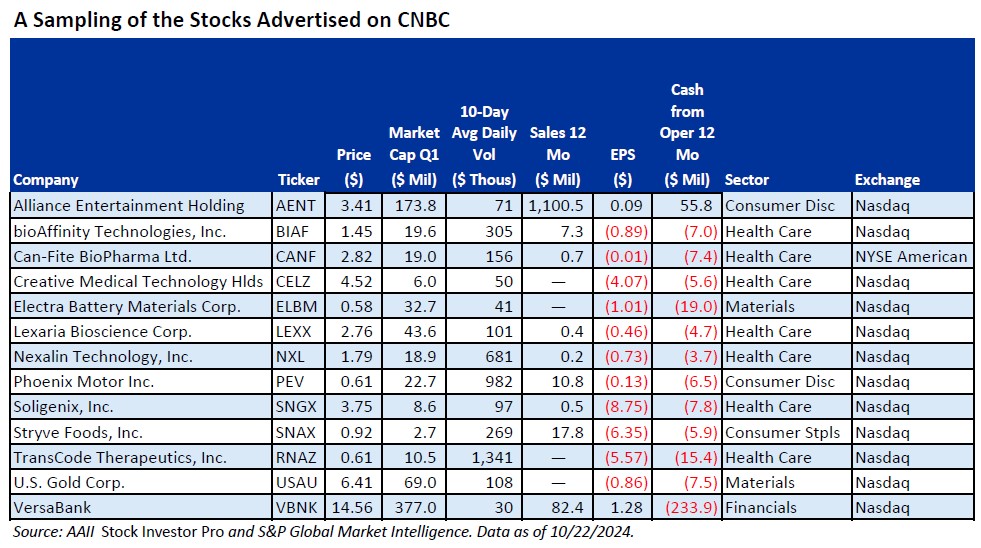
All 13 ticker symbols I wrote down are for exchange-listed stocks. All but two of those stocks trade for under $5.00 per share. Eight have market capitalizations below $30 million—the minimum required to be considered for our small-cap Model Shadow Stock Portfolio. (I’ll contrast our Shadow Stock rules with these companies momentarily.)
Four companies on the list have not realized any revenues. S&P Global Market Intelligence data shows four more as having revenues of less than $1 million for the past four reported quarters: Can-Fite BioPharma Ltd.  (CANF), Lexaria Bioscience Corp. (LEXX), Nexalin Technology Inc. (NXL) and Soligenix Inc. (SNGX).
Only two of the companies are profitable: Alliance Entertainment Holding Corp. (AENT) and VersaBank (VBNK). Only Alliance Entertainment is realizing positive cash flow from operations.
Unsurprisingly, most of these companies have been issuing shares. It is common for newer and emerging companies to raise capital by selling shares.
Though all these stocks are in the small-cap universe, they are not the type of companies that are considered for the Model Shadow Stock Portfolio. In addition to the minimum market cap size requirement of $30 million, the Model Shadow Stock Portfolio requires companies to be profitable and have price-to-book-value (P/B) ratios of 0.90 or less. The maximum market cap for being added to the portfolio is $300 million. Financial stocks—including those in the rental and leasing industry—or limited partnerships are not considered because of the portfolio’s use of the price-to-book ratio.
RedChip Companies Inc. was hired by nine of the 13 companies listed in the table to run commercials. Business Television runs ads for three of the four other stocks. Both RedChip Companies and Business Television produce television shows designed to publicize the publicly traded companies they work with in addition to producing the on-air commercials. Their shows air on Bloomberg, Fox Business and other television networks. RedChip Companies’ shows also appear on CNBC.
If you catch one of their shows, pay attention to the disclaimers. The companies being profiled likely paid for the spots.
There is nothing wrong with a company promoting itself. Companies commonly give presentations to analysts. They also interact with institutional investors.
These companies are very small and are not getting much attention. While bargains can be found in the shadows of Wall Street, the fundamentals of these companies point to a high degree of risk.

-
How Shadow Stock Metrics Have Evolved Over Time
The thresholds used to establish size and valuation limits for identifying candidates for the Model Shadow Stock Portfolio are periodically adjusted based on prevailing market conditions. -
Valuing Young Growth Companies
Valuations for growth companies with limited histories can be performed with this six-step method, but it requires making assumptions about the future. -
Finding the Right Retirement Allocation and Withdrawal Strategy
In the October 2024 AAII Journal, Christine Benz discusses using a bucket approach for income and growth in retirement while maintaining flexibility with withdrawals.
AAII Sentiment Survey
Bullish sentiment among individual investors about the short-term outlook for stocks decreased in the latest AAII Sentiment Survey. Meanwhile, both neutral sentiment and pessimism increased.
Bullish sentiment, expectations that stock prices will rise over the next six months, decreased 7.7 percentage points to 37.7%. Bullish sentiment is above its historical average of 37.5% for the 50th time in 51 weeks.
Neutral sentiment, expectations that stock prices will stay essentially unchanged over the next six months, increased 3.2 percentage points to 32.4%. Neutral sentiment is above its historical average of 31.5% for the first time in 16 weeks.
Bearish sentiment, expectations that stock prices will fall over the next six months, increased 4.5 percentage points to 29.9%. Bearish sentiment is below its historical average of 31.0% for the 10th time in 11 weeks.
The bull-bear spread (bullish minus bearish sentiment) decreased 12.3 percentage points to 7.8%. The bull-bear spread is above its historical average of 6.5% for the 24th time in 25 weeks.
This week’s special question asked AAII members what information they are particularly paying attention to as companies are reporting earnings.
Here is how they responded:
- Whether earnings were better or worse than expected: 29.1%
- Guidance on future revenues and earnings: 26.5%
- Sales and/or earnings growth: 22.8%
- Fundamentals such as the balance sheet or cash flow: 16.4%
- Other: 5.3%
Bullish: 37.7%, down 7.7 points
Neutral: 32.4%, up 3.2 points
Bearish: 29.9%, up 4.5 points
Bullish: 37.5%
Neutral: 31.5%
Bearish: 31.0%
See more Sentiment Survey results.

October 17, 2024 October Charts of Interest: Happy Second Birthday, Bull Market
October 10, 2024 The Lessons We Learned From Caregiving and Estate Settlement
October 3, 2024 Our New Data Feed and Its Impact on Your Investments
September 26, 2024 A Snapshot of Current Stock Valuations

Discussion
Barry from TX posted almost 2 years ago:
Charles, thank you for presenting yet another reason to be wary of cable television networks as sources of reliable investing information. Other ads in this same ilk are (1) Tom Selleck’s soothing voice recommending reverse mortgages for seniors; (2) William Devane’s authoritative voiceover on the benefits of buying gold and silver in a melt-up market; and, (3) the “She sitting on a gold mine” commercial promoting cashing in insurance policies for 10 cents on the Dollar. I noted that all these stocks are traded on NASDAQ. What do these examples tell investors about the quiet dangers lurking in the communication systems we welcome into our homes?
Rob from NC posted almost 2 years ago:
I echo Barry's sentiments. Thank you, Charles, for letting me know part of what I've been missing by not watching financial "news" shows. Decades ago, I made a conscious decision to ignore such shows after becoming slightly dismayed at the recommendations of Louis Rukeyser's guests. Three thoughts: (1) It's always better to think and learn for yourself than to be taught by people who do not have your best interests at heart. (2) Following the herd will not put you on the road to wealth. (3) Generally, the true value of something is inversely proportional to the degree it is advertised.
Randy from Florida posted almost 2 years ago:
CNBC is a cable channel, so its viewers have paid for this information to enter their homes.
david schneider from ca posted almost 2 years ago:
ASPI heavily advertised and then did a stock offering. getting caught up in the nuclear hype.
You need to log in as a registered AAII user before commenting.
Create an account