

An Update on Inherited Retirement Accounts and Bankruptcy Protections
by Charles Rotblut | August 05, 2021
Retirement accounts such as 401(k) plan accounts and individual retirement accounts (IRAs) generally receive bankruptcy protection. The rules for inherited retirement accounts can differ. Over the past several years, court rulings have clarified which types of inherited retirement accounts are and are not eligible for protection in the event of a bankruptcy.
In this month’s AAII Journal, we discuss the latest of these court rulings. Two months ago, a U.S. bankruptcy court judge ruled that inherited 401(k) accounts are protected from creditors. The protection for these accounts comes under the U.S. Employment Retirement Income Security Act (ERISA).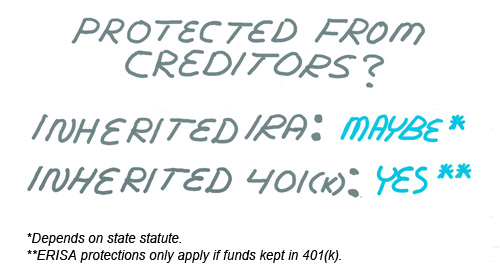
This protection only exists “so long as the funds are within the fiduciary responsibility of the plan administrator.” Once the funds are rolled over to an IRA or the beneficiary takes withdrawals, the bankruptcy protection under ERISA ends.
It’s important to contrast this with inherited IRAs. Unlike inherited 401(k) accounts, inherited IRAs are not covered by ERISA (neither are traditional or Roth IRAs). Furthermore, inherited IRAs do not receive bankruptcy protection unless state law specifically gives such protection.
The U.S. Supreme Court’s 2014 ruling in “Clark et ux v. Rameker, Trustee, et al.” defined inherited IRAs as not holding ‘retirement funds.’ Justice Sonia Sotomayor gave three specific reasons why in the court’s opinion. First, beneficiaries cannot add new dollars to save for retirement. Second, withdrawals must be taken within a certain time after inheritance has occurred. Third, beneficiaries can take withdrawals at any time and at any age without incurring a penalty.
While the three characteristics used to differentiate inherited IRAs from workplace retirement accounts (e.g., IRAs) also apply to inherited 401(k) accounts, ERISA must also be considered. ERISA affords certain protections and exemptions that non-workplace accounts such as IRAs do not receive. The presence of ERISA is one argument for not rolling over a 401(k) account to an IRA. Other factors must also be considered when deciding whether to roll over a workplace retirement account [or an inherited 401(k) account]. They include whether your (the) former employer will allow you to maintain the account, the fees charged by the 401(k) and the investment options offered through the plan. [Traditional IRAs and Roth IRAs are covered by the Bankruptcy Abuse Prevention and Consumer Protection Act of 2005 (BAPCPA); the exemption is currently $1,362,800 according to asset manager Lord Abbett.]
Some state laws do protect inherited IRAs from creditors. A 2019 U.S. bankruptcy court ruling found that Idaho state law protected inherited IRAs from creditors. In this case, the judge specifically cited Idaho’s statute as using “different language” than the federal statute.
The American College of Trust and Estate Counsel published a state-by-state summary of bankruptcy exemptions for inherited IRAs in 2018. Check with a legal professional in your state to confirm which protections are and are not provided by your state.
Trusts can provide protections that inherited IRAs may lack. There are costs for setting up a trust, and potentially some for maintaining them. Trusts have different tax rates than individual taxpayers do. Careful thought needs to be given to the selection of a trustee. Bluntly put, setting up a trust is not a simple decision and should not be made on impulse. For those leaving significant assets to their heirs or who desire to add a layer of protection against creditors (e.g., because an heir is at risk of incurring high medical bills, has an unsteady source of income, etc.), trusts can be a consideration.

- We covered the Supreme Court’s ruling that inherited IRAs are not eligible for bankruptcy protection in the Dispatches section of the July 2014 AAII Journal.
- The U.S. Bankruptcy Court ruling that state statutes can protect inherited IRAs from creditors was discussed in the Dispatches section of the 2019 AAII Journal.
- The August AAII Journal is now online. In it, you can read about the June court ruling that ERISA protection from creditors extends to inherited 401(k) accounts.
- On Wednesday, Derek Hageman unveils AAII Dividend Investing’s brand-new dividend screening tool. He will show what it can do and explain what it is designed to look for.
AAII Sentiment Survey
The percentage of individual investors describing their outlook for stocks as “neutral” plunged in the latest AAII Sentiment Survey, reversing the upward trend of the past four weeks. Pessimism rose by a similar magnitude and is now above its historical average.
Bullish sentiment, expectations that stock prices will rise over the next six months, fell 0.1 percentage points to 36.1%. This is the fourth consecutive week that optimism is below the historical average.
Neutral sentiment, expectations that stock prices will stay essentially unchanged over the next six months, dropped 7.5 percentage points to 32.2%. Even with the sizable decline, neutral sentiment remains above its historical average of 31.5% for the fifth consecutive week and the 14th time out of the past 15 weeks.
Bearish sentiment, expectations that stock prices will fall over the next six months, rose sharply by 7.6 percentage points to 31.7%. Pessimism was last higher on February 3, 2021 (35.6%). This is the second time out of the last 26 weeks that bearish sentiment is above its historical average of 30.5%.
At current levels, all three readings are within their typical historical ranges.
The return to normalcy from the coronavirus pandemic, monetary and fiscal stimulus and inflationary pressures are influencing individual investors’ outlook for stocks. Other factors include earnings, valuations and the Biden administration’s initiatives. Timing may have also played a role, as the reminder to take this week’s survey was sent out on Monday when the major indexes were declining.
In this week’s special question, we asked AAII members to share their thoughts on whether they felt the Federal Reserve should start tapering its bond purchases in the fall.
Three out of five respondents (60%) say that they believe the Federal Reserve should start tapering bond purchases in the fall. The respondents mention the threat of inflation as well as there currently being too much money supply in circulation. This compares to 25% of respondents who say that the Fed shouldn’t reduce its bond purchases, stating that the market remains uncertain and fragile due to the coronavirus pandemic and inflation is not as much of a risk as people think. About 11% of responses are uncertain or conditional, supporting the tapering of Fed bond buying if it is done a certain way.
Here is a sampling of the responses:
- “Yes. Inflation is a real problem and there is no reason for the bond purchases anymore.”
- “No, there is still too much uncertainty regarding the pandemic and its impact on the market.”
- “Yes, however, start small and gradually increase purchases.”
Bullish: 36.1%, down 0.1 points
Neutral: 32.2%, down 7.5 points
Bearish: 31.7%, up 7.6 points
Bullish: 38.0%
Neutral: 31.5%
Bearish: 30.5%
See more Sentiment Survey results.

AAII Asset Allocation Survey
Asset allocations among individual investors moved minimally last month, according to the July AAII Asset Allocation Survey. Cash holdings declined for a second month.
Stock and stock fund allocations remained relatively unchanged, decreasing by 0.1 percentage points to 71.1%. This marks the 14th consecutive month that equity allocations are above their historical average of 61.0%.
Bond and bond fund allocations grew by 0.3 percentage points to 15.0%. Even with the increase, fixed-income exposure stayed below its historical average of 16.0% for the fifth consecutive month. Fixed-income allocations were last lower in October 2018 (13.3%).
Cash allocations decreased by 0.2 percentage points to 13.9%. Cash allocations were last lower in January 2020 (13.8%). July was the 15th consecutive month that cash allocations have been below their historical average of 23.0%.
Equity allocations are at an unusually high level for the fifth consecutive month (more than one standard deviation above the historical average). The continued rebound in the stock market continues to increase the value of equities in individual investors’ portfolios relative to other assets.
- Stocks and Stock Funds: 71.1%, down 0.1 percentage points
- Bonds and Bond Funds: 15.0%, up 0.3 percentage points
- Cash: 13.9%, down 0.2 percentage points
- Stocks: 32.3%, up 0.1 percentage points
- Stocks Funds: 38.8%, down 0.2 percentage points
- Bonds: 2.6%, up 0.1 percentage points
- Bond Funds: 12.4%, up 0.3 percentage points
- Stocks/Stock Funds: 62.0%
- Bonds/Bond Funds: 16.0%
- Cash: 22.0%
Take the Asset Allocation Survey.
July 29, 2021 Making Sense of Stock Splits
July 22, 2021 The Relationship Between Brand Equity and Stock Performance
July 15, 2021 Two Measures of a Stock's Valuation
July 8, 2021 The S&P 500's Ongoing Streak

Discussion
Jim from WA posted over 5 years ago:
I really appreciate estate planning articles like this. The State by State link was especially informative and helpful.
You need to log in as a registered AAII user before commenting.
Create an account