

Making Sense of Stock Splits
by Charles Rotblut | July 29, 2021
Featured Tickers: AAPL
C
GE
NVDA
AAPL
C
GE
NVDA
On Monday, August 2, General Electric Co. (GE) will undergo a reverse stock split. Shareholders will see the number of shares they hold reduced by a margin of 1:8. Post-split, each share of General Electric will be worth the equivalent of eight pre-split shares (adjusted, of course, for changes in market value).
Last week, Nvidia Corp. (NVDA) did the opposite. Its stock split increased the number of shares by a margin of 4:1. The action made each post-split share worth the equivalent of one-quarter of a pre-split share (again, adjusted for changes in the market value of the company).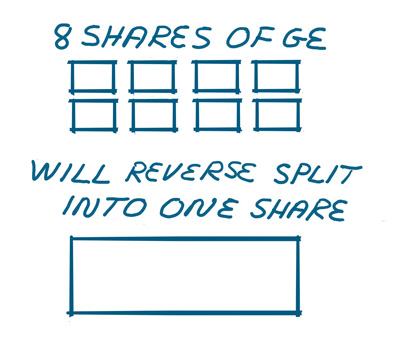
Stock splits are often misunderstood. It’s not uncommon to see a stock rise following the announcement of a split. This happens even though nothing fundamental with the company changes because of the split and each shareholder’s ownership interest will remain the same post-split. Yet because there can be reactions to splits in a stock’s price, I’m going to share the following primer on stock splits by my colleague Wayne Thorp.
Why Do Companies Engage in Stock Splits?
When a company’s share price increases to levels that it believes are too high, it may decide to do a stock split. The reason for this is that a stock split can make shares seem more affordable to small investors (even though the underlying value of the company has not changed). This also has the practical effect of increasing liquidity in the stock.
When a stock splits, it can also result in a share price increase—even though there may be a decrease immediately after the stock split. Small investors may perceive the stock as being more affordable and buy the stock. This effectively boosts demand for the stock and drives up prices.
Another possible reason for a price increase is that a stock split provides a signal to the market that the company’s share price has been increasing; people may assume this growth will continue in the future, thereby further boosting demand and prices.
Stock Split Dates
When a company announces a stock split, it gives out two dates that are important to shareholders, a record date and an ex-date. You must hold the stock at the close of business on the record date to be eligible for the split, while the actual split itself and the adjustment to the number of shares in your account take place on the ex-date.
Last year, Apple Inc. (AAPL) announced a 4-for-1 stock split. Each Apple shareholder of record at the close of business on August 24, 2020, received three additional shares for every share held on the record date (August 24), and trading began on a split-adjusted basis on August 31, 2020.
If you held shares of Apple before the market open on August 31, you owned four shares for every share you held (1 × 4.0) after the split. The stock price was reduced to one-quarter of its value at the start of trading on August 31. Apple shares closed on August 28 at $499.24 (pre-split), which translated into a split-adjusted price of $124.81 ($499.24 ÷ 4.0). On August 31, Apple shares closed at $129.04.
If you sold Apple shares after the record date (August 24) but before the open on August 31, you sold them at the pre-split price. You were not entitled to the split shares. If you bought Apple shares after the record date but before August 31, you purchased shares at the pre-split price. Following the split, you received the additional shares resulting from the stock split.
What Is a Reverse Split?
Another version of a stock split is called a reverse split. Companies with low share prices typically use this procedure to increase their prices. A company may do this if it is afraid that its shares are going to be delisted or as a way of gaining more respectability in the market. Many stock exchanges will delist stocks if they fall below a specific price per share.
For example, in a reverse 1-for-5 split, 10 million outstanding shares at $0.50 each would now become two million shares outstanding [10 million × (1 ÷ 5)] at $2.50 per share [$0.50 ÷ (1 ÷ 5)]. In both cases, the company’s market capitalization (share price multiplied by the number of shares outstanding) is $5 million.
In May 2011, Citigroup Inc. (C) reverse split its shares 1-for-10 to reduce its share volatility and discourage trading by speculators. The reverse split increased its share price from $4.52 to $45.12 post-split. Every 10 shares held by an investor were replaced with one share. While the split reduced the number of its shares outstanding from 29 billion to 2.9 billion shares, the market cap of the company stayed the same (at approximately $131 billion).
What Should Investors Do?
When it comes to stock splits, this is perhaps the most straightforward question to answer, because most of the time investors should do nothing at all.
You may want to reconsider a stock you own if it undergoes a reverse split, as it often encourages more selling after the action. But with a regular split, there isn’t much more to do besides standing pat. Historically, there is a good chance that immediately following both the announcement and the ex-date, the stock will get a small boost, so if you were thinking of selling just before an announcement, you might want to hold off a little before doing so.

- Two macro factors have been associated with the timing of stock split announcements: stock market conditions and economic conditions.
- The cost basis of a stock is adjusted when a split occurs. Brokers report the basis for stocks purchased after January 1, 2011. (See our tax guide for more information about cost basis reporting). If you want to know how the math works, I suggest reading this article on tracking cost basis from the AAII Journal archives.
- Trying to identify a stock that may potentially split is far less important than making intelligent asset allocation decisions. Here are helpful portfolio allocation tools and resources available to AAII members.
- Speaking of allocation, bond ladders and/or annuities can help generate portfolio income for retirees.
- Next week’s Individual Investor Show will discuss vice stocks, money transfer apps and more. Be sure to tune in.
AAII Sentiment Survey
The percentage of individual investors describing their short-term outlook for stocks as “neutral” reached its highest level in nearly 19 months. The latest AAII Sentiment Survey also shows a rebound in optimism and a drop in bearish sentiment.
Bullish sentiment, expectations that stock prices will rise over the next six months, rose 5.5 percentage points to 36.2%. This is the third consecutive week that optimism is below the historical average of 38.5%.
Neutral sentiment, expectations that stock prices will stay essentially unchanged over the next six months, rose 1.0 percentage points to 39.7%. Neutral sentiment was last higher on January 1, 2020 (40.9%). Neutral sentiment is above its historical average of 31.5% for the 13th time in 14 weeks.
Bearish sentiment, expectations that stock prices will fall over the next six months, sharply declined by 6.5 percentage points to 24.1%. This is the 32nd time out of the past 37 weeks that pessimism is below its historical average of 30.5%.
Neutral sentiment is now at the top of its typical historical range. The breakpoint between typical and unusually high readings is 39.8% (or one standard deviation above the historical average).
The return to normalcy from the pandemic as well as the emergence of the delta variant of the coronavirus, monetary and fiscal stimulus and inflationary pressures are influencing individual investors’ outlook for stocks. Other factors include Washington politics, interest rates, valuations and earnings.
For this week’s special question, we asked AAII members to share their thoughts on whether they feel that the coronavirus delta variant is a risk to the economy.
A little under half of all respondents (45%) say that they view the delta variant as an economic risk. The respondents cite the increased transmissibility of the virus and inferred that it may cause more shutdowns, which would in turn slow the economy. This compares to 30% of respondents who say that the new variant is not a risk to the economy because the government is now experienced in dealing with the coronavirus and more people have been vaccinated. About 12% of responses cite the variant as a small risk, mainly to unvaccinated populations. About 7% of respondents have a neutral stance on the delta variant.
Here is a sampling of the responses:
- “Yes, the delta variant is significantly more transmissible than the original version and, while those who are fully vaccinated are generally not affected by it, there are still significant numbers of unvaccinated people who can be negatively affected. As the number of cases rise, more and more economic shutdowns will occur.”
- “No, I expect the American people and/or economy will be able to cope with this variant to minimize any further disruption.”
- “Yes, slightly. It may depress the rate of recovery, but I don’t think it’ll cause another recession. Many people have already been vaccinated and there are additional people who are either resistant or have had the virus.”
- “Unknown at this time. Hopefully as more of the populace becomes vaccinated the threat of variants will fade.”
Bullish: 36.2%, up 5.5 points
Neutral: 39.7%, up 1.0 points
Bearish: 24.1%, down 6.5 points
Bullish: 38.0%
Neutral: 31.5%
Bearish: 30.5%
See more Sentiment Survey results.

July 22, 2021 The Relationship Between Brand Equity and Stock Performance
July 15, 2021 Two Measures of a Stock's Valuation
July 8, 2021 The S&P 500's Ongoing Streak
July 1, 2021 How We Pick Benchmarks for AAII Model Portfolios

Discussion
No comments have been added yet. Add your thoughts to the discussion!
You need to log in as a registered AAII user before commenting.
Create an account