

How Often Should You Look at Your Portfolio?
by Charles Rotblut | September 16, 2021
A special note: Registration for our virtual Investor Conference 360 is now open. This will be an interactive experience you can enjoy from the comfort of your home. The conference will run from September 30 through October 1. To learn more about it, including our great keynote speakers, please visit https://conference.aaii.com. I hope you join us; it’s going to be fun and informative.
Driving home on Tuesday, I heard a newscaster mention how the major stock indexes were all down month to date. My initial reaction was, “So what? The markets are still very close to their highs.”
But there was a bigger reason for my reaction: The information just didn’t matter. Stocks, and the indexes they constitute, fluctuate. Some days they are up. Other days they aren’t. The day-to-day moves have no bearing on my long-term portfolio decisions. 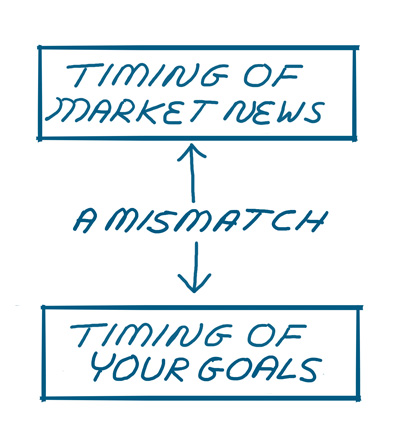
What’s conveyed by the media and the various outlets for investing content does raise a question: How often should you look at your portfolio? The frequency is less than the headlines, soundbites and tweets we’re all subject to would otherwise suggest.
At a high level, there are two parts to portfolio monitoring: the allocation followed and the investments held. Our PRISM Wealth-Building Process calls for basing your allocation on your goals and tolerance for risk. Monitoring the investments held should be in accordance with your buy and sell rules.
For a long-term goal (saving for retirement) or for a goal with a long spending duration (taking withdrawals once in retirement), significant allocations to equities are required. Maintaining a steady allocation to equities allows the portfolio to benefit from the power of compounding. In such situations, the daily or monthly moves in the markets don’t matter much. In fact, they can be a dangerous distraction—especially if they prompt you to abandon your allocation strategy and lose the long-term benefit of compounded returns.
Allocations do evolve over time. Left unchecked, the weighting of the best-performing asset class will move the portfolio off-kilter. So, this aspect of the portfolio does need to be checked. Once every six or 12 months is often enough. When doing so, allow some room for drift. Allocations are never stable, and too-frequent rebalancing will result in unnecessary transaction costs. Plus, you want to give your winners some room to run. Bands of five to 10 percentage points can also be used (e.g., a 5% band would mean not rebalancing the stock allocation back to, say, 60% until it accounts for more than 65% or less than 55% of the total portfolio).
The frequency of monitoring individual investments depends on what they are and your rules.
Mutual funds can be checked once a quarter, semiannually or even annually. The same applies to exchange-traded funds (ETFs) unless you are using a shorter-term trading strategy. For the most part, you want to ensure there isn’t a move of an unusual magnitude relative to the fund’s peers. Once a year, compare longer-term returns and the expense ratio to the mutual fund’s or ETF’s peers to make sure they are still reasonable. Check the prospectus annually as well to ensure the objective has not changed.
Individual bonds intended to be held to maturity can be checked semiannually when interest payments are due. In doing so, look to see if there is any reason to believe the issuer’s credit quality is deteriorating.
How often to check your stocks depends on your strategy. Fundamental data points—including growth rates, margins and leverage ratios—are updated quarterly. Valuation ratios tend to evolve over time and can be checked monthly unless there is a significant price move. News can be monitored weekly or less frequently. Even relative strength indicators, which measure momentum, can be tracked weekly.
For all types of investments, give thought to what information you are looking at. The more you can view the portfolio through the lens of your strategy as opposed to news and scuttlebutt about what is happening in the market, the better your decisions will be.
How often do you look at your portfolio? Tell us in the comments section below.

- Julie Jason’s suggestions for how to perform a portfolio review in this 2010 AAII Journal article remain valid today.
- A checklist is a helpful tool when monitoring a portfolio. Here is value investor Guy Spier’s checklist.
- Even in the current low-interest-rate environment, bonds and cash-like investments can play an important role in your portfolio as I explain in the current issue of the AAII Journal.
- Our Level3 Passive Portfolio is an example of a portfolio that can be maintained with only periodic monitoring required.
- On Wednesday, we’ll be previewing our upcoming virtual AAII Investor Conference 360. We’ll explain what to expect, give some insider tips for getting the most out of the conference, share insights from our speakers and more.
AAII Sentiment Survey
The results from the latest AAII Sentiment Survey show a major decrease in bullish sentiment, conveying lower optimism among investors that the current bull market will continue. In addition, the number of investors who describe their outlook for stocks as “neutral” increased.
Bullish sentiment, expectations that stock prices will rise over the next six months, dropped 16.4 percentage points to 22.4%. This is the lowest level of bullish sentiment since July 29, 2020, over one year ago. Optimism is well below the historical average low of 28.0% (one standard deviation below the historical average of 38.0%).
Neutral sentiment, expectations that stock prices will stay essentially unchanged over the next six months, rose 4.4 percentage points to 38.3%. This is the second consecutive week that neutral sentiment is above the historical average of 31.5%.
Bearish sentiment, expectations that stock prices will fall over the next six months, rose by 12.1 percentage points to 39.3%. This is the seventh time out of the last nine weeks that pessimism is above the historical average of 30.5%.
At current levels, optimism is unusually low. Neutral and bearish sentiment are near the top end of their typical historical ranges.
The return to normalcy from the coronavirus pandemic, monetary and fiscal stimulus and inflationary pressures are influencing individual investors’ outlook for stocks. Other factors include earnings, valuations and the Biden administration’s initiatives.
In this week’s special question, we asked AAII members to share their thoughts about the impact that supply shortages are having on their outlook for stocks.
We received over 100 responses, of which 32% of respondents say that they feel the supply shortage could have a negative impact, predicting a decrease in sales and lackluster earnings. This compares to 31% of respondents who say that it is having little to no impact. About 19% of respondents express a mixed outlook on the impact of supply shortages, implying it could help some industries but hurt others. Conversely, 10% of respondents have positive sentiments regarding supply shortages, citing recovery. About 7% of responses fell into the “other” category.
Here is a sampling of the responses:
- “Sales are going to be limited this year and earnings per share (EPS) will fall dramatically.”
- “Not much. I think low interest rates and strong earnings will fuel a continued bullish outlook for stocks. I do expect a correction during this time frame with a quick reversal.”
- “Transportation companies will continue to increase profits, but car companies will continue to struggle with higher costs and lower profits with reduced sales volume.”
- “Bullish. Gives pricing power to companies to raise prices.”
Bullish: 22.4%, down 16.4 points
Neutral: 38.3%, up 4.4 points
Bearish: 39.3%, up 12.1 points
Bullish: 38.0%
Neutral: 31.5%
Bearish: 30.5%
See more Sentiment Survey results.

September 9, 2021 Low Share Prices Do Not Imply a Low Valuation
September 2, 2021 The Advantages of Stock Screening
August 26, 2021 Put an Asterisk by Those Second-Quarter Results
August 19, 2021 Why Not Having to Trade Is a Big Advantage

Discussion
Donald Myers from Arizoma posted over 5 years ago:
Not to disagree with anything you said about how often to look at my portfolio but I think the question is really much deeper than implied. First of all there is the question of why one would look at their portfolio, i.e. are they only monitoring it or are they contemplating an action? Neither I nor my wife is a trader so looking at our porfolio(s) is seldom related to an action. We both have Schwab One accounts which include check writing so regular perusing our cash positions is important. Our Fidelity IRA's are set to monthly RMD payouts (covered by automatic proportional selling as well as automatic re-investment of dividends). Both Schwab and Fidelity provide a number of tools for monitoring the performance of our accounts (only mutual funds, no ETF's or stock shares). I use QCD's from my IRA so it is important to monitor the processing of those payments. Looking back a month, two months, six months, a year or two years is helpful to interpret the daily flucuations in account balances (and avoid panic selling or buying). The daily flucuations in the DOW, NASDAQ, S & P 500 provides a broad picture but sometimes is mis-leading when looking at account balances (even or especially when the account is diversified. The problem is not often one looks at a portfolio but rather whether one is tempted to try and "time the market. Does the frequency at which one looks at their portfolio related to how well they sleep at night? For some people the answer might be yes in which case the advice to look less frequently is good. Does looking at your portfolio require time that you might well spend doing something else (chatting with your spouse or children or friends, reading the newspaper, reading a book, listening to music, going to the gym, maybe even working, etc).. There is no simple answer
Don Schmidt from ND posted over 5 years ago:
I update my portfolio spreadsheet when I get the monthly statements from Edward Jones. I own two stocks on my own. I update those in my spreadsheet on Fridays after market close. I am of the RMD age so I plan to use the fund with the lowest return to make up the difference between the cash in my IRAs and the RMD.I have set my accounts to pay dividends in cash instead of reinvesting to minimize adjusting my portfolio to get cash for the RMD. After I get my October statements, I plan to continue moving some holdings to Roth and return the conversions to reinvestment of dividends. My spreadsheet is one I developed from an article in AAII in 1991 that adjusts the return to reflect additions or subtractions from the holdings in my portfolio.
Rob Fates from California posted over 5 years ago:
I monitor my portfolio daily. I own 20 stocks and reinvest dividends, so I want to check that dividends are collected and reinvested. I rarely make additions or sales, unless a stock has risen significantly beyond my 5% ceiling, and then it depends on whether I want to let a winner run. In a way, market dips provide faster compounding and lowering my cost basis. Plus, investing is fun and an intellectual escape from more mundane pursuits.
You need to log in as a registered AAII user before commenting.
Create an account