

Low Share Prices Do Not Imply a Low Valuation
by Charles Rotblut | September 09, 2021
Featured Tickers: BB
SEB
BB
SEB
A special note: We’ve opened registration for our first-ever Investor Conference 360. This will be an interactive experience you can enjoy from the comfort of your home. The conference will run from September 30 through October 1. To learn more about it, including our great keynote speakers, please visit https://conference.aaii.com. I hope you join us; it’s going to be fun and informative.
The phenomenon of “meme” stocks largely involved stocks trading at low share prices. Though this was not universally the case, some meme stocks could have been purchased for less than you would spend on a pumpkin spice latte at Starbucks.
Price is not value. Price is what you pay. Value is what you get. Or, as my colleague Wayne Thorp put it, price is arbitrary while value is fundamental.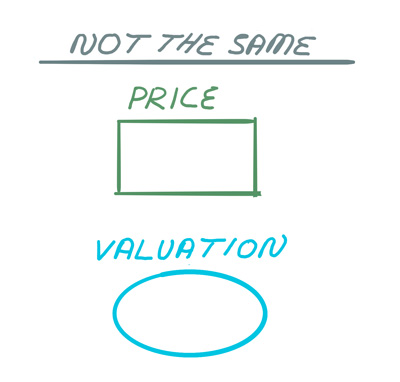
The key for investors is to determine whether a difference between a stock’s price and its value exists. The goal is to pay less for a stock than another investor can reasonably be expected to pay for the same stock in the future. A stock’s price alone will not convey this information. Its valuation can shed light on such information.
To help explain the difference, I’m going to use a comparison Wayne wrote earlier this year:
The price of a stock is determined by a number of factors, many of which are driven by human characteristics and emotions such as fear and greed. In addition, market tendencies and events can and do affect the price of a stock. However, rarely do these factors significantly affect the value of stocks.
Factors that can influence stock prices include:
- Investor demand
- Broad market trends
- Media and analyst reports
- Economic factors
- Company news, such as earnings reports, financial issues, etc.
A company derives its value from fundamental factors including:
- Earnings
- Market share
- Sales volume over time
- Valuation metrics such as the price-earnings (P/E) ratio
- Competitors
In short, a company’s stock price, especially in the short term, is primarily driven by external factors, while fundamental factors such as profit margins or earnings are long-term drivers of a company’s “true” value.
Notice that there is more to a stock’s value than just its valuation metrics. A stock can have a low valuation ratio because it isn’t a good company. Therefore, value investors frequently seek out additional traits to ensure that the stock is a bargain. Quality is a key companion trait to seek out because it suggests that the market is unfairly pricing a profitable entity too low.
Consider Seaboard Corp. (SEB). It has one of the highest share prices of any stock in our Stock Investor Pro database. Shares of Seaboard closed today at a price of $4,052.26. Yet, this agribusiness and transportation stock has a low valuation, as is evident by its A+ Investor Value Grade of A. Lending support to the idea that this stock could be potentially undervalued is the A+ Investor Quality Grade of B.
In contrast, meme stock BlackBerry Ltd. (BB) closed today at $10.73. While one could buy nearly 380 shares of BlackBerry for the price of just one share of Seaboard, the valuations are far different. Shares of BlackBerry have an A+ Investor Value Grade of D. This suggests the stock is expensive despite its low share price. The high valuation is not supported by the stock’s underlying fundamentals either, as its A+ Investor Quality Grade is a very average C.

- The A+ Value Grade ranks stocks on a range from deep value to ultra expensive. It is based on up to six valuation metrics.
- Many stocks with low share prices appear on AAII’s O’Shaughnessy Tiny Titans Screen. The screen seeks out micro-cap stocks with low price-to-sales ratios and strong price momentum.
- The Mutual Fund and ETF First Cuts featured in this month’s AAII Journal identify outperforming small-cap funds.
- Also in this month’s AAII Journal, AAII president John Bajkowski looks at the pandemic’s effect on Shadow Stocks.
- Be sure to tune into our latest Individual Investor Show. On Wednesday, September 15, we’ll be discussing small-cap funds, Roth IRA conversions and more.
AAII Sentiment Survey
The results from the latest AAII Sentiment Survey show a jump in neutral sentiment. In addition, both optimism and pessimism declined.
Bullish sentiment, expectations that stock prices will rise over the next six months, fell 4.5 percentage points to 38.9%. Even with the decline, this is the third consecutive week that optimism is above its historical average of 38.0%.
Neutral sentiment, expectations that stock prices will stay essentially unchanged over the next six months, sharply rose by 10.7 percentage points to 33.9%. This is a six-week high. Neutral sentiment is above its historical average of 31.5% for the 17th time in 20 weeks.
Bearish sentiment, expectations that stock prices will fall over the next six months, declined by 6.1 percentage points to 27.2%. This is the first time in six weeks that bearish sentiment is below its historical average of 30.5%.
At current levels, all three readings are within their typical historical ranges.
The return to normalcy from the coronavirus pandemic, monetary and fiscal stimulus and inflationary pressures are influencing individual investors’ outlook for stocks. Other factors include earnings, valuations and the Biden administration’s initiatives.
In this week’s special question, we asked AAII members to share their thoughts about the level of optimism being reflected in the stock market.
Nearly three out of 10 respondents (29%) say that they feel optimism is too high and express concerns of a potential bubble bursting soon. An additional 22% say that they are more cautious. Their reasons include a belief that the market is optimistic without any viable reason and they have expectations for an impending correction. An additional 20% of respondents express negative sentiment regarding market optimism.
Conversely, 20% of respondents express a positive outlook on market optimism.
Here is a sampling of the responses:
- “I believe it is too high, but we are in uncharted territory with the entry of so many individual investors. I’m not sure if history has any relevance, with this new group participating that has so little experience and knowledge as well as many barriers to investing.”
- “The bull market may continue for the rest of the year. I believe we are overdue for a correction in 2022.”
- “I think there is some optimism in the market, but not to euphoric levels. So, there is probably more room to run up.”
- “Inflation is not going away as the Federal Reserve presumes, so the market will pull back.”
- “Strong economy but high valuations and several potential risks = neutral.”
Bullish: 38.9%, down 4.5 points
Neutral: 33.9%, up 10.7 points
Bearish: 27.2%, down 6.1 points
Bullish: 38.0%
Neutral: 31.5%
Bearish: 30.5%
See more Sentiment Survey results.

September 2, 2021 The Advantages of Stock Screening
August 26, 2021 Put an Asterisk by Those Second-Quarter Results
August 19, 2021 Why Not Having to Trade Is a Big Advantage
August 12, 2021 The Key Pillars of Good Dividend Stocks

Discussion
No comments have been added yet. Add your thoughts to the discussion!
You need to log in as a registered AAII user before commenting.
Create an account