

Run Your Own Race: Investing as Marathon Training
by Charles Rotblut | November 11, 2021
This past Saturday, I completed a marathon for the first time. Specifically, I ran the CNO Financial Group Indianapolis Monumental Marathon.
As I was training for the event—long runs provide plenty of time to think, especially at my pace—some of the similarities between prepping for a marathon and investing became apparent. While both are very different activities, the framework for how one approaches either is not.
The goal of a marathon is to run 26.2 miles. The race date is the time for when the goal will be reached. The duration of the goal is dependent on how fast you expect to run. A common maximum time limit for marathons is six hours, though some have more generous cutoffs. Most marathon training programs call for four to six months of preparation. The cost is the entry fee plus any associated travel and, obviously, gear (running shoes, hydration packs, etc.). These parameters drive all other decisions.
The investing equivalent would be a goal with an estimated time for being reached, an estimated spending duration and an estimated cost. Establish these parameters and all your other decisions will be easier.
Running a marathon requires a certain of level of physical health. I personally sought medical approval from my orthopedic surgeon (who is also a runner) before starting my marathon training because I severely fractured my arm in April. I started training by walking (my arm wasn’t too keen about running at first) and very gradually introduced running into my workouts. As a percentage of pre-race training time and mileage, it’s a good bet that my allocation to walking was at the high end of the nearly 4,000 people who also finished the full marathon.
What everyone else was doing had no bearing on me. The same applies to investing. Just because your relative, neighbor or friend can withstand a lot of portfolio volatility doesn’t mean you can. Your investing time frames, willingness to cope with downturns and dependence on portfolio withdrawals may be very different than those of everyone else. The allocation strategy you can stick with is always better than the one you can’t.
How I trained was also a personal decision. I opted for the marathon training program included in The New York Times’ “How to Start Running” guide (with a few small modifications). It fit my time frame of 20 weeks well enough and was appropriate for where I was at as a runner. It was also a program I could follow without having to adjust my work schedule. The guide listed the mileage for each run, but I chose what each workout was like (lots of intervals in my case).
An investing analogy is whether one handpicks securities, uses mutual funds and exchange-traded funds (ETFs) or works with a financial planner or adviser. An individual investor may prefer control over selecting their own securities. Some individual investors prefer mutual funds or ETFs. Others work with financial planners or advisers. It’s a matter of personal preference and constraints.
Selecting investments—be it stocks, bonds, mutual funds or ETFs—requires due diligence, discipline and a repeatable process. While running does not require digging through financial statements or prospectuses, having a defined repeatable process makes a huge difference. I monitored my heart rate and always made sure I stayed hydrated and ate during longer runs. (I’m not sure I want to know how many Clif Bars I’ve eaten over the past few months.) I also had a preset structure for each workout.
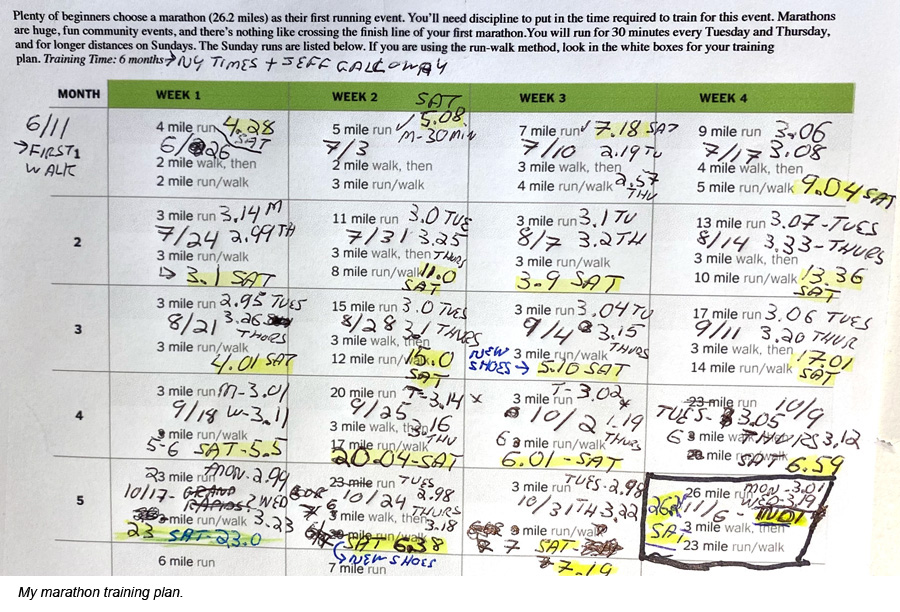
There is also, of course, monitoring. This is a key part of any goals-driven process. I constantly wrote on the training plan to track my progress as you can see here. I was also very conscious about listening to my body and making adjustments as necessary (more cross-training for my hips and more stretching of my IT bands). For investing, it’s about making sure your allocation stays close enough to your target at the portfolio level and ensuring that none of your investments are meeting your sell rules. Monitoring also involves knowing when you are offtrack from achieving your running or investing goals and being prepared to make adjustments as necessary—adjustments that may require making changes to your goals.
If I were to sum up everything into a few words of advice, it would be: Have a written plan, follow it and run your own race. How the thousands of people who were with me at the starting line on Saturday morning were going to run the marathon had no bearing on me. I ran the race in the manner I had trained myself to do. I took confidence in knowing that I was disciplined and followed a good plan. Investing is no different. Your goals, tolerance for risk, preferences and investing style are personal. Build a plan based on them, follow the plan, invest in a manner that is right for you and take confidence in doing so.

- Prioritizing financial goals is the subject of the new video and lesson we just added to the PRISM Academy.
- In the latest AAII Journal, I give tips for monitoring your portfolio for progress toward your goals and changes in your life.
- Not having a disciplined investing plan can be harmful. An analysis found that Robinhood users who chased the most-traded stocks on the platform underperformed.
- We’ll be hosting two webinars next week. I’ll be answering member questions live about our PRISM Wealth-Building Process on Monday. Then on Wednesday, Derek Hageman will share dividend warning signs you should watch out for.
AAII Sentiment Survey
The results from the latest AAII Sentiment Survey show bullish sentiment rising right to the edge of its typical historical range. In addition, the percentage of investors who describe their outlook for stocks as “neutral” or “bearish” both declined.
Bullish sentiment, expectations that stock prices will rise over the next six months, rose 6.5 percentage points to 48.0%. Optimism was last higher on July 1, 2021 (48.6%). This is the fourth consecutive week that bullish sentiment is above its historical average of 38.0%.
Neutral sentiment, expectations that stock prices will stay essentially unchanged over the next six months, fell by 4.5 percentage points to 28.0%. This is the fourth week time in the last five weeks that neutral sentiment is below the historical average of 31.5%.
Bearish sentiment, expectations that stock prices will fall over the next six months, decreased by 2.0 percentage points to 24.0%. This week marks the fourth consecutive week that bearish sentiment is below the historical average of 30.5%.
Bullish sentiment is now just 0.1 percentage points away from the breakpoint between typical and unusually high readings of 48.1%. Historically, unusually high levels of optimism have been followed by below-average and below-median six-month returns for the S&P 500 index.
The increase in optimism follows the unusually long streak of consecutive up days for the S&P 500 and the Nasdaq composite. Also influencing individual investors’ outlook for stocks is the continued return to normalcy from the coronavirus pandemic, monetary and fiscal stimulus and inflationary pressures. Other factors include earnings, valuations and the Biden administration’s initiatives.
In this week’s special question, we asked AAII members to share what they think about the Federal Reserve’s intention to start tapering its bond purchases.
Slightly more than half of respondents (52%) say that the Fed was smart in terms of its timing for tapering. Many respondents believe the reduction in bond purchases will help the economy. Conversely, 33% of respondents have a more negative outlook on the taper, expressing that the Fed waited too long to take action. Moreover, about 8% of respondents are neutral, feeling undecided or unphased by the taper and its impacts.
Here is a sampling of the responses:
- “I believe it is the right decision. The time has come to transition from stimulative monetary policy to a fiscal policy that bears most of the burden for the promotion of prosperity.”
- “I feel the tapering of bond purchases by the Fed is long overdue. The coronavirus crisis is over, and the economy is doing well. The markets need to get back to normal.”
- “It is what it is. As investors, we will deal with whatever the outcome is. For those of us doing buy and hold, the decision is interesting and aimed at reducing inflation.”
Bullish: 48.0%, up 6.5 points
Neutral: 28.0%, down 4.5 points
Bearish: 24.0%, down 2.0 points
Bullish: 38.0%
Neutral: 31.5%
Bearish: 30.5%
See more Sentiment Survey results.

November 4, 2021 Portfolio Reviews Can Often Lead to Doing Nothing
October 28, 2021 Small-Cap Stocks Are Cheap Relative to Large-Cap Stocks
October 21, 2021 Don't Judge a Bitcoin ETF by Its Name
October 14, 2021 Two New AAII Member Benefits

Discussion
William Eelkema from Montana posted over 4 years ago:
Your finishing time?
Rich from NY posted over 4 years ago:
Congrats on finishing a marathon! Same question—finishing time?
Charles Rotblut from Illinois posted over 4 years ago:
Thanks! My time was 5:22. While certainly not fast by marathon standards, it was faster than I expected.
Charles Rotblut from Illinois posted over 4 years ago:
Thanks! My time was 5:22. Though certainly not fast, it was faster than I expected.
Richard from Colorado posted over 4 years ago:
Congratulations on finishing. That is a HUGH accomplishment. I’m not a runner but my two boys were and they were so pleased after their first marathon. And, by the way, you analogies are great!
Bill Clendenen from Oregon posted over 4 years ago:
Congratulations Charles, and thanks for helping us all successfully compete in our own financial marathons!
Dave Gartland from New Jersey posted over 4 years ago:
Congratulations Charles! I completed my first of four consecutive NYC marathon in 1981. The significance of that feat was I could not run non-stop for one mile in 7th grade gym class, and failed physical fitness tests throughout my school years. However, what my marathon achievement taught me was the power of goal setting. I have used goal setting in all aspects of my life, financially, professionally and personally. The latest goal I set after being laid off from my job in 2020 was to get my motorcycle to start, which had not run for 34 years because my wife hates motorcycles. After working on this for the entire summer, on October 27, 2021 I got it to run. Goals have saved my life. I hope your readers will apply goal setting to live the life they want.
Charles Rotblut from Illinois posted over 4 years ago:
Thank you, everyone! Dave, that is a great story. I hope you have some great--and safe--rides on that motorcycle.
JoeC from MA posted over 4 years ago:
Thanks for this nice comparison between running and investing. Makes sense and makes me miss the days when I used to be able to run. Do it while you can too, is something I'd add. As you get older, you might not be able to run, but you can still invest.
peter from ny posted over 4 years ago:
Congratulations. one step forward is closer to our goals, that's sure for running. in investing, sometimes I need to stand still, or step back a few times, and patiently wait for the best possible oppotunities to make an investment decision. the most difficult part is the training, preparations, studies, reading, et al, i.e. the process of investing. "due diligence, discipline, and a repeatable and productive process" would be paid off sooner or later, even if I will never reach the end line. thank you, AAII
peter from ny posted over 4 years ago:
at certain times, the best investment in no investment.
You need to log in as a registered AAII user before commenting.
Create an account