

Seeking a Truly Active Fund Is Not Enough
by Charles Rotblut | March 24, 2022
Featured Tickers: DHAMX
VFIAX
DHAMX
VFIAX
Investors buying actively managed funds should seek out those with truly active managers. When active management is combined with skill, there is a greater likelihood of outperformance. The question is whether there is enough skill to overcome the dual challenges of efficient markets and higher fees.
A new study published in the Financial Analysts Journal (FAJ) supports the notion of seeking truly active managers. Its authors found that separate accounts with high levels of “active share” were more likely to have persistent outperformance. Separate accounts share similarities to mutual funds but are privately run and customized. Still, the findings have implications for mutual fund investors as well as exchange-traded fund (ETF) investors.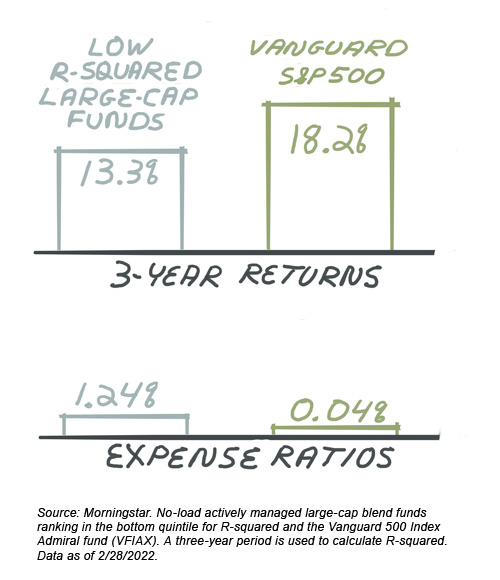
Active share is a measure that compares the weight of a stock within a portfolio to its weight within a benchmark index. A separate account or fund directly tracking a benchmark index, such as the S&P 500 index, would have no active share. A separate account or fund that holds no stocks within the index would have an extremely high active share level. The lower the level of active share, the closer the portfolio is to the index. Hence, the nickname for such actively managed funds and their managers is “closet indexer.”
We at AAII use R-squared to analyze how actively managed a fund is. R-squared indicates the percentage of a fund’s movement that can be explained by movements in the S&P 500. The lower the R-squared value is, the more a portfolio’s return can be explained by other factors.
With either measure, a manager with both skill and signs of being truly active should be preferred when considering an actively managed mutual fund, ETF or separate account. Otherwise, you will likely incur higher costs.
Having a comparatively high active share or a low R-squared is not enough. As the authors of the FAJ study wrote, “active share does not measure manager skill, but rather the extent to which managers apply whatever skill they have.” A fund or a separate account can have a portfolio that is truly active (high active share or low R-squared for its category) and underperform its peers at the same time. A truly active approach combined with better-than-peer returns and a low expense ratio is what investors should seek out.
Therein lies the problem. It’s not easy to do with mutual funds. When I looked at the returns of no-load, large-cap blend funds, only one with a low R-squared value beat the Vanguard 500 Index Admiral fund  (VFIAX) on a one-, three- and five-year basis. The fund is Centre American Select Equity Investor (DHAMX). Its R-squared value is 75%. (The highest value is 100%. For purposes of disclosure, I own shares of the Vanguard 500 Index Admiral fund.)
Why haven’t other the low R-squared large-cap blend funds consistently beat the S&P 500? Cost is a big issue. The median expense ratio of these funds (defined as having R-squared values ranking in the lowest 20% of the group) was 1.24%. Vanguard 500 Index Admiral’s expense ratio is 0.04%. The median fund in this group has to outperform the Vanguard index fund by 1.2 percentage points each year just to break even in terms of returns after fees.
The types of stocks these funds are targeting is another reason. To the extent that the market is efficient (meaning stock prices reflect all known information), it is most efficient in the large-cap arena. These stocks are held by more investors, are covered by more analysts and are discussed in the media far more than their smaller peers. Therein lies the skill component. To outperform, a large-cap manager must have a very high level of skill.
A fund manager’s skill is more likely to be apparent in less-efficiently priced stocks, like small-cap stocks. Lesser attention creates more opportunities to succeed by being different than the index. Again, following a purely active strategy is not enough. In addition to skill, a fund’s expense ratio must be low enough to not offset any advantage the manager may have.

- Using R-squared to measure the skills of a fund manager was the topic of this April 2015 AAII Journal article.
- Speaking of funds, we discuss the benefits and risks of intermediate-term bond funds in the current issue of the AAII Journal.
- When looking at bonds, the aftertax yield matters if you are holding individual bonds or bond funds in a taxable account. Learn how to calculate it.
- I’ll give suggestions for how to pick stocks, funds and bonds in a live webinar on Thursday.
- There over 5,000 U.S. exchange-listed stocks, so how do you narrow down that list? Consider how your risk tolerance, allocation and investment management preferences play a role in which stocks you should focus on. Complete Lesson 5 of “S” in the PRISM Academy.
“What small-cap growth strategies like the O’Shaughnessy Small Cap Growth & Value Screen do you continue to follow?”
Click here and then choose the Join Community button on the right to answer this question or read other responses.
AAII Sentiment Survey
The results from the latest AAII Sentiment Survey show both bullish and neutral sentiment rising. In addition, the number of investors describing their outlook for stocks as “bearish” decreased.
Bullish sentiment, expectations that stock prices will rise over the next six months, sharply rose by 10.3 percentage points to 32.8%. Optimism was last at this level on January 6, 2022. Even with the big jump, bullish sentiment remains below its historical average of 38.0% for the 18th consecutive week.
Neutral sentiment, expectations that stock prices will stay essentially unchanged over the next six months, increased by 4.0 percentage points to 31.7%. This is the first time in five weeks that neutral sentiment is above its historical average of 31.5%.
Bearish sentiment, expectations that stock prices will fall over the next six months, plunged 14.3 percentage points to 35.4%. Pessimism was last lower on January 6, 2022 (33.3%). This is bearish sentiment’s 18th consecutive week above the historical average of 30.5%.
Bullish sentiment, bearish sentiment and the bull-bear spread (bullish minus bearish sentiment) are all now back within their typical historical ranges.
The ongoing invasion of Ukraine by Russia, stock market volatility, inflation, interest rates, the coronavirus pandemic and politics are all influencing individual investors’ outlook for stocks. Other factors include the economy and corporate earnings.
In this week’s special question, we asked AAII members to share their thoughts on the Federal Reserve’s first interest rate increase since 2018, and how that informed their outlook for stocks.
Almost one-third of respondents (32%) say that they have a neutral outlook regarding stocks. Many anticipate or expect the Fed to increase interest rates. A bearish outlook was cited by 21% of respondents. These respondents think the economy may be heading for a recession and that the recent interest rate increase will not be enough to get inflation under control. In contrast, approximately 20% of respondents are bullish about stocks, with many saying that the rate hike indicates the economy is in a strong place. Finally, around 20% of respondents cite a mixed outlook. Respondents in this category see both the positives and negatives relating to the interest rate increases.
Here is a sampling of the responses:
- “It does not influence my outlook, since it has been anticipated for a few months and is just the first step in a lengthy process.”
- “Until the Fed gets serious about stopping inflation, the economy and the market will suffer.”
- “Seems like not enough to tackle the inflation but may turn out to be okay after six or seven hikes, especially if oil prices come down and the pandemic turns into an endemic.”
- “Positive, probably too little too late but it didn’t spook the market, so I have to say it was about right.”
Bullish: 32.8%, up 10.3 points
Neutral: 31.7%, up 4.0 points
Bearish: 35.4%, down 14.3 points
Bullish: 38.0%
Neutral: 31.5%
Bearish: 30.5%
See more Sentiment Survey results.

March 17, 2022 A Useful and Free Resource for Viewing Economic Trends
March 10, 2022 Key Considerations When Adding Commodities to Your Portfolio
March 3, 2022 Warren Buffett's Comments on Allocation
February 24, 2022 Stock Market Returns Following Military Conflicts

Discussion
Rob from NC posted over 4 years ago:
I think it's a lot easier to pick a good individual company than a good fund manager. Within the fund universe, one can outperform the market without seeking active management. Some low-expense-ratio domestic equity index ETFs such as VGT, FTEC, and SCHG have substantially outperformed the overall market over the past 3, 5, and 10 years.
Mike from Michigan posted over 4 years ago:
Does AAII provide R squared values for mutual funds?
Barry J from TX posted over 4 years ago:
Persistence is the problem -- for all the reasons stated. Every homage to a "great" fund manager is reported ex post facto, by definition. The research articles cited in this article point to short-term runs for funds that outperform the market. The annual AAII MF and ETF lists support this theory; the leaders change each year and the 3-year, 5-year and 10-year rankings change every cycle. The most recent example is Cathy Wood of ARK Invest funds which are down >30% and are may well be among the first cadre of victims with any market correction. After the recent February correction, I am seeing more technical analyses that point to the inverted USTs/UST10 yield and UST3/UST5 curves as indicators of a market cycle peak. The time to "buy on the dip" into ARK funds (which are based on innovation over the long term) may come soon. Just guessing.
You need to log in as a registered AAII user before commenting.
Create an account