

Warren Buffett's Comments on Allocation
by Charles Rotblut | March 03, 2022
Longtime readers of my weekly commentary will know that among the small collection of things I consider must-reads for investors is Warren Buffett’s annual letter to Berkshire Hathaway shareholders. Even if you are not a Berkshire Hathaway shareholder, like I am, there are more than enough good insights to learn from it.
In this year’s letter, Buffett brought up the topic of allocation. Specifically, he discussed the role of holding cash and cash equivalents (aka safe assets). Berkshire Hathaway holds a large amount of them. The corporation’s year-end balance sheet includes $144 billion of cash and cash equivalents. Most of this sum, $120 billion, is allocated to U.S. Treasury bills. These bills have maturity dates of less than one year.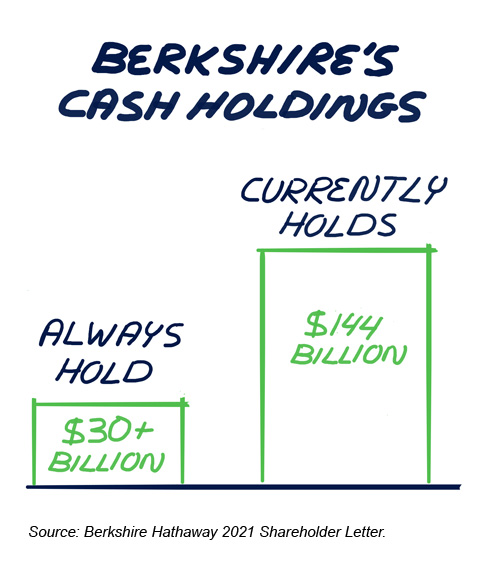
If we exclude the $30 billion that Buffett and co-chairman Charlie Munger “have pledged” to “always hold,” this still leaves Berkshire Hathaway with $114 billion to spend. It is enough money to acquire one of more than 400 companies currently part of the S&P 500 index and still leave Buffett and Munger with money to spend.
Buffett says he has maintained a target of holding “at least 80% of my net worth in equities” since making his first investment in 1942. His “favored status” has been and “still is” 100% to equities. Berkshire Hathaway’s current buildup of cash “is a consequence of my failure to find entire companies or small portions thereof (that is, marketable stocks) which meet our criteria for long-term holding,” explained Buffett.
Take note of his reasoning. It is a tactical decision by Buffett and Munger to keep an unusually large allocation to safe assets while waiting for investment opportunities to appear. The duo has enjoyed far more success than most professional and individual investors when it comes to investing. Buffett and Munger certainly have not been flawless—and Buffett regularly brings up the fact that he has made mistakes—but their long-term record is extraordinary.
Plus, Berkshire Hathaway’s time horizon extends into perpetuity. This is different than an individual investor, who has a finite life-span and personal goals, such as having enough wealth to live comfortably in retirement. Even if one’s goal is to leave a financial legacy to their family, heirs will also face finite life-spans and goals with definitive dates.
Another thing separating Buffett from many other investors is psychology. Buffett has been able to maintain a high allocation to equities because he is unfazed by market volatility. It is a wonderful trait to have as an investor. Moreover, Buffett and Munger have shown a willingness in the past to open their wallets when they see an opportunity to do so. (Though, there has been criticism in recent years about the two being too cautious.)
When you step back, there is one more aspect of Buffett’s allocation worth paying attention to: the requirement to always maintain a buffer composed of safe assets. As noted above, Buffett and Munger have a minimum target of $30 billion in cash and cash equivalents. The rationale, as Buffett explained in this year’s shareholder letter (and shared in previous shareholder letters), is: “We want your company to be financially impregnable and never dependent on the kindness of strangers (or even that of friends). Both of us like to sleep soundly, and we want our creditors, insurance claimants and you to do so as well.”
Even the Aggressive Investor AAII allocation model calls for a 10% allocation to bonds (though Treasury bills, money market accounts, etc., can be substituted). The role of such an allocation is to provide a buffer against having to sell stocks during a significant market downturn. How large your allocation should be to assets with comparatively low to virtually no price volatility depends on your withdrawal needs and non-portfolio sources of cash flow. An investor who is in their early-to-mid career years can maintain a full allocation to equities within their retirement portfolios. This is contingent on having the psychological ability to withstand volatility and maintaining adequate emergency savings. Those nearing or in retirement will need a larger buffer to avoid having to sell stocks during a downturn to fund withdrawals.
The exact amount allocated to this buffer will vary by near-retiree/retiree. AAII founder James Cloonan suggested holding the equivalent of two to four years of living expenses in safe assets. If you have a pension, annuities, a reverse mortgage or some other source of guaranteed income you can tap, then there is less of a need to hold a sizable sum of dollars to safe assets.

- AAII president John Bajkowski discussed Cloonan’s suggestion for keeping an allocation to safe assets as part of the Level3 withdrawal strategy in this 2019 AAII Journal article.
- The March AAII Journal is now online!
- In the latest AAII Journal, we show you how much the futures markets were expecting the Federal Reserve to raise rates this year and where to find the current expectations.
- On her My Investing Discoveries blog, assistant editor Anine Sus writes about building a budget that doesn’t leave you broke.
- My colleagues and I will discuss how to invest amid all of the ongoing uncertainty—including Russia’s attack on Ukraine, rising inflation and market volatility—in a special live webinar on March 16. Bring your questions and join us.
- Welcome to the first lesson of Step 4, “S” in the PRISM Academy, Selecting and Managing Your Investments. Use your wealth-building plan to select investments appropriate for your portfolio.
“I am wondering what investors are buying since fixed-income yields are so low. Do high quality equities with nice dividends make a viable alternative?”
Click here and then choose the Join the Community button on the right to answer this question and read other responses.
AAII Sentiment Survey
The results from the latest AAII Sentiment Survey saw bullish sentiment rebounding for the second consecutive week. Neutral sentiment also rebounded, while bearish sentiment significantly decreased.
Bullish sentiment, expectations that stock prices will rise over the next six months, jumped 7.0 percentage points to 30.4%. Optimism was last higher on January 6, 2022 (32.8%). Even with the rise, bullish sentiment remains below its historical average of 38.0% for the 15th consecutive week.
Neutral sentiment, expectations that stock prices will stay essentially unchanged over the next six months, increased by 5.2 percentage points to 28.2%. This is the second consecutive week that neutral sentiment is below its historical average of 31.5%.
Bearish sentiment, expectations that stock prices will fall over the next six months plunged 12.2 percentage points to 41.4%. Even with the steep drop, pessimism is still above its historical average of 30.5% for the 15th consecutive week.
Bullish sentiment is back within its typical range for the first time in eight weeks. Pessimism, however, remains unusually high for the third consecutive week. Historically, unusually high bearish sentiment readings have been followed by above-average and above-median six-month returns in the S&P 500 index.
The ongoing invasion of Ukraine by Russia, inflation, interest rates, the coronavirus pandemic and politics are all influencing individual investors’ outlook for stocks. Other factors include the economy and corporate earnings. The ongoing volatility in the stock market is likely also playing a role.
In this week’s special question, we asked AAII members how oil prices are impacting their outlook for stocks. Slightly more than one-third of respondents (34%) say that they have a bearish outlook on stocks due to the rising oil prices.
Conversely, 26% of respondents say that oil prices are having little to no impact on their outlook. Approximately, 19% view the rise in oil prices as a buying opportunity for stocks, particularly those in the energy sector. Roughly 14% of respondents have a mixed outlook.
Here is a sampling of the responses:
- “Higher oil prices are usually bad for stocks.”
- “No impact; prices go up, prices go down. If the war in Ukraine continues, then the price will go up, but the war will influence my outlook, not the price of oil.”
- “All things delivered, all things made with chemicals, all transportation, food bills and utility bills are going to continue to increase. Anything that reduces costs for any of these items may be a good investment.”
- “I am not sure that oil prices will have the biggest effect on stocks. I think the Russian invasion of Ukraine will have a bigger effect, although the two are tied together.”
Bullish: 30.4%, up 7.0 points
Neutral: 28.2%, up 5.2 points
Bearish: 41.4%, down 12.2 points
Bullish: 38.0%
Neutral: 31.5%
Bearish: 30.5%
See more Sentiment Survey results.

AAII Asset Allocation Survey
Equity allocations among individual investors fell to their lowest level in a year. Stock allocations specifically declined to a level not seen since February 2021. Meanwhile, cash allocations rose for the third consecutive month.
Stock and stock fund allocations decreased by 1.1 percentage points to 68.5% in February. Equity exposure was last lower in February 2021 (67.7%). Nonetheless, last month was the 21st consecutive month that AAII members’ exposure to equities was above the historical average of 61.0%.
Bond and bond fund allocations rose by 0.4 percentage points to 14.7%. Allocations were last higher in October 2021 at 15.1%. Even with the increase, fixed-income exposure was below its historical average of 16.0% for the 12th consecutive month.
Cash allocations increased by 0.6 percentage points to 16.7%. They were last higher in November 2020 (18.4%). February was the 22nd consecutive month that cash allocations have been below their historical average of 23.0%.
Though equity allocations pulled back, they have only declined into the upper end of the typical historical range. The breakpoint point between typical and unusually high equity allocations is 69.0%.
Stocks have not seen a fruitful 2022 so far, with multiple issues in supply chains, inflation, interest rates and now conflict in Ukraine. The major stock indexes reached their lowest levels in 2022 late in February.
Optimism among individual investors about the short-term direction of the stock market fell to its 29th lowest level in the history of the AAII Sentiment Survey in mid-February. Last week, pessimism reached its highest level in nearly nine years. Nonetheless, low yields, expectations for the Federal Reserve to raise interest rates and a long-term approach to investing by AAII members are keeping equity allocations at above-average levels.
- Stocks and Stock Funds: 68.5%, down 1.1 percentage points
- Bonds and Bond Funds: 14.7%, up 0.5 percentage points
- Cash: 16.7%, up 0.6 percentage points
- Stocks: 30.8%, down 2.0 percentage points
- Stocks Funds: 37.7%, up 0.9 percentage points
- Bonds: 2.2%, down 0.0 percentage points
- Bond Funds: 12.6%, up 0.5 percentage points
- Stocks/Stock Funds: 62.0%
- Bonds/Bond Funds: 16.0%
- Cash: 22.0%
Take the Asset Allocation Survey.
February 24, 2022 Stock Market Returns Following Military Conflicts
February 17, 2022 The Small-Cap Premium Is Below Its Historical Median
February 10, 2022 Time to Embrace Instead of Abandon Value?
February 3, 2022 A Sign of Light for Value Investors

Discussion
Barry J from TX posted over 4 years ago:
I always enjoy reading about the investing Buffett and Munger's "psychology." As noted, they are not like us when it comes to the amount of cash they keep on hand. Having $30B cash on hand sounds like a lot, but $30B was 3% of 2021 operating costs. That $30B would cover about 11 days of costs and expenses (page K-72). That ratio is a sizeable difference from the recommended 3 to 6 months (90 to 180 days) of living expenses recommend for us IIs. Although you may have credit scores over 825 and over $5M in assets, for example, large corporations and wealthy folks have a huge advantage in access to cheaper money. When you read advice from people with lots of money, always remember, they are no like us. They experience the world differently. To paraphrase the opening sentences in "Anna Karinina", Rich folks are all wealthy. Poor folks are poor each in their own way.
Kirk S from PA posted over 4 years ago:
Berkshire's approach to investing in companies, as opposed to investing in stocks, forces each investor to learn the fundamentals of basic accounting, finance, and business model core to any investment. It should be the core to any MBA investment course syllabus in the education process and is the one best way to long-term success. Just like the rich and poor, they either win or are forced to learn.
Rob from NC posted over 4 years ago:
I’m glad to see that Warren Buffett approves of my 100% allocation to equities. But I have a bone to pick with Mr. Rotblut’s statement that “Those nearing or in retirement will need a larger buffer to avoid having to sell stocks during a downturn to fund withdrawals.” I learned a hard lesson back in 2012, when I sold off enough stock to fund a year’s worth of expenses. The stocks I had sold increased by about 150% over the following year. I will never do that again. I now sell only when necessary to fund the next month’s expenses (that is, when dividends and other sources of cash are insufficient). Pick any period you want, from one day to one year. For that given period, the stock market is more likely to increase than it is to decline, and the probability of an increase multiplied by the average increase is greater than the probability of a decline multiplied by the average decline. To restate it simply, you are more likely to win than lose in any given period. That does not mean you will win in every period; just that you will win more often than you lose. It’s like playing blackjack in Vegas except that you get to be the house. The odds are in your favor if you stay invested in the stock market in any given period. By selling only to fund the next month’s expenses, I am simply dollar-cost averaging in reverse. I am not a fan of dollar-cost averaging when buying because it is beneficial only in a declining market. If the market goes up, the equities you are buying are getting more and more expensive. But selling is different. Selling into an increasing market, as opposed to selling a lump sum up front, is beneficial to the seller. So what happens if the market crashes? Well, yeah, I’ll have to take my lumps, but since I’m carrying a very large chunk of unrealized long-term capital gains, I have a long way to fall before getting to a net loss. Also, to the extent I have underperformers among my holdings, I can reduce (or, if the market falls enough, eliminate) capital gains taxes if I sell them. If selling my assets becomes too painful, I will do what any rational person would do -- reduce my expenses. In short, I do not need a buffer against having to sell stocks during a downturn.
Vijay from NC posted over 4 years ago:
Thanks Charles. Excellent insight. I reviewed the letter with a deep comb. Unable to upload here. But if anyone is interested, I unearthed atleast 25 lessons from the Legend. Here is the link https://drive.google.com/file/d/1y5aTBBRPFDyxcphnyGGL6uM-v8ut5sE2/view?usp=sharing. What I enjoyed is Warren talked Trust, loyalty, empathy on the softer side and the section on Share Repurchase is "pure gold". Thank you.
Michael from Ohio posted over 4 years ago:
I find it interesting that a 100% stock portfolio which would carry an annual standard deviation of 16% + would be advisable in retirement FOR A WITHDRAWAL PORTFOLIO. Even Buffett doesn't do this with company money. The issue is risk measured by standard deviation. If you average 8-10% per year with 100% equities taking a 16% std dev risk (long term historical average) and a third std dev event happens, the 5% per year you thought you were going to take out is suddenly not sustainable. Say you a have a portfolio of $1.0 mil and that third std deviation event happens, you will take a hit of -38% (3 minus 16's off your average of say 10%). So now you're at $620,000 but need to withdraw $50,000 or 8% per year off your new number. It will take a 61% pop to get you back to your 1 million and that doesn't consider the $50k you need to withdraw for living expenses. You will never make it back. I think we have all been lulled to sleep by the market since 2008-09 and by the Fed papering over all our problems. We have experienced one bad event in March 2020 and that was so short lived it's like it almost didn't happen. As famous value investor Bill Smead says "Fear Stock Market Failure"! Mix in some liquid alternatives (I don't like a lot bonds now for all the obvious reasons) like arbitrage, market neutral, managed futures, gold, and commodities. If you are aggressive by all means keep a lot stocks around-but keep a couple years worth of cash for withdrawal needs and mix in bonds and alternatives. The game in retirement moves from average annual returns to dollar weighted or geometric returns taking into account risk in a withdrawal portfolio. Happy Investing Friends!
Rob from NC posted over 4 years ago:
"I always kept at least 80% of my net worth in equities. My favored status throughout that period was 100% – and still is." -- Warren Buffett. Michael, the key is margin for error. If, when you retire, you absolutely must have 5% of your net worth to live on for the following year and the same amount or more for each year thereafter, then I'd agree you're running a big risk with a 100%-equity portfolio. But I'd also say that you're running a big risk no matter what the composition of your portfolio. In other words, in my humble opinion, you simply would not have enough money to retire. One element of my 100%-equity plan is to avoid having a lot of fixed expenses. I've lived in my current house for over 20 years, and my monthly mortgage payment is now less than the rent on a one-bedroom apartment. Other than property taxes and insurance, my mortgage is my only fixed expense; I have no other debts. (Well, I do have a gym membership that I'd be loath to give up.) My fixed expenses are covered several times over by dividends alone. Although everyone has other "necessaries," one can find ways to reduce costs for most of them. I can stay home instead of travel. I can buy groceries instead of eating out. I can put off remodeling the house until the market improves. I've had the same attitude toward such things throughout my life, so nothing has changed since I retired about 10 years ago. If we have an 80% drop in the market, I will not be happy, but I will survive. And I will recover with the market because I'll simply tighten my belt instead of selling off assets.
Michael from Ohio posted over 4 years ago:
I would agree Rob that if you only need 1-2% or less per year (really anything under 3%) you're not nearly as concerned about vol as the retiree who needs the typical 4-6%. I have a similar situation as you as far as fixed expenses for retirement: no debt and low basic needs. However my goals do not include passing on as much wealth as possible to the next gen or charity so we choose to live our lives up to that 3-4% per year by making home upgrades, lifetime gifts and travel. All these discretionary items can be reduced quickly. But again if you are looking at trying to get the best returns, mixing in alternatives like commodities will actually get you HIGHER returns than 100% stock. It's all about geometric returns not average annual returns. But, hey, let's the two of us agree that we are lucky guys to be discussing things like this rather than the average US retiree who hasn't much income or options over their monthly social security check or down in the subway in Ukraine waiting out the latest bombing. Right?
Rob from NC posted over 4 years ago:
No question, Michael, we are very fortunate guys to live in this country, to live in this time, and to have learned to handle money prudently enough to have this level of freedom and financial security.
You need to log in as a registered AAII user before commenting.
Create an account